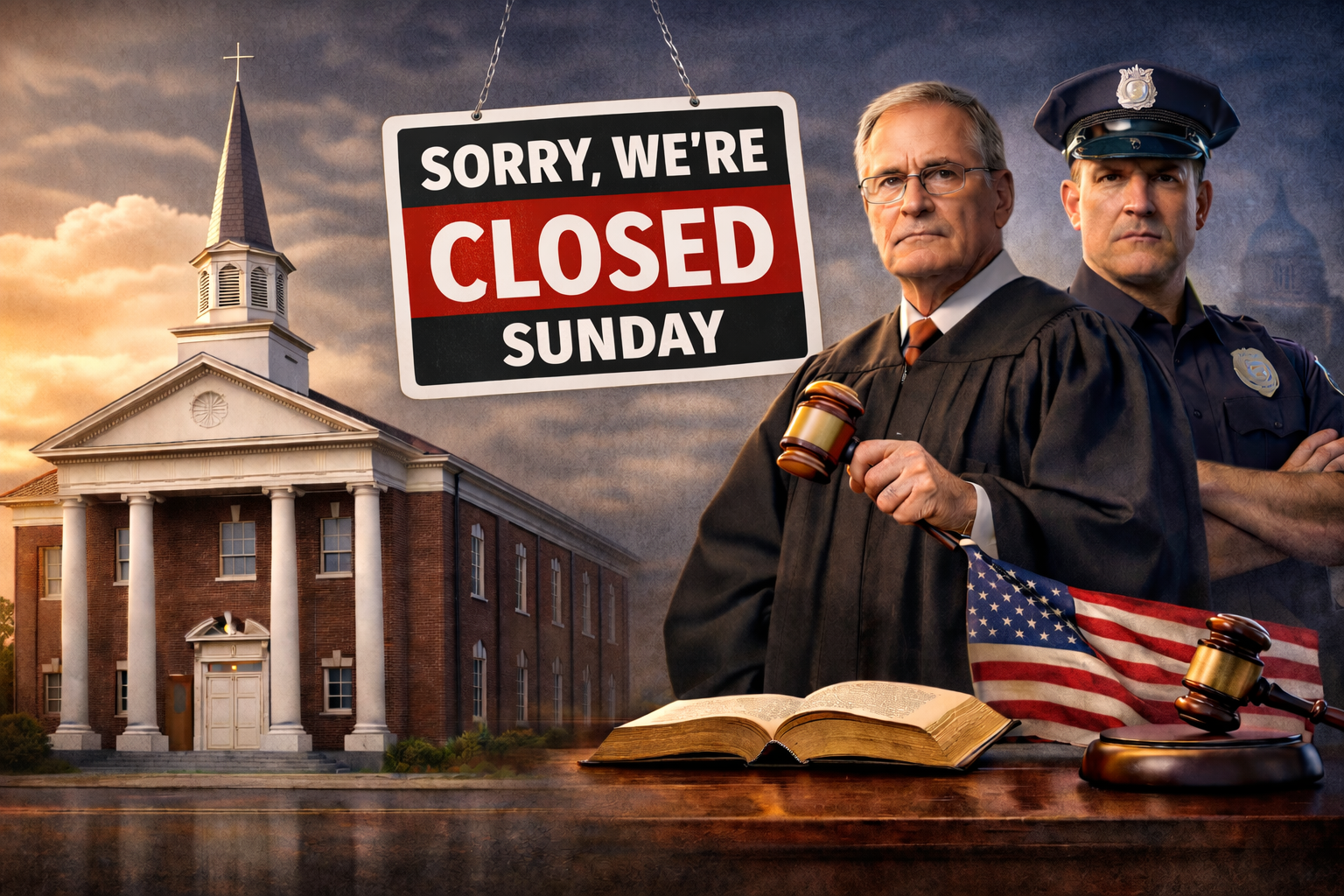
Stephen Wolfe, PhD, is a Presbyterian scholar and author of the book “The Case for Christian Nationalism,” who writes on Reformed Protestant political theory. On February 27, 2026, Wolfe announced the publication of a new study he co-authored with two Presbyterian pastors and encouraged that it be shared among members of the clergy. He stated that the central thesis of the new study is that “civil government must promote true religion.” [1] The 210-page work, titled “Recovering the Politics of the Classical Protestant Tradition,” is available online. [2] In it, the authors are not casually reminiscing about Sunday rest legislation—they are making a sustained, principled argument that civil enforcement of Sunday laws is not only legitimate but also absolutely necessary in a Christian nation.
After many months of work, Zach Garris (@ZacharyGarris), Sean McGowan (@irishpresby), and I present to you our Study Report on Reformed Christian politics.
Our main thesis: Civil government must promote true religion.
Read and share with friends and pastors. Link below. pic.twitter.com/YMRabJFXZP
— Stephen Wolfe (@PerfInjust) February 27, 2026
Below are excerpts from the document, and you will see how the authors describe Sabbath laws as a “moral necessity” and argue that magistrates are duty-bound to promote “true religion” within their objective limits. Importantly, they reject the idea that society must first experience widespread spiritual revival before enacting Christian civil laws, such as Sunday closing laws. In their view, law shapes outward behavior regardless of inward regeneration, and a majority vote—whether from nominal or devout Christians—is sufficient to justify and uphold enforcement. This position removes one of the primary barriers often raised—that revival must precede legislation of Christian moral standards—and, instead, clears the path for immediate political action.
The document supports its claims by appealing to the Westminster Larger Catechism, the Westminster Confession, and American Presbyterian precedent, arguing that enforcing Sabbath observance falls within the magistrate’s responsibility under the Fourth Commandment. By claiming that refusal to support Sabbath laws is “out-of-step” with the entire Reformed tradition, the authors present dissent or opposition to Sunday laws not as a minor disagreement but as a departure from long-established historic Christian orthodoxy. Taken together, these statements demonstrate that they are not merely defending the theoretical possibility of Sunday legislation; rather, they are constructing a theological, historical, and legal case that civil enforcement of the Sabbath is proper—and even expected—in a Christian state today. Furthermore, they argue that failure to uphold Sunday laws constitutes an act of “tyranny” and would justify “rebellion” against civil leaders.
The study titled Recovering the Politics of the Classical Protestant Tradition makes the following statements:
• Pages 5-6: “Civil action is good and proper only if it achieves or contributes to a good end within its objective limitations. However, the magistrate must promote true religion in some way, even if circumstances significantly constrain him. Some civil acts are ordinarily necessary, in our view, such as Sabbath laws, not because they are absolute duties of magistrates per the genus of action, but because they are, ordinarily, moral necessities—i.e., per species, they are prudentially always necessary and proper. Furthermore, failing to act prudently is, itself, immoral.” [3]
• Pages 38-39: “Many today claim that they desire a ‘Christian nation’ but want to wait upon revival to enact Christian laws. These laws would arise organically from regenerate hearts rather than be imposed upon an unwilling populace. To be sure, politics is the art of the possible, and some conditions render Christian laws ineffectual and impossible to enforce, even if they can be enacted. But we must recognize that law enforces outward behavior, and the possibility of effective law requires not true faith but majority assent and compliance. Nominal Christianity may be sufficient for the effective enforcement of Christian civil laws, such as Sunday Sabbath laws, if the people assent to Christianity. So, while revival is a possible antecedent to Christian laws and is preferred, it is not the only antecedent condition. The only fundamental requirement for enacting a good law is effectuality, which, for a Christian law, is feasible with a mixture of nominal and faithful Christians. Therefore, there is no need to wait upon revival and to reduce Christian political action to Gospel preaching.” [3]
• Page 74: “This civil Sabbath, this cessation from worldly business, is what the civil government in Christian countries is called upon to enforce. Not only, he argued, is Sabbath-practice ‘the right of Christians’ and ‘the command of God,’ but ‘the civil Sabbath is necessary for the preservation of our free institutions, and of the good order of society.’ Morality is dependent on religion, and thus a day must be set aside for instruction—indeed, ‘If the Sabbath, therefore, be abolished, the fountain of life for the people will be sealed.’ Hodge even went so far as to say that should government ‘disregard’ the Sabbath day and direct courts and legislative bodies to ‘be open on the Lord’s Day, and public business be transacted as on other days, it would be an act of tyranny, which would justify rebellion’.” [3]
• Page 94: “American Presbyterians, both individually and in the courts of the church, advocated for civil sanctions against violations of the first table of God’s law, particularly the Sabbath and occasionally blasphemy. Even the Virginians, who arguably were the least inclined to favor a distinctly Christian state, recognized the importance of Sabbath laws for a society. And while some, like Dabney might have argued for Sabbath laws without religious reasons, it is difficult to make a case for civil legislation favoring a Sunday Sabbath without invoking Christianity.” [3]
• Page 95: “The state was ‘not competent to decide between religions or to ordain anything as law directly on the ground that revealed religion requires it.’ But the civil government may still make laws that reflect the majority religion and the interests of a people, including Sabbath laws, and by doing so, the state acts by general revelation. Out of ‘necessity,’ writes Robinson, ‘American law must recognize the fact that Protestant Christianity is the religion of the people because that law is the reflection of the will of the people’.” [3]
• Page 102: “And the Fourth Commandment, according to the Larger Catechism, requires the magistrate to enforce Sabbath laws (WLC 118, 124). As WLC 118 states, ‘The charge of keeping the sabbath is more specially directed to governors of families and other superiors, because they are bound not only to keep it themselves, but to see that it be observed by all those that are under their charge; and because they are prone oft-times to hinder them by employments of their own’.” [3]
• Page 173: “The Westminster Confession teaches that civil government should enforce laws related to the First Table. This was also the conclusion of VanDrunen’s mentor, Meredith Kline. As shown above, the Westminster Standards particularly expect the magistrate to enforce Sabbath laws, but also to remove ‘monuments of idolatry.’ The Reformed orthodox and Westminster Divines supported Sabbath laws, but so did eighteenth and nineteenth century American Presbyterians.” [3]
• Page 173: “The refusal to support Sabbath laws is out-of-step with the entire Reformed tradition, including even the American Presbyterians who embraced the modified Westminster Confession.” [3]
This Presbyterian study, along with other Christian nationalists like the ones at The Heritage Foundation, is not just talking theory or looking back at church history for academic interest. They are serious about bringing Sunday laws back into public life. They believe the government has a responsibility to promote Christianity and to enforce Sunday observance, and they do not think the country needs to experience a spiritual revival first before passing such laws. In their view, if enough people agree—even backslidden nominal Christians—that is reason enough to move forward. This shows that their goal is real political action aimed at reshaping society according to their understanding of Christian principles.
“Sunday observance shall be enforced by law, and the world shall be enlightened concerning the obligation of the true Sabbath.” (Great Controversy, p. 449).
Sources
[1] https://x.com/PerfInjust/status/2027376422398853127
[2] https://www.reformedchristianpolitics.org/
[3] https://www.reformedchristianpolitics.org/_files/ugd/e554b2_fcbf0b0df2854a948f1a8d44c3acea7f.pdf
 0
0 0
0 0
0
There is nothing good, righteous, or moral that results from forcing relationships.
Forced marriages or forced intimacy is never good, no matter how much righteous reasons or intentions may fuel it.
So like with Christ Jesus; appealing to the government to enforcing the “uniform day of rest” is not just forced worship, but forced relationship.
Even before God destroyed the Antediluvian world by flood, He never forced them to worship Him. They had freedoms and the liberty to serve whomever they chose. God never attempted to force them.
God’s solution was to send a faithful servant Noah to preach to them warning them of impending judgement if they do not repent from their evil ways.
This a solution God consistently used throughout history and now even in our time. God wants us to be faithful to Him by faithfulness to His Word.
Christian – means followers of Christ because He is our Creator and Redeemer, our Lord and God. He’s even Lord of the Sabbath(7th day):
“7 But if ye had known what this meaneth, I will have mercy, and not sacrifice, ye would not have condemned the guiltless.
8 For the Son of man is Lord even of the sabbath day. ”
Matthew 12:7-8 KJV
Christ Jesus would desire mercy than sacrifice. But yet they want people to sacrifice our God given liberties for civil redorms. Many of the reforms being advocated are biblical and moral, but this still is not justification to ignore the Words of Christ and the example He set for His followers.
Christ’s is the Truth:
“Truth is straight, plain, clear, and stands out boldly in its own defense; but it is not so with error. It is so winding and twisting that it needs a multitude of words to explain it in its crooked form.” Early Writings, page 96.1