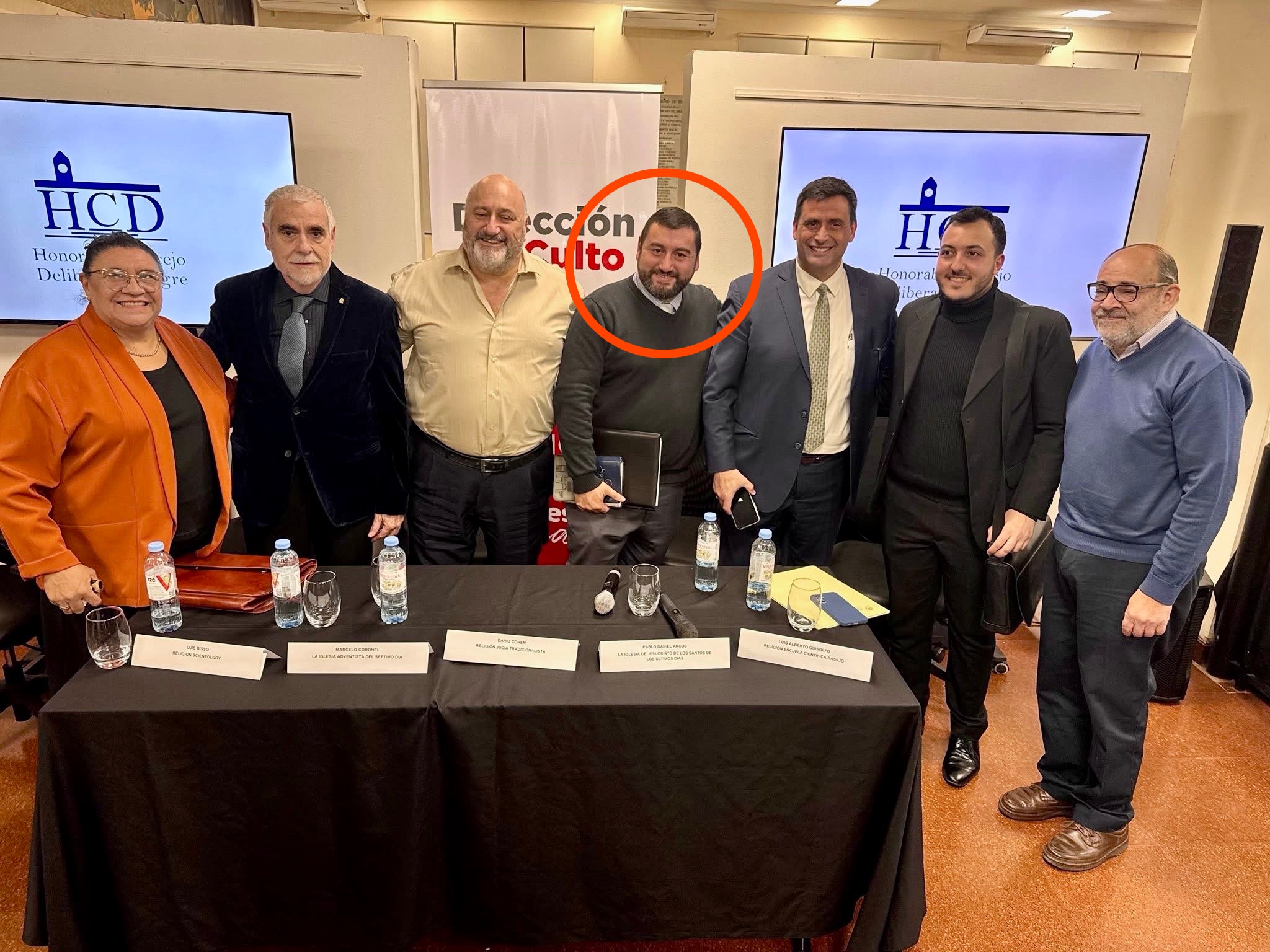
On August 6, 2025, leaders of diverse faith traditions gathered in Tigre, a city in the Buenos Aires district of Argentina. The meeting, held under the banner of the Tigre Interfaith Forum, was titled “Forgiveness and Reconciliation in the Context of Conflict.” The event sought to unite churches in an effort to heal collective wounds, bringing together government officials, religious representatives, and community members who share the belief that dialogue and mutual respect can bridge even the deepest divides. Representing the Seventh-day Adventist Church at this inter-denominational ecumenical forum was Marcelo Coronel of Buenos Aires, Argentina. He is a theologian, pastor, and president of the Central West Argentine Mission of Seventh-day Adventists [1], and is shown in the photo marked with a red circle.
The following news release was published by one of the participants who attended the Tigre Interfaith Forum:
• “To the council members, officials, religious leaders, and the entire community present: Thank you for building peace together!” [2]
• “8 years weaving dialogue—The Tigre Interfaith Dialogue Roundtable (MEDINTI) was founded on October 2, 2017, with a joint declaration for peace signed by various spiritual traditions.” [2]
• “Key Milestones: 2017—Founding with Catholic, Evangelical, and academic leaders. 2022 – Inclusion of new communities: Jewish, Africanist, Scientology, Basilio Scientific School, the Church of Jesus Christ of Latter-day Saints, the Seventh-day Adventist Church, and the Evangelical Pentecostal Church.” [2]
• “3 Lines of Work – 1. Dialogue and Formation, 2. Solidarity: ‘United is Better’ campaigns in vulnerable neighborhoods. 3. Institutional Participation: ethical and spiritual participation in national, provincial, and municipal public policies.” [2]
• “Today we renew the commitment: Religious diversity does not divide: it enriches, unites, and projects.” [2]
• “In this forum, we sow seeds of unity through: Reflections on forgiveness as a tool for reconciliation, spiritual contributions to heal collective wounds, and concrete actions toward a culture of encounter.” [2]
• “Final Message—With hope, love, and respect, we continue to build in Tigre, where dialogue is the essential path toward justice and fraternity.” [2]
The Tigre Interreligious Dialogue Roundtable (MEDINTI) is part of the broader global ecumenical movement and was established on October 2, 2017, by Roman Catholic and Evangelical leaders. In the years since, its membership has expanded to include representatives from the Jewish, Africanist, and Scientology communities; the Seventh-Day Adventist Church; the Basilio Scientific School; the Church of Jesus Christ of Latter-day Saints; and the Evangelical Pentecostal Church. This growing coalition now stands as a clear example of how a wide range of faiths and philosophies can gather in the spirit of fraternity and shared purpose.
The organization’s work is built on three core priorities: dialogue, education, and solidarity. At this year’s forum, the prevailing message was that religious diversity should be seen not as a barrier, but as a source of strength. Participants explored forgiveness as a practical tool for reconciliation, shared approaches to healing collective wounds, and outlined concrete steps toward fostering a culture of encounter. The call was clear—to create interfaith spaces where differences are respected, dialogue is welcomed, and unity is actively pursued. This is the mission of the Tigre Interfaith Forum: to make the city not merely a place where people of many backgrounds live side by side, but a community where they walk together toward a shared vision of peace.
The ecumenical movement, with its emphasis on reconciliation and the healing of historic differences between religious traditions, is creating a deep identity crisis within Seventh-day Adventism because ecumenism often promotes a form of harmony that downplays doctrinal distinctives and seeks to hide the prophetic mission entrusted to the remnant church. By seeking to heal the wounds of our theological differences, such initiatives try to eliminate the urgency of the Three Angels’ Messages of Revelation 14—truths that call the world to reject false worship, embrace the commandments of God, and prepare for Christ’s soon return. In the name of solidarity, the clear, distinct voice of Adventism is being silenced, jeopardizing the very mission that defines our existence. Our leaders should have no part in interfaith engagements that aim to draw us toward Rome.
God’s people have been entrusted with an urgent mission: to call all nations, kindreds, tongues, and peoples out of Babylon and into the light of God’s truth. This means not merely seeking coexistence or leaving individuals comfortable in their sins and disobedience, but calling them to turn from error and embrace God’s last message of mercy. This is not a passive invitation—it is a heaven-sent warning to reject man-made traditions and surrender fully to Christ’s word. True love does not withhold truth for the sake of peace; it points souls to the only path of salvation, even when that message challenges popular beliefs or demands obedience.
“Let not those who have the truth as it is in Jesus give sanction, even by their silence, to the work of the mystery of iniquity. Let them never cease to sound the note of alarm” (Selected Messages, Vol. 2, p. 369).
“In a special sense Seventh-day Adventists have been set in the world as watchmen and light bearers. To them has been entrusted the last warning for a perishing world. On them is shining wonderful light from the word of God. They have been given a work of the most solemn import—the proclamation of the first, second, and third angels’ messages. There is no other work of so great importance. They are to allow nothing else to absorb their attention” (Testimonies, Vol. 9, p. 19).
Sources
[1] https://www.adventistyearbook.org/entity?EntityID=52430&highlight=Marcelo%7Ccoronel
 0
0 0
0 0
0
Leave a Reply