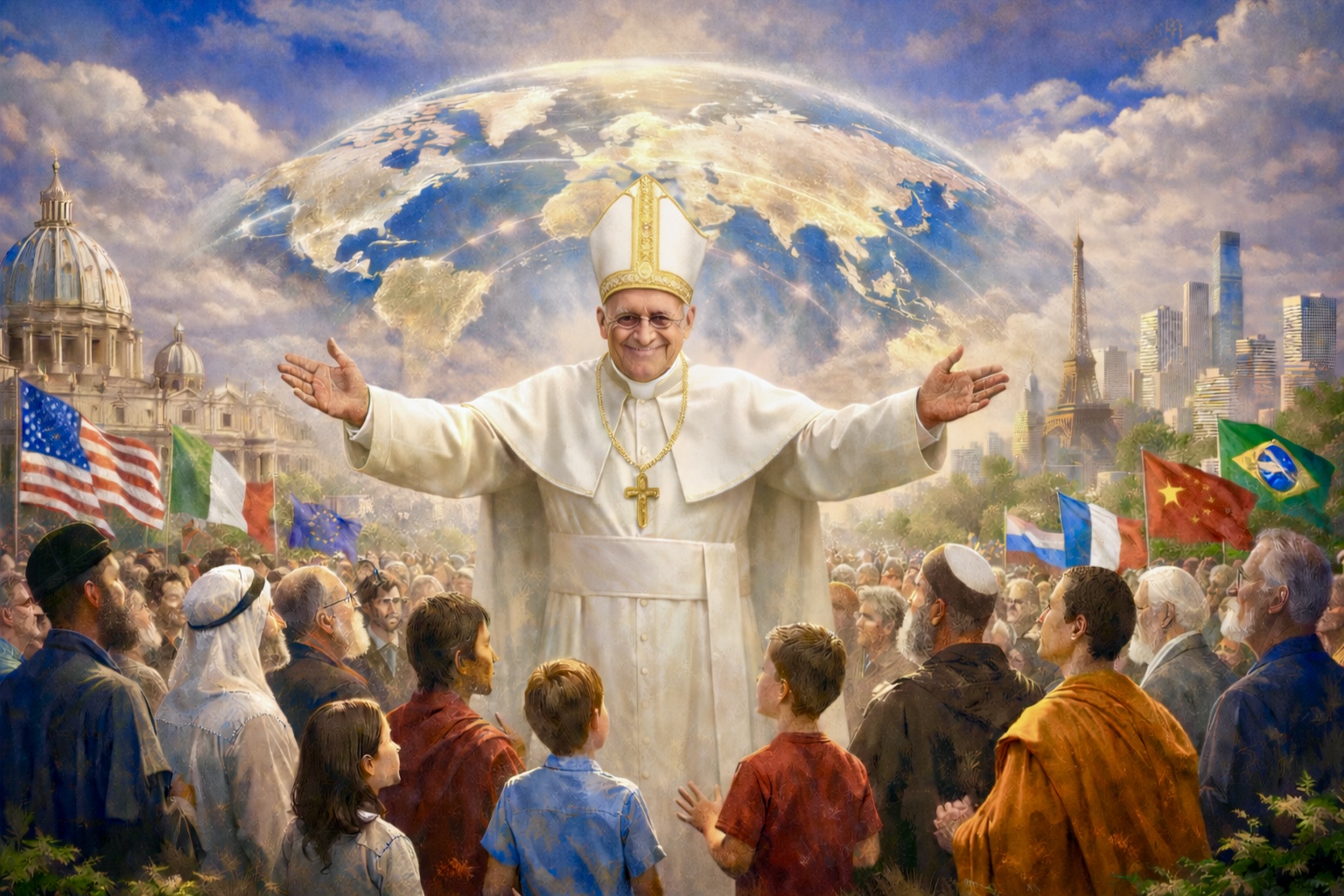
On January 9, 2026, Pope Leo XIV addressed the ambassadors of 184 countries that maintain official diplomatic relations with the Vatican. His message clearly illustrated how the modern Papacy continues to pursue the ancient Vatican strategy of bringing the world into a visible and structural unity under the moral and spiritual leadership of Rome.
Pope Leo XIV’s address to the world’s ambassadors was a theological and prophetic statement describing his intent to heal divisions, reclaim spiritual authority, and rally the nations around a single body. According to prophecy, such visible unity must arise before Christ’s return, for it sets the stage for the final conflict between human authority and divine law, between the counterfeit unity of Babylon and the true people of God who “keep the commandments of God and the faith of Jesus” (Revelation 14:12).
The Vatican Press Office published the Pope’s message, and some excerpts are shared below.
• “I am pleased, therefore, to welcome you this morning, and I am grateful for your generous participation.” [1]
• “This is a tangible sign of good and fruitful bilateral relations. Through each of you, dear Ambassadors, I wish to extend my good wishes to your countries, and to share a reflection on our times, which are so troubled by a growing number of tensions and conflicts.” [1]
• “This past year saw many significant events, beginning with those directly affecting the life of the Church, which experienced a profound Jubilee, and saw the return to the Father’s house of my venerable predecessor, Pope Francis. The whole world gathered around his coffin on the day of his funeral, and sensed the loss of a father who had guided the People of God with immense pastoral charity.” [1]
• “I am also grateful for the visits that I received from the senior Government officials at the beginning of my Pontificate and for the exquisite hospitality shown to me.” [1]
• “During the past year, having accepted the invitation given to Pope Francis, I had the joy of visiting Türkiye and Lebanon. I am grateful to the Authorities of both countries for their welcome. In İznik, Türkiye, together with the Ecumenical Patriarch of Constantinople and representatives of other Christian denominations, I commemorated the 1700th anniversary of the first Ecumenical Council. This was an important opportunity for renewing our commitment to the journey towards the full visible unity of all Christians.” [1]
• “In Lebanon, I met a people who, despite their difficulties, are full of faith and enthusiasm. There, I sensed the hope of young people who aspire to build a more just and cohesive society, and to strengthen the bond of cultures and religions that makes the Land of the Cedars unique in the world.” [1]
When the Pope welcomed the world’s ambassadors and thanked them for being present, he was openly acknowledging the Vatican as the central meeting place for global governments. This affirms that the Holy See sees its role not merely as a religious voice but as the primary influence among world leaders—helping shape how the international community thinks and acts. From a prophetic standpoint, this shows how Revelation 17 is gradually coming to life. In that chapter, the “woman” represents a church, and the “many waters” mean people from all over the world—different nations, cultures, and languages. What we are seeing today is Rome extending its influence far beyond religion alone, reaching into politics and global diplomacy.
Leo XIV’s statement that the world had “gathered around the coffin” of Pope Francis, mourning “the loss of a father who had guided the People of God with immense pastoral charity,” positions the Papacy as the paternal figure for humanity. His emphasis on the idea that “the whole world” united around the death of Pope Francis reinforces the idea that the Pope is the father of the nations. From a prophetic perspective, this agrees with Revelation 13:3, which states that “all the world wondered after the beast.” It illustrates how reverence and emotional affection for the Papal office are today crossing denominational, cultural, and political lines—laying the groundwork for the kind of universal homage, or “worship,” that prophecy warns will one day be fully realized.
Pope Leo XIV’s comments about visiting Turkey and Lebanon and about commemorating the “1700th anniversary of the first Ecumenical Council held in Nicaea” are especially significant from a prophetic perspective. The Council of Nicaea in A.D. 325 marked a major turning point in Christian history, when the church aligned itself with Emperor Constantine’s imperial power. This alliance blended Christianity with pagan influences and laid the foundation for the first formal union of church and state. By invoking this Nicaean anniversary and presenting it as the model for a “journey toward the full visible unity of all Christians,” Leo XIV is projecting a renewed vision of a reunited Christendom—one that follows Constantine’s model. This emphasis on “visible unity” is a necessary precursor to the final union of church and state foretold in Revelation 13, where religious and civil authorities act together to enforce the mark of the beast.
Before the second coming of Christ, prophecy reveals that there will be a counterfeit unity—a global alliance that brings together religions and governments in the name of peace, fraternity, and political and religious healing. Rome’s diplomatic and ecumenical initiatives are driving this movement, positioning the papacy as the spiritual leader for global cooperation. By uniting nations, courting world leaders, and calling Christians to visible unity, Pope Leo XIV is fulfilling the very predictions Ellen G. White described:
“The line of distinction between professed Christians and the ungodly is now hardly distinguishable. Church-members love what the world loves, and are ready to join with them; and Satan determines to unite them in one body, and thus strengthen his cause by sweeping all into the ranks of Spiritualism. Papists, who boast of miracles as a certain sign of the true church, will be readily deceived by this wonder-working power; and Protestants, having cast away the shield of truth, will also bedeluded. Papists, Protestants, and worldlings will alike accept the form of godliness without the power, and they will see in this union a grand movement for the conversion of the world, and the ushering in of the long-expected millennium” (Great Controversy, p. 588).
Sources
[1] https://press.vatican.va/content/salastampa/en/bollettino/pubblico/2026/01/09/260109a.html
 0
0 0
0 0
0
“And call no man your father upon the earth: for one is your Father, which is in heaven. ”
Matthew 23:9 KJV
“1 These words spake Jesus, and lifted up his eyes to heaven, and said, Father, the hour is come; glorify thy Son, that thy Son also may glorify thee:
2 As thou hast given him power over all flesh, that he should give eternal life to as many as thou hast given him.
3 And this is life eternal, that they might know thee the only true God, and Jesus Christ, whom thou hast sent.
4 I have glorified thee on the earth: I have finished the work which thou gavest me to do.
5 And now, O Father, glorify thou me with thine own self with the glory which I had with thee before the world was.
6 I have manifested thy name unto the men which thou gavest me out of the world: thine they were, and thou gavest them me; and they have kept thy word.
7 Now they have known that all things whatsoever thou hast given me are of thee.
8 For I have given unto them the words which thou gavest me; and they have received them, and have known surely that I came out from thee, and they have believed that thou didst send me.
9 I pray for them: I pray not for the world, but for them which thou hast given me; for they are thine.
10 And all mine are thine, and thine are mine; and I am glorified in them.
11 And now I am no more in the world, but these are in the world, and I come to thee. Holy Father, keep through thine own name those whom thou hast given me, that they may be one, as we are.
12 While I was with them in the world, I kept them in thy name: those that thou gavest me I have kept, and none of them is lost, but the son of perdition; that the scripture might be fulfilled.
13 And now come I to thee; and these things I speak in the world, that they might have my joy fulfilled in themselves. 14 I have given them thy word; and the world hath hated them, because they are not of the world, even as I am not of the world. ”
John 17:1-14 KJV