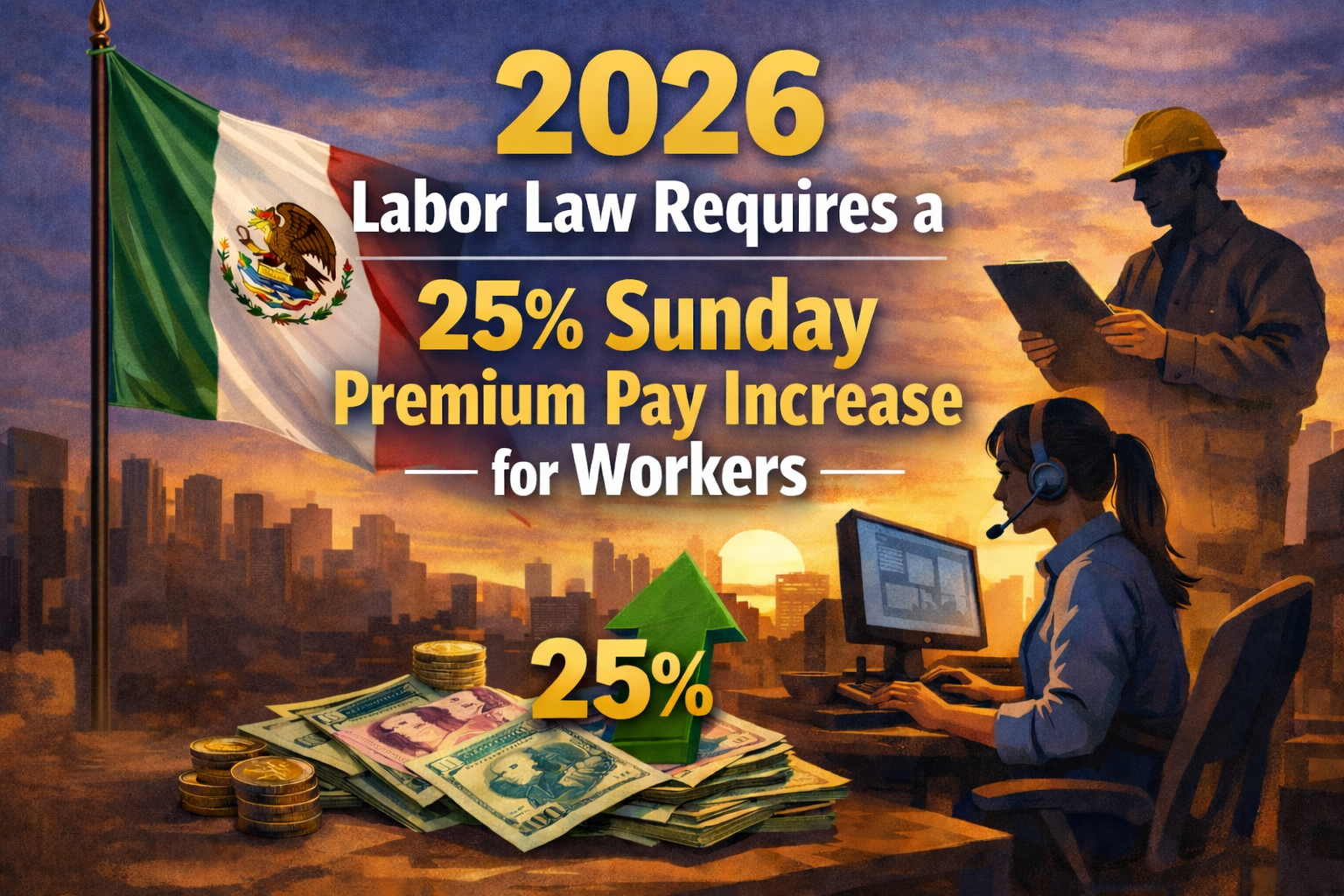
Labor laws that mandate premium pay for Sunday work are often presented as fair worker protections. They sound reasonable—paying people more for giving up Sunday, the so-called day of rest. But in reality, their real function is to apply economic pressure on businesses. By making Sunday labor significantly more expensive than other days, the law deliberately raises the cost of operating on Sunday. This is not accidental. When wages are increased by law, businesses are forced to reconsider whether staying open on Sunday is financially practical at all.
On January 18, 2026, MSN News published an article about Mexico’s decision to provide an additional 25% pay to employees who work on Sundays:
• “Sunday premium pay in 2026 is not a bonus, a favor, or an optional negotiation. Sunday premium pay in 2026 is a mandatory labor right in Mexico.” [1]
• “Think of the Sunday premium as the ‘extra charge’ that appears when you use a service outside of normal business hours. Sunday isn’t just any day under the Federal Labor Law. It may seem like a normal workday, but legally it costs more.” [1]
• “In 2026, the Sunday premium will be at least 25% of your daily wage , in addition to your regular salary.” [1]
• “Review your pay stubs starting today. Check if Sundays show a higher amount.” [1]
• “The first step is to request the correction by directly citing the Federal Labor Law.” [1]
• “The Federal Labor Defense Attorney’s Office offers free advice and can intervene at no cost. You don’t need a private lawyer to demand what is rightfully yours.” [1]
For many businesses—especially retailers, supermarkets, and small businesses—the higher Sunday wage does not automatically come with higher Sunday revenue to cover that cost. This means that employers have to pay workers more money on Sunday without an increase of sales. Businesses end up losing money just for being open on that day. In other words, the 25% extra pay functions as a penalty rather than a benefit.
Over time, the obvious response for businesses is not to keep paying more but to close on Sundays. When enough businesses reach that same conclusion, Sunday gradually stops being a normal commercial day—not because people freely choose rest, but because the cost of operating has been manipulated to make Sunday closure the only sensible option.
This is how economic coercion works. Instead of openly calling for Sunday laws—which would provoke resistance—the state often seeks to control the markets by making Sunday work economically unattractive. Workers, employers, and shoppers end up having to adjust their routines because stores are no longer open. In time, Sunday is established as the de facto day of rest across society through labor laws and regulatory pressure, quietly advanced by Rome’s agents as they work to codify Sunday closures into civil law.”
Sources
 0
0 0
0 0
0
Leave a Reply