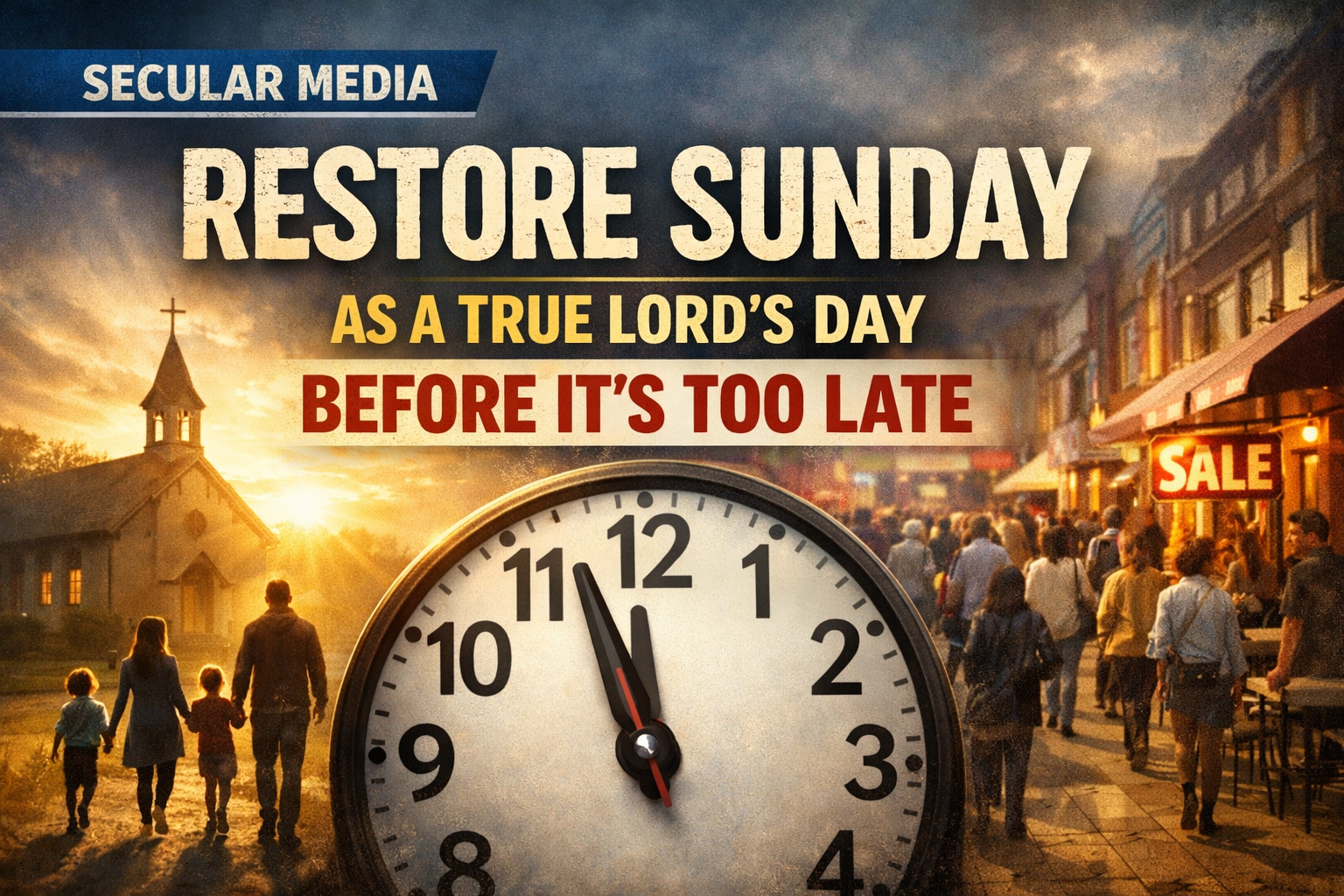
Noti Red Mérida is a local media outlet based in Mérida, the capital of the Mexican state of Yucatán, which primarily focuses on reporting on issues in the city and the surrounding region. However, on January 28, 2026, the outlet published an article titled “Sundays Are a Whole Day for God, Not Just an Hour,” which expressed concern over the cultural and spiritual erosion of Sunday as a sacred day of rest.
The article argued that what was once widely recognized as a day set apart for worship and family time has gradually been reduced to just another commercial day. It cited both religious and sociological reasons for restoring reverence for Sunday through meaningful rest and devotion, and it called on society to “turn back” and “restore Sunday” before it is too late.
Noti Red Mérida published the following:
• “At what point did Sunday stop being the Lord’s Day and become just an hour dedicated to God?” [1]
• “I remember that in my childhood, the only places open on Sundays were churches and hospitals.” [1]
• “The only people who should be working were emergency personnel, doctors, law enforcement, and ministers or priests.” [1]
• “There were no organized sports leagues or scheduled practices on Sundays. Sunday rest was a universally respected cultural institution.” [1]
• “Currently, virtually all shops remain open, with exceptions such as Hobby Lobby and Chick-fil-A, sporting activities have invaded even Sunday mornings. They need to accommodate all the tournament matches, and Sunday has become as busy as any other day of the week.” [1]
• “The Lord’s Day has become yet another victim on our wide highway to spiritual perdition.” [1]
• “This reality has become prevalent in the United States, Canada, and Europe.” [1]
• “Church attendance statistics in the West show a steady decline: in the United States, regular attendance at religious services has fallen from 70% in the 1950s to less than 47% today.” [1]
• “In Europe, the numbers are even more dramatic, with countries like France where only 5% of Catholics regularly attend Sunday mass.” [1]
• “Sociological studies have shown that the loss of the collective ‘day of rest’ has negative effects on family and community cohesion.” [1]
• “Families have fewer opportunities to get together without the distractions of work, shopping, or scheduled activities. The frenetic pace that has invaded even our supposed day of rest contributes significantly to the increasing levels of stress, anxiety, and exhaustion that characterize modern society.” [1]
• “The Catholic Church, through documents such as Pope John Paul II’s ‘Dies Domini,’ has consistently reaffirmed the importance of Sunday as a day dedicated not only to attending Mass, but also to spiritual renewal, physical rest, strengthening family ties, and practicing works of charity.” [1]
• “Turn around before it’s too late … restore Sunday as a true Lord’s Day, not out of legalistic obligation, but as a loving response to the God who first loved us.” [1]
The author’s central burden is that Sunday has lost its sacred meaning, and he argues that this has contributed to spiritual decline, weakened families, and widespread cultural exhaustion. These concerns closely align with the growing agenda of Christian nationalist movements and organizations such as the Heritage Foundation, which seek to restore Sunday as a unifying day of rest through public policy. What is now being expressed in religious and cultural commentary in Mexico is, in the United States, being pursued through political means—namely, the reestablishment of Sunday observance as a way to reverse moral decay, restore family cohesion, and reassert Christian identity in public life.
At the heart of the modern effort to restore Sunday lies the Catholic foundation. Through official documents such as Dies Domini, Laudato Si’, and others, the Roman Catholic Church has consistently called for Sunday to be reclaimed as a sacred institution. Yet beneath this appeal lies a deeper reality: Sunday, as a religious obligation, is rooted in Catholic theology and Papal authority. By presenting Sunday observance as a remedy for moral decline, they are laying the foundation for uniting religious influence with state power, just as Revelation 13 warns us. The same power that once changed God’s Sabbath is now moving once again to elevate Sunday, this time under the banner of moral renewal and societal good.
“The enforcement of Sunday-keeping on the part of Protestant churches is an enforcement of the worship of the papacy—of the beast. Those who, understanding the claims of the fourth commandment, choose to observe the false instead of the true Sabbath are thereby paying homage to that power by which alone it is commanded. But in the very act of enforcing a religious duty by secular power, the churches would themselves form an image to the beast; hence the enforcement of Sunday-keeping in the United States would be an enforcement of the worship of the beast and his image” (Great Controversy, p. 448).
Sources
[1] https://notiredmerida.com/2026/01/28/los-domingos-son-un-dia-entero-para-dios-no-solo-una-hora/
 0
0 0
0 0
0
Leave a Reply