“And he shall speak great words against the most High, and shall wear out the saints of the most High, and think to change times and laws.” Daniel 7:25
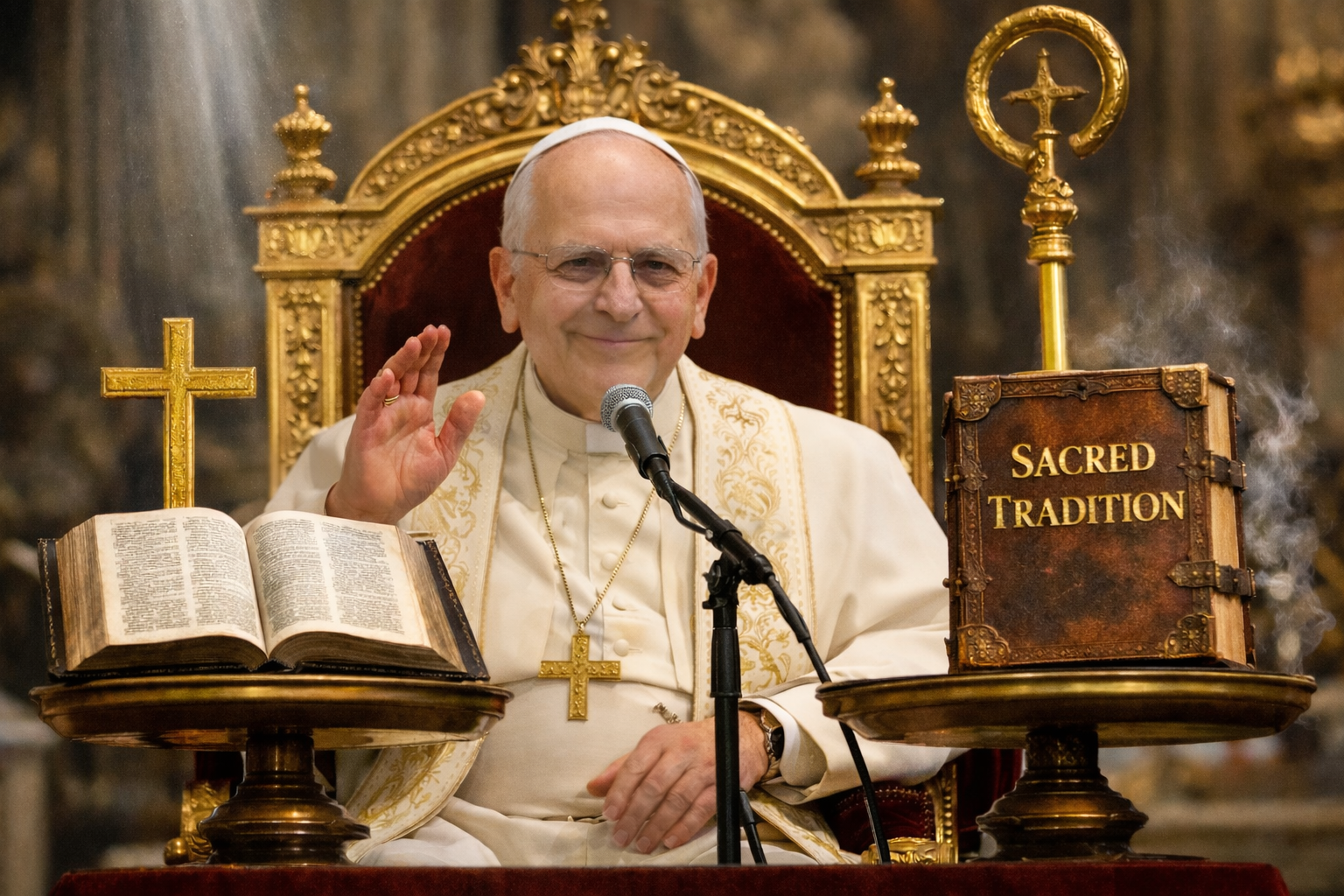
On January 28, 2026, during a general audience at the Vatican, Pope Leo XIV addressed visitors from around the world on the relationship between Scripture and tradition. In his remarks, the Pope reaffirmed the long-standing Roman Catholic principle that church tradition stands on the same level as—if not above—the Holy Scriptures. This position stands in direct contrast to historic Protestant belief, which holds that when tradition becomes a second authority in the church, it gains the power to reinterpret, correct, or even override what God Himself has written, making the final judge of truth no longer God’s Word but fallible men who claim the authority to define tradition.
The Holy See Press Office published the following statement from Pope Leo XIV:
• “Today we will reflect on the relationship between Sacred Scripture and Tradition.” [1]
• “It is what the Second Vatican Council affirms, using an evocative image: ‘There exists a close connection and communication between sacred tradition and Sacred Scripture. For both of them, flowing from the same divine wellspring, in a certain way merge into a unity and tend toward the same end.” [1]
• “The Council affirms that ‘this tradition which comes from the Apostles develops in the Church with the help of the Holy Spirit’.” [1]
• “The Church, in her teaching, life and worship, perpetuates and hands on to all generations all that she herself is, all that she believes.” [1]
• “Sacred tradition and Sacred Scripture form one sacred deposit of the word of God, committed to the Church, interpreted by the living teaching office of the Church, whose authority is exercised in the name of Jesus Christ.” [1]
• “Scripture and Tradition … are so linked and joined together that they cannot stand independently, and together, each in their own way, under the action of the one Holy Spirit, they contribute effectively to the salvation of souls.” [1]
When human tradition is treated as authoritative, it can supersede and effectively nullify God’s commandments by substituting His clear instructions with man-made rules. Jesus Himself rebuked religious leaders for elevating human tradition in a way that set aside the Word of God:
“For laying aside the commandment of God, ye hold the tradition of men.” Mark 7:8.
“Making the word of God of none effect through your tradition, which ye have delivered: and many such like things do ye.” Mark 7:13.
“But in vain they do worship me, teaching for doctrines the commandments of men.” Matthew 15:9.
When tradition is viewed as equal to the Holy Scriptures, it becomes a rival rule of faith—an alternate standard that many end up following instead of submitting to what God’s Word actually teaches. Yet Scripture presents itself as the sole measuring rod for doctrine and practice. Once tradition is placed on the same level as the Bible, Scripture ceases to be the clear and final authority, and truth is increasingly determined by long-standing traditions rather than by the plain teaching of God’s Word.
“To the law and to the testimony: if they speak not according to this word, it is because there is no light in them.” Isaiah 8:20.
“These were more noble than those in Thessalonica, in that they received the word with all readiness of mind, and searched the scriptures daily, whether those things were so.” Acts 17:11.
“All scripture is given by inspiration of God, and is profitable for doctrine, for reproof, for correction, for instruction in righteousness: That the man of God may be perfect, throughly furnished unto all good works.” 2 Timothy 3:16-17.
Tradition allows non-biblical beliefs and practices to take root without clear biblical support. God’s word warns against teaching human rules as divine requirements. When tradition is granted the same authority as Scripture, errors can become locked in—because people will treat those traditions as untouchable and refuse to correct them even when the Bible shows they’re wrong.
“Not giving heed to Jewish fables, and commandments of men, that turn from the truth.” Titus 1:14.
“Wherefore the Lord said, Forasmuch as this people draw near me with their mouth, and with their lips do honour me, but have removed their heart far from me, and their fear toward me is taught by the precept of men.” Isiah 29:13.
“And they shall turn away their ears from the truth, and shall be turned unto fables.” 2 Timothy 4:4.
“Now the Spirit speaketh expressly, that in the latter times some shall depart from the faith, giving heed to seducing spirits, and doctrines of devils.” 1 Timothy 4:1.
When fables, seducing spirits, and doctrines of devils are placed on equal footing with Scripture, heresies can be accepted simply because they are ancient or widely practiced, rather than because they are clearly taught in God’s Word. Over time, this has allowed doctrines such as Sunday sacredness, the natural immortality of the soul, prayers to dead saints, purgatory, the eternal torment of the wicked, the veneration of Mary, and many other errors to take root in the church—not through explicit biblical command, but through tradition, philosophical influence, and human authority.
Once these non-biblical ideas became embedded in the church, Scripture was often reinterpreted to support them, rather than being allowed to test and correct them. As a result, divine revelation has been gradually replaced with human teachings, and serious errors have been preserved, defended, and passed down through generations under the assumption that long-standing traditions are equal with biblical truth, even when those doctrines plainly conflict with the clear teaching of Scripture.
In the last days, Scripture reveals that the final conflict will center on worship and authority—whether people will obey the commandments of God or submit to the traditions of men. The true biblical Sabbath, established by God at Creation and written into His law, stands as a visible sign of loyalty to the Creator, while the Papal Sabbath, Sunday, was instituted by man, changed by human authority, and is the counterfeited day of rest. In this crisis, the Sabbath becomes decisive because it directly confronts the question of who has the right to define worship—God alone or man—and this is what separates those who keep the commandments of God from those who follow the commandments of men.
Sources
[1] https://press.vatican.va/content/salastampa/en/bollettino/pubblico/2026/01/28/260128a.html
 0
0 0
0 0
0
The Pope elevates himself ,to a position equal to God Himself? That’s why the scriptures reffers to him as the ”Anti -christ” The one who exalteth himself above anything else that is called God. According to the book of 2 Thessalonians 2;2-9, we know from the scriptures especially in the books of Daniel and Revelation that the papacy is the little stout horn and the leopard like beast predicted in these prophetic books. It’s also the same little horn of Daniel 8;25 THAT that casts the truth to the ground. Rome does not like the biblical truth, that’s the reason as to why Rome persecuted millions of christians during the first centuries of the early church, who did not agree with Rome’s pagan traditions. Pagan ROME killed around 10 million christians especially during the years of Emperor Nero.
All the apostles, and the early church followers were victims of the horrors of Rome’s atrocities. You can read the book of Hebrews 11;37 it gives the account of how faithful christans were butchered and killed for standing for the truth and defending Christ. Many christians were cut and split into half, others were fed up to angry lions, and others were beheaded. These Massacres and killinggs continued until the rise of PAPAL ROME which succeded the authority and power once held by the ancient Roman Empire. Now at the height of it’s power during the period of dark ages, PAPACY clearly demanded that the holy scriptures were forbidden to be read throught EUROPE and only the traditions upheld by Rome were supposed to be followed and not the word of God.
The Pope of Rome , the Supreme pontiff, the Bishop of Rome reigned supreme in Europe , and all the Kings, and Emperors were subject to him. The christians ran to hide in Alp mountains so that they can worship God according to their own concsience. The Albigenses , Huegenots, Waldenses bore the brunt of the papal persecutions in Europe. The papal traditions, and heresies were widely accepted by the christendom in those days. Today ,in the Church of Rome the traditions are held high with a lot of esteem. The Roman catholic traditions are anchoed in the seven sacraments; Baptism, Eucharist, Confirmation, Reconciliation, Anointing of the sick, Holy orders , Matrimony. And devotional and liturgical traditions; like honoring Mary, devotion to saints, Rosary, Genuflection. These traditions are no where supported in the scriptures and no where Jesus asked his apostles to follow and teach the traditions. That’s why in the book of Mattthew 15;9 Jesus says; How beit, they worship me in vain, teaching the doctrines and commandments of men. Human traditions are in way superior to the God’s word as Pope Leo XIV wants us to believe.