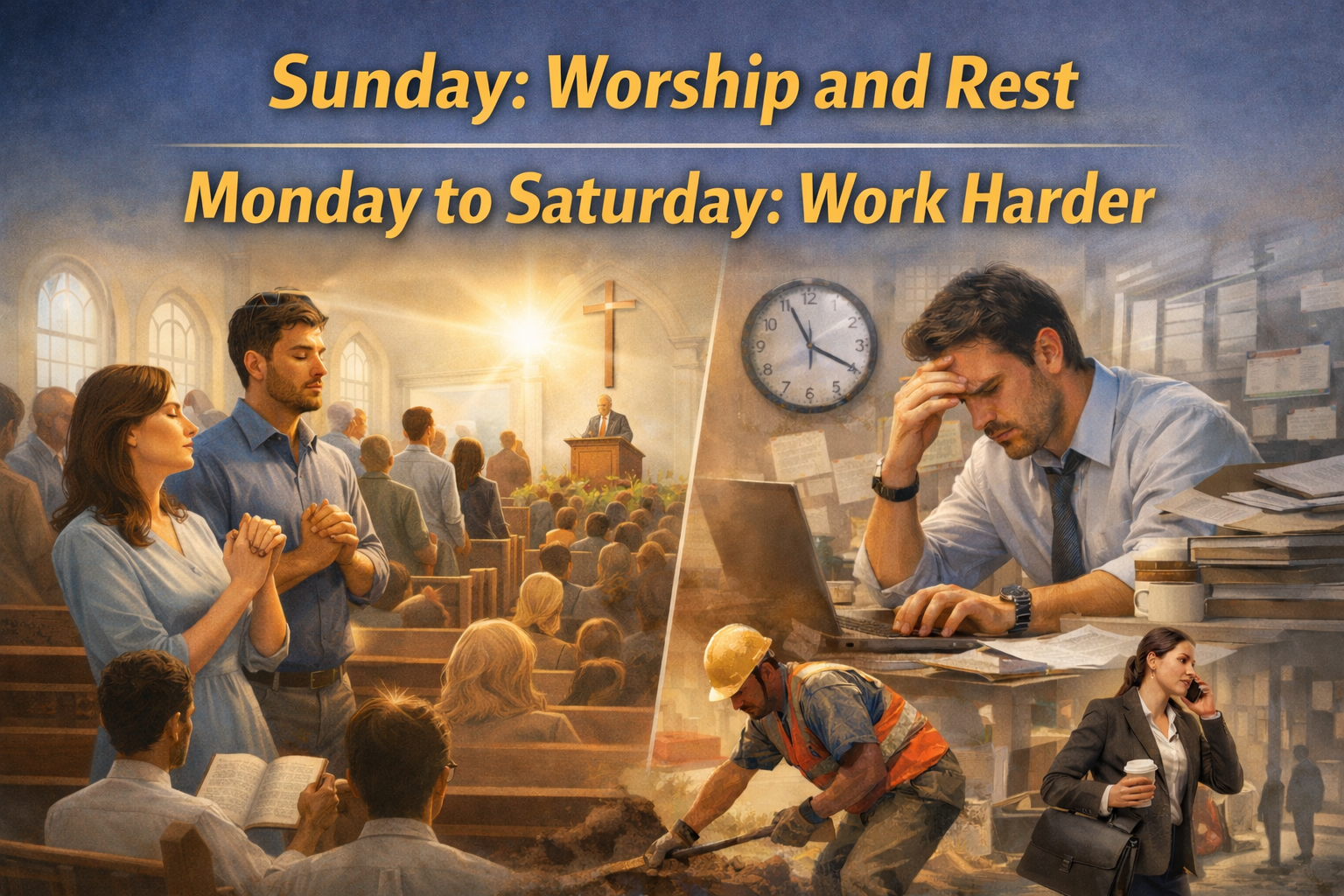
A Productive Household is an online lifestyle magazine that focuses on enhancing people’s lives by offering advice on everyday matters, including fashion, health, beauty, travel, home décor, and even Sunday worship. By following its guidance, readers are promised a more “productive household.” Unfortunately, this illustrates how a lifestyle magazine can help normalize Sunday as the official day of rest. By appealing to both secular and religious audiences alike, such outlets often succeed in advancing erroneous teachings about Sunday worship beyond church walls and into everyday life.
A Productive Household published the following on January 1, 2026:
• “By the grace of God, for the past 7 years, we’ve been setting aside Sundays—the Christian Sabbath—for rest and worship. I’ll be the first to admit that this was a hard arrangement for me to accept at first! We all need rest, and yet, resting doesn’t come naturally.” [1]
• “There’s so much to do. And there are even things we miss out on because Sundays are set aside for worship and rest. But at this point, I can confidently say the blessings of the Lord’s Day—and most of all, of obedience to God—are far greater than anything we’ve ever missed out on on a Sunday.” [1]
• “After weeks, probably a couple of years, to be honest, of fighting the sabbath in my heart, it’s now so obvious that we as humans don’t have time to NOT take a sabbath. Resting on Sundays precedes work, and it necessitates hard work the other 6 days of the week.” [1]
• “Sundays offer the physical rest and the rest in Christ that we need to give us abundant energy for the blessings and demands of the other 6 days.” [1]
The article begins by explicitly redefining Sunday as “the Christian Sabbath,” immediately establishing the discussion in theological terms and presenting Sunday observance as an act of obedience to God. No scriptural evidence is offered to support this claim—only a confident, unsubstantiated assertion. Without explaining how or why such a shift is biblically justified, Sunday rest is simply elevated as the wiser, healthier, and more responsible choice.
After mistakenly establishing Sunday as the day for worship and rest, the article takes a significant turn by revealing that honoring Sunday requires even more intense work during the remaining six days, including Saturday. In other words, Sunday is not just a special day; it becomes the justification for increasing the workload during the rest of the week.
What makes this error especially egregious is that Saturday is not treated as a distinct or protected day in any way. Instead, the seventh day is explicitly categorized as a workday—one that, because of Sunday observance, is expected to be even more laborious. This directly reverses the biblical structure of the week. Instead of working six days and then resting on the seventh day—Saturday—just like God clearly laid out in the Ten Commandments, the article flips the order and treats Sunday as the real day of rest, while Saturday is while Saturday is coungted like just another regular workday.
In Scripture, God established a clear and unchanging order—six days of labor followed by the seventh-day Sabbath, which He blessed and sanctified as holy. Yet Satan has simply switched the labels, so that today many believe they are obeying God while doing the very opposite of what He commanded. The day God blessed and set apart for rest is treated as a common workday, while rest is observed on a day God designated for labor.
Isaiah warned of this very condition: “Woe unto them that call evil good, and good evil; that put darkness for light, and light for darkness; that put bitter for sweet, and sweet for bitter!” Isaiah 5:20. In such a system, the final deception is complete: the commandments of God are honored in name only but denied in practice. The greatest danger today is the devotion to a counterfeit faith and a counterfeit day of worship that feels right, sounds biblical, and is widely accepted.
“The Protestant world have set up an idol sabbath in the place where God’s Sabbath should be, and they are treading in the footsteps of the Papacy” (Selected Messages, Vol. 2, p. 359).
Sources
[1] https://aproductivehousehold.com/what-does-a-weekly-sabbath-look-like/
 0
0 0
0 0
0
I read your messages regularly and find them very helpful in understanding the move toward Sunday laws. I have also noticed on Facebook a growing number of Adventists who reference a departed loved one being in heaven. I know this is off topic but I don’t know how to reach you in any other way. I would like to see coverage on the state of the dead and the role of spiritualism in America. It seems to me that is a more dangerous error for us right now. I don’t want to study spiritualism but just be warned of its dangers. Thanks
History shows that this has happened before:
“But with great subtlety, Satan worked through his agents to bring about his object. That the attention of the people might be called to the Sunday… Religious services were held upon it; yet it was regarded as a day of recreation”
“The detector of error having been removed, Satan worked according to his will. Prophecy had declared that the papacy was to “think to change times and laws.” [Daniel 7:25.] This work it was not slow to attempt. To afford converts from heathenism a substitute for the worship of idols, and thus to promote their nominal acceptance of Christianity, the adoration of images and relics was gradually introduced into the Christian worship. The decree of a general council [Second Council of Nice, A.D. 787.] finally established this system of idolatry. To complete the sacrilegious work, Rome presumed to expunge from the law of God the second commandment, forbidding image worship, and to divide the tenth commandment, in order to preserve the number.
The spirit of concession to paganism opened the way for a still further disregard of Heaven’s authority. Satan tampered with the fourth commandment also, and essayed to set aside the ancient Sabbath, the day which God had blessed and sanctified, [Genesis 2:2, 3.] and in its stead to exalt the festival observed by the heathen as “the venerable day of the sun.” This change was not at first attempted openly. In the first centuries the true Sabbath had been kept by all Christians. They were jealous for the honor of God, and, believing that his law is immutable, they zealously guarded the sacredness of its precepts. But with great subtlety, Satan worked through his agents to bring about his object. That the attention of the people might be called to the Sunday, it was made a festival in honor of the resurrection of Christ. Religious services were held upon it; yet it was regarded as a day of recreation, the Sabbath being still sacredly observed.
To prepare the way for the work which he designed to accomplish, Satan had led the Jews, before the advent of Christ, to load down the Sabbath with the most rigorous exactions, making its observance a burden. Now, taking advantage of the false light in which he had thus caused it to be regarded, he cast contempt upon it as a Jewish institution. While Christians continued to observe the Sunday as a joyous festival, he led them, in order to show their hatred of Judaism, to make the Sabbath a fast, a day of sadness and gloom.
In the early part of the fourth century, the emperor Constantine issued a decree making Sunday a public festival throughout the Roman Empire. [See Appendix, note 1.] The day of the sun was reverenced by his pagan subjects, and was honored by Christians; it was the emperor’s policy to unite the conflicting interests of heathenism and Christianity. He was urged to do this by the bishops of the church, who, inspired by ambition, and thirst for power, perceived that if the same day was observed by both Christians and the heathen, it would promote the nominal acceptance of Christianity by pagans, and thus advance the power and glory of the church. But while Christians were gradually led to regard Sunday as possessing a degree of sacredness, they still held the true Sabbath as the holy of the Lord, and observed it in obedience to the fourth commandment.
The arch-deceiver had not completed his work. He was resolved to gather the Christian world under his banner, and to exercise his power through his vicegerent, the proud pontiff who claimed to be the representative of Christ. Through half-converted pagans, ambitious prelates, and world-loving churchmen, he accomplished his purpose. Vast councils were held, from time to time, in which the dignitaries of the church were convened from all the world. In nearly every council the Sabbath which God had instituted was pressed down a little lower, while the Sunday was correspondingly exalted. Thus the pagan festival came finally to be honored as a divine institution, while the Bible Sabbath was pronounced a relic of Judaism, and its observers were declared to be accursed.
The great apostate had succeeded in exalting himself “above all that is called God, or that is worshiped.” [2 Thessalonians 2:4.] He had dared to change the only precept of the divine law that unmistakably points all mankind to the true and living God. In the fourth commandment, God is revealed as the Creator of the heavens and the earth, and is thereby distinguished from all false gods. It was as a memorial of the work of creation that the seventh day was sanctified as a rest-day for man. It was designed to keep the living God ever before the minds of men as the source of being and the object of reverence and worship. Satan strives to turn men from their allegiance to God, and from rendering obedience to his law; therefore he directs his efforts especially against that commandment which points to God as the Creator.
Protestants now urge that the resurrection of Christ on Sunday made it the Christian Sabbath. But Scripture evidence is lacking. No such honor was given to the day by Christ or his apostles. The observance of Sunday as a Christian institution had its origin in that “mystery of lawlessness” [2 Thessalonians 2:7, Revised Version.] which, even in Paul’s day, had begun its work. Where and when did the Lord adopt this child of the papacy? What valid reason can be given for a change which the Scriptures do not sanction?” Ellen G. White, ‘Great Controversy’ 1888 Edition, pages 51.4 – GC88 54.1