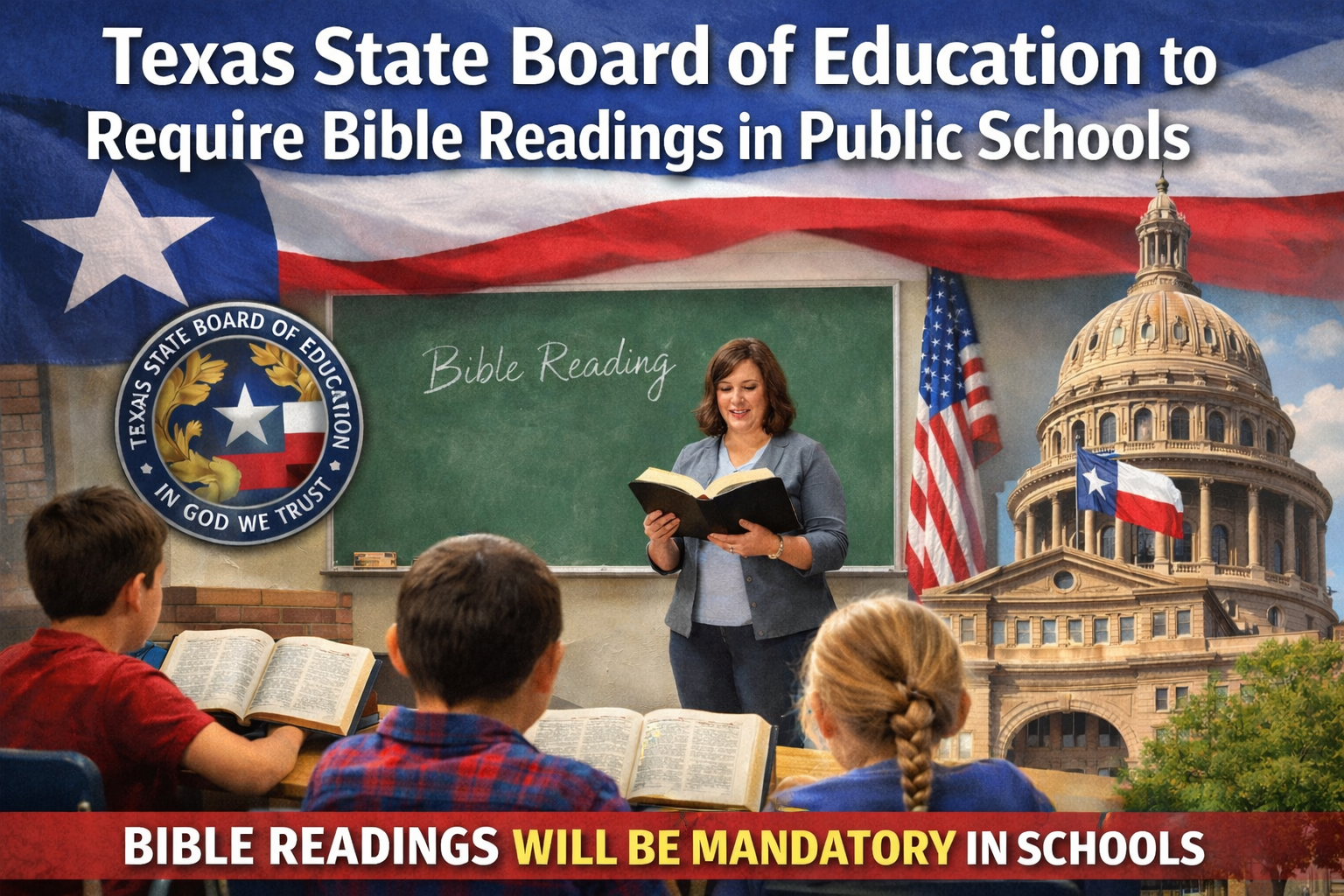
A significant shift is unfolding in public education in Texas—and potentially across the nation—one that carries implications far beyond classroom curriculum. On January 29, 2026, the Houston Chronicle reported that the Texas State Board of Education is moving toward a statewide requirement for Bible readings in public school instruction. Supporters argue the proposal would restore moral grounding through historical context, while critics warn it blurs the constitutional line between church and state. Either way, the development highlights the growing momentum to embed religious influence within government and state-run institutions.
On January 29, 2026, the Houston Chronicle published the following:
• “The GOP-led State Board of Education on Wednesday showed support for a plan that would make Texas the first state in the country to mandate all public school students read passages of the Bible.” [1]
• “This would bring the Word of God back into schools in a meaningful way for the first time in decades,’ Brandon Hall, a North Texas Republican, wrote on Facebook before the discussion began Wednesday. ‘We need prayer warriors to intercede for this vote.” [1]
• “The board is in charge of setting the state’s new required reading list for grades K-12.” [1]
• “If passed, the list would be the first instance in recent history of any state in the country mandating students read a religious text.” [1]
Yet the controversy does not center on whether the Bible has historical significance—it certainly does—but on who has the authority to decide which texts should be read, how the Bible is to be used, and by what power a government body selects and enforces specific biblical passages within official educational standards. Even if the intent is historical, the result is the elevation and furtherance of religion by public authority. In a pluralistic society, there will be families who do not share the religious tradition being advocated by the state, and there are others who believe faith should remain voluntary and personal. These kinds of policies raise concern about conscience and coercion.
This debate is not confined to Texas. Across the United States, similar initiatives have emerged, including proposals to display the Ten Commandments in classrooms, expand Bible reading courses, and reintroduce prayer into public education. History shows that policies that begin as popular and well-intentioned can set precedents that later pave the way for broader forms of religious regulation.
Ellen White and the early Seventh-day Adventists confronted many of the same challenges seen today. They responded to public campaigns to introduce religious instruction into public schools—debates that directly touched on issues of worship, conscience, and the union of church and state. At the same time, efforts to enact Sunday laws were also gaining momentum.
“In our own country there is much to be done. There are many cities to be entered and warned. Evangelists should be finding their way into all the places where the minds of men are agitated over the question of Sunday legislation and the teaching of religion in the public schools. It is the neglect of Seventh-day Adventists to improve these providential opportunities that is hindering the advancement of the cause” (Testimonies, Vol. 9, p. 51).
Ellen White counseled that Adventists should not support such measures while recognizing that these controversies create moments when public attention is already focused on spiritual authority, God’s law, and religious liberty. She urged believers to enter the cities to preach and warn, presenting the biblical Sabbath, the commandments of God, and the gospel with clarity while public interest is awakened. She viewed these debates and developments as providential opportunities to proclaim present truth.
These events at the state level have broader implications and warrant special attention. For those who value both Scripture and freedom of conscience, this moment demands careful consideration. Historically, the Bible has never depended on government endorsement to endure or spread; religious faith has proven strongest when embraced voluntarily rather than imposed by law. In this sense, Texas is not only debating educational policies, but it is also helping to shape the future union of church and state and setting a precedent in which worship is imposed by law (Revelation 13).
Sources
 0
0 0
0 0
0
Leave a Reply