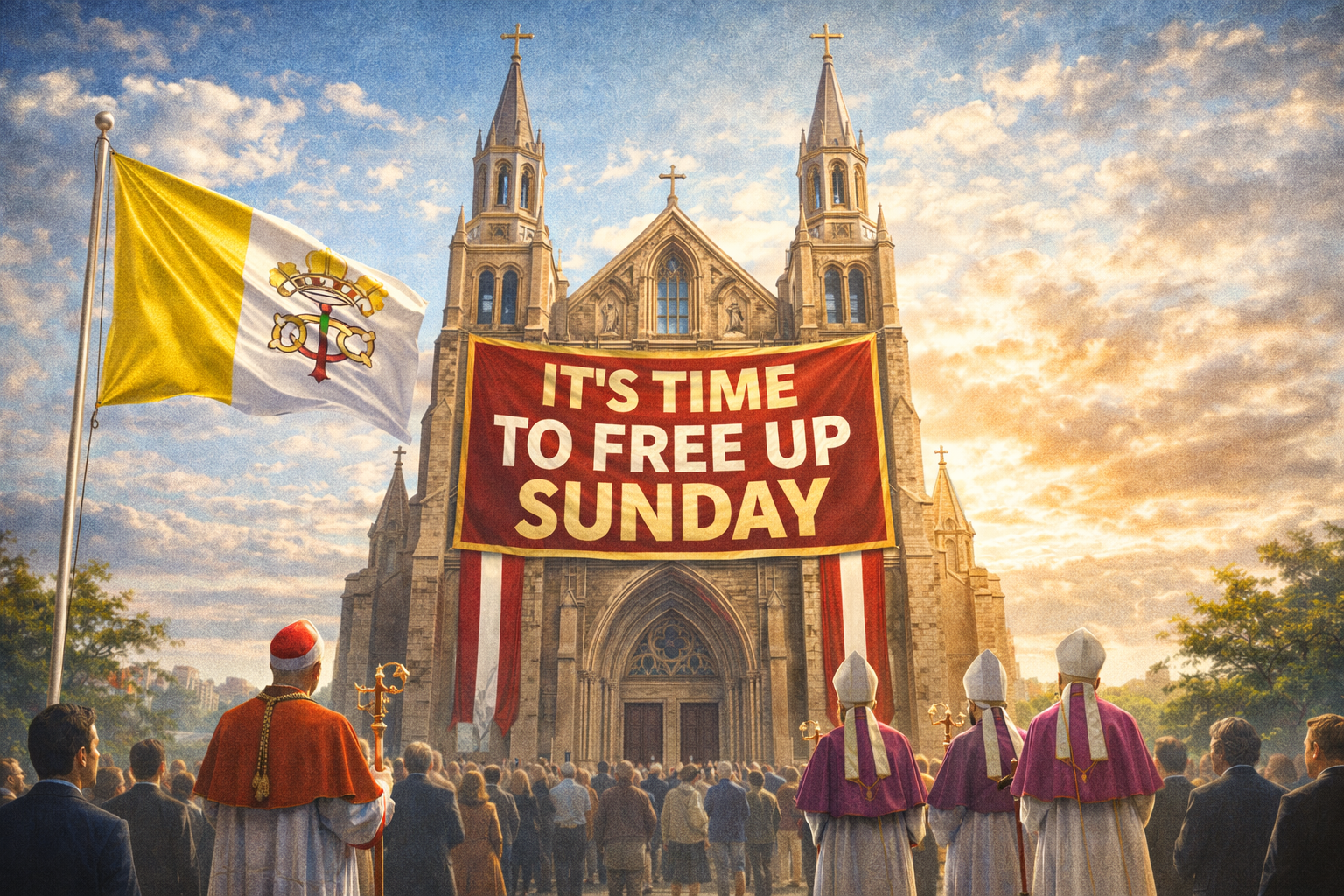
The Italian Episcopal Conference (CEI) is the permanent governing body of the Catholic Church in Italy, composed of the country’s Catholic bishops. It is responsible for promoting and coordinating the Church’s mission and pastoral life at the national level. Based in Rome, its president and general secretary are appointed by the Pope. The CEI also owns the newspaper Avvenire, which serves as a principal national voice of the Church, communicating the Catholic Church’s positions on a wide range of social, moral, and public issues.
On January 26, 2026, Avvenire published a very concerning article written by Elisabeth Cara, a professor at the Catholic University of the Sacred Heart in Milan. The article, titled “Not Just Rest: Sunday Is a Social Resource and It’s Time to Free It Up,” presents Sunday not only as a necessary religious imperative but also as a matter of social justice that should be protected by public authorities. In her argument, the erosion of Sunday rest—and the expectation that people must work on that day—is portrayed as contributing to gender inequality and social discrimination. Rome, through its official national publication, is advancing a narrative that will help secure the necessary legislation needed to end the so-called injustice of forcing people to work on Sunday.
Pay close attention to how Roman Catholics in Italy are shaping the arguments today—arguments that are being used by Protestants in America and other Christians elsewhere. What is now being presented as a matter of social justice, saving the family, and protecting human dignity is becoming the foundation for the movement to institutionalize Sunday rest across society.
Avvenire published the following:
• “The loss of Sunday creates new temporal inequalities and makes gender inequalities visible, challenging society to consider how to protect and make shared time more equitable.” [1]
• “For a long time, Sunday was the only truly ‘different’ day from the work and school week. Then, gradually, this protected time was joined by a non-working Saturday for many sectors, and subsequently even schools reduced attendance to five days.” [1]
• “Saturday remained largely a ‘hybrid’ day, marked by the opening of shops, while Sunday retained its character as a collectively suspended time.” [1]
• “Today, the extension of Sunday opening hours, the flexibilization of working hours, and the society of seven-day-a-week services tend to erase even this distinction. The risk is that the ‘special’ days are no longer two, but none.” [1]
• “And it is precisely in this transition that Sunday gradually loses its value as a shared temporal space. Sunday is not simply a day of rest, which can be replaced by any other day of the week, or a cultural custom, but represents one of the few moments in which individual time can synchronize and the family can exist as a concrete unit of relationships, and not just as the sum of personal agendas. In this sense, Sunday represents a public relational good: a social resource that supports parenthood, solidarity between generations, and family and community cohesion.” [1]
• “Research shows that time spent together on weekends, and especially on Sundays, is qualitatively different from that on weekdays.” [1]
• “It’s not just about having more time, but a different kind of time, more continuous and symbolically charged, in which family memories and a sense of belonging are built.” [1]
• “This means that working on Sundays doesn’t just mean losing a day of rest, but also losing access to shared time. This gives rise to a new form of temporal inequality: not everyone has the same opportunity to share time with their family.” [1]
• “This disrupts the synchronization of family time, reduces opportunities for shared life, and transforms Sunday from shared time to residual time.” [1]
• “Surveys on time use clearly show that for many women, Sunday also remains a day of work: cooking, caring, organizing family life, managing parental relationships. Shared time, therefore, is not neutral. Its relational potential is distributed asymmetrically and can continue to reproduce gender inequalities, highlighting how invisible family work remains structurally unbalanced.” [1]
• “Sunday can be a space of unity, but it can also become a space where unequal workloads and responsibilities are concentrated. Therefore, reflection on Sunday is neither nostalgic nor confessional. It is not about longing for an idealized past, but about recognizing that shared time is a fragile and precious social resource, which must be protected and made more equitable.” [1]
• “Defending Sunday, then, means defending not only the possibility of being together, but the possibility of a less unequal, less fragmented, and richer family life of meaningful relationships.” [1]
In Italy, Catholic leaders speaking through outlets like Avvenire are laying the groundwork for policies that would set aside Sunday as the common day of rest for all people. In the United States, organizations such as The Heritage Foundation and other Christian nationalist movements similarly argue that America’s moral decline, family disintegration, and social division also require a restoration of shared Christian standards in public life—often including the recovery of Sunday as a protected day for worship and renewal. What is unfolding in America parallels the European Catholic strategy: to construct a comprehensive set of moral arguments and justifications leading to legislation that mandates Sunday as a day of rest for family, leisure, worship, and health.
The Catholic and Protestant visions for the future are strikingly similar. Both appeal to the “common good” as justification for closing businesses and giving people Sundays off. However, the entire movement to elevate Sunday as society’s sacred day of rest is fundamentally flawed and misguided because, according to Scripture, God has already established His appointed day of rest—the seventh-day Sabbath—Saturday. In Genesis 2:2–3, God blessed and sanctified the seventh day at Creation, setting it apart before sin entered the world and long before the rise of any political power or religious institution. The Fourth Commandment (Exodus 20:8–11) explicitly identifies the seventh day—not the first—as the Sabbath of the Lord. In this view, true rest and peace are not produced by civil law or tradition, but by obedience to God’s revealed will.
Those who defend Sunday observance have no choice but to appeal to church tradition and so-called perceived social benefits, because Scripture contains no command calling us to sanctify the first day of the week as holy. That is why the work of securing Sunday as the remedy for society’s moral dilemmas and social crises has become a spiritual snare. It diverts attention from what God has actually called us to do—to keep all of God’s commandments. The rest God promises His people is both physical and spiritual and must be rooted in obedience and loyalty (Hebrews 4:9–10). That rest comes only after we align with God’s law—including keeping holy the seventh day He sanctified.
“Great peace have they which love thy law: and nothing shall offend them.” Psalm 119:165.
Sources
 0
0 0
0 0
0
Amen
Thanks for your updates.
What will they think of next? It’s as though Sunday laws are being presented as the solution to discrimination—yet in reality, they would end up discriminating against seventh-day Sabbath keepers.
It’s the same Heritage Foundation’s plan.