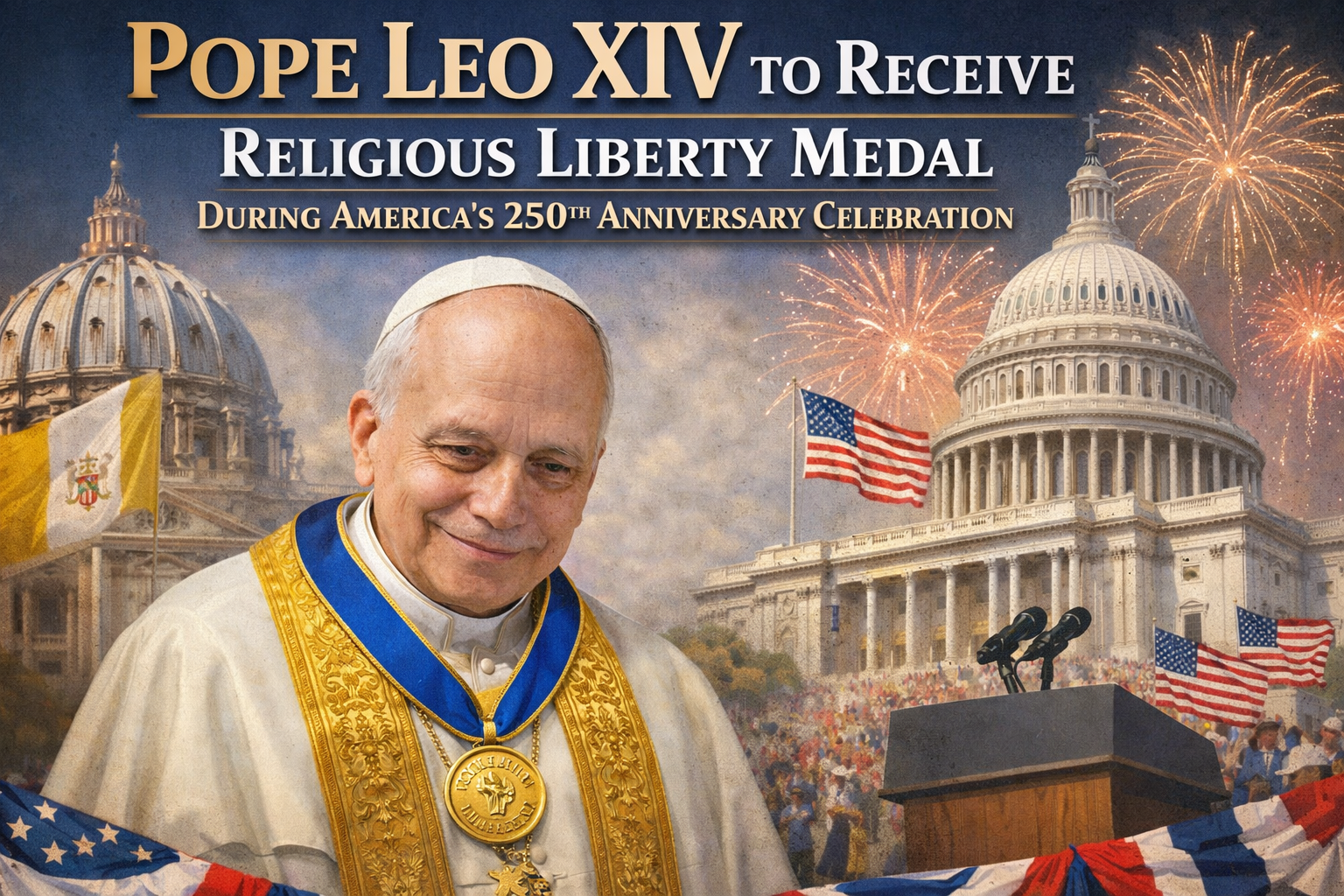
A nation founded as a refuge from religious persecution now publicly honors a system historically associated with persecution—and does so in the name of religious freedom. What was once a safeguard against centralized religious authority is now being used to celebrate it. This striking contradiction reveals how the very principle of liberty is being redefined to accommodate the power it was meant to resist.
On March 16, 2026, Catholic Review, a Catholic news outlet based in Baltimore, Maryland, reported that Pope Leo XIV will be honored with a religious liberty medal during the 250th anniversary of the founding of the United States. This presents a striking historical contradiction. The United States was largely founded by Protestants fleeing religious persecution—much of it inflicted by the Roman Catholic Church in Europe. Furthermore, the U.S. Constitution establishes a clear separation between church and state, explicitly forbidding the government from endorsing or elevating any religious authority. Honoring a sitting Pope who is both a global religious leader and the head of the Vatican state—during a national celebration—undermines the very principles the nation is meant to commemorate.
The Catholic Review published the following statement regarding the pope’s Religious Liberty Medal:
• “As the U.S. marks its 250th anniversary, Pope Leo XIV will be honored in the nation’s former capital of Philadelphia for his efforts to promote religious liberty as well as freedom of expression and conscience.” [1]
• “The National Constitution Center will bestow its Liberty Medal on Pope Leo July 3 during a public ceremony outside its location at Independence Mall in Philadelphia, part of Independence National Historical Park, home to several sites of historical significance in the nation’s founding.” [1]
• “The pope is set to deliver live acceptance remarks from the Vatican, which will be livestreamed to in-person attendees and online at the center’s website.” [1]
• “In its release, the center also noted that since his May 2025 election, the pope ‘has made interfaith and ecumenical dialogue a defining priority of his pontificate, engaging leaders from Jewish, Muslim, Christian, and other religious communities to promote mutual respect and peaceful coexistence‘.” [1]
• “A statement in the center’s press release attributed to the Holy See Press Office said Pope Leo was ‘deeply grateful’ for the award during ‘such a meaningful anniversary for the American people, as they are called to reflect on the 250 years of their history holding the Constitution of the United States and Liberty as hallmarks of their heritage for future generations‘.” [1]
Pope Leo is being honored with a medal for his work in ecumenism and his efforts to unite the religious and political worlds into one global family. Yet this recognition is now being linked with the American experiment—a nation historically built on the governing principle of “We the People,” not on centralized religious authority vested in a single individual. Placing the Vatican and the United States side by side in a national celebration highlights two fundamentally opposing foundations of authority.
What will actually be honored during our 250th anniversary will be the fulfillment of Revelation 13, where a lamblike beast gradually begins to speak like a dragon—moving from principles of liberty to the use of coercion in matters of worship. The growing public honor and acceptance of papal authority within American life will most certainly lead to the disappearance of both civil and religious liberty, preparing the ground for future religious legislation that aligns with the interests of the papacy.
“Protestants have tampered with and patronized popery; they have made compromises and concessions which papists themselves are surprised to see, and fail to understand. Men are closing their eyes to the real character of Romanism, and the dangers to be apprehended from her supremacy. The people need to be aroused to resist the advances of this most dangerous foe to civil and religious liberty” (Great Controversy, p. 566).
Sources
 0
0 0
0 0
0
The irony of this reward is baffling and hilarious-sad 😭 Keep your eyes on Christ Almighty!
“The Papal Church will never renounce its claims to infallibility. It continues to consider as correct all the persecutions that took place in the past against those who disagreed with its dogmas, and, if such an opportunity arises, will it not repeat the same actions? If only the secular governments remove the restrictions imposed and return Rome to its former power, the former persecutions and tyranny will immediately resume.”
“The Great Controversy”
Chapter 35.
We must not forget what God’s messenger warns us about
👇
“The policy of the papacy is very flexible, it strives to give itself the appearance that will best contribute to the implementation of its goals, but under every color of the chameleon is hidden the constant deadlyness of the serpent’s venom.”
(The Great Controversy. Chapter 35).
This honour is a mockery to the pigrim fathers who fled persecution from the papal power tyranny in Europe. This is because Roman catholic church itself it’s a church -state union which ruled in supremacy in Europe during the dark ages period from (A.D 538-1798). Rome does not like the religious liberty because it always wants to control people’s consciouness in the way they worship which is in contrast to the U.S constitution which guarantees the freedom of religious liberty in the bill of rights. Let’s read the first amendment: congress shall make no law respecting an establishment of religion or prohibiting free exercise thereof; or abridging the freedom of speech or of the press or the right of people peaceably to assemble and to petition the government for redress or grievance. From the History of the rise of and
spirit of Rationalism in Europe volume 2 we read the following words.” The church of Rome has shed more blood than any other institution that has ever existed in the history of mankind. This is very sad day for religious liberty.
Things are heating up. I am excited to see that our prophetic understanding and position is being vindicated by the moment. Let’s do our part.
As we near the close of time, there will be greater and still greater external parade of heathen power; heathen deities will manifest their signal power, and will exhibit themselves before the cities of the world; and this delineation has already begun to be fulfilled. By a variety of images the Lord Jesus represented to John the wicked character and seductive influence of those who have been distinguished for their persecution of God’s people. All need wisdom carefully to search out the mystery of iniquity that figures so largely in the winding up of this earth’s history…. In the very time in which we live, the Lord has called His people and has given them a message to bear. He has called them to expose the wickedness of the man of sin who has made the Sunday law a distinctive power, who has thought to change times and laws, and to oppress the people of God who stand firmly to honor Him by keeping the only true Sabbath, the Sabbath of creation, as holy unto the Lord. TM 117.5.
Share the Truth, God’s Sabbath Truth.
https://godsabbathtruth.org/