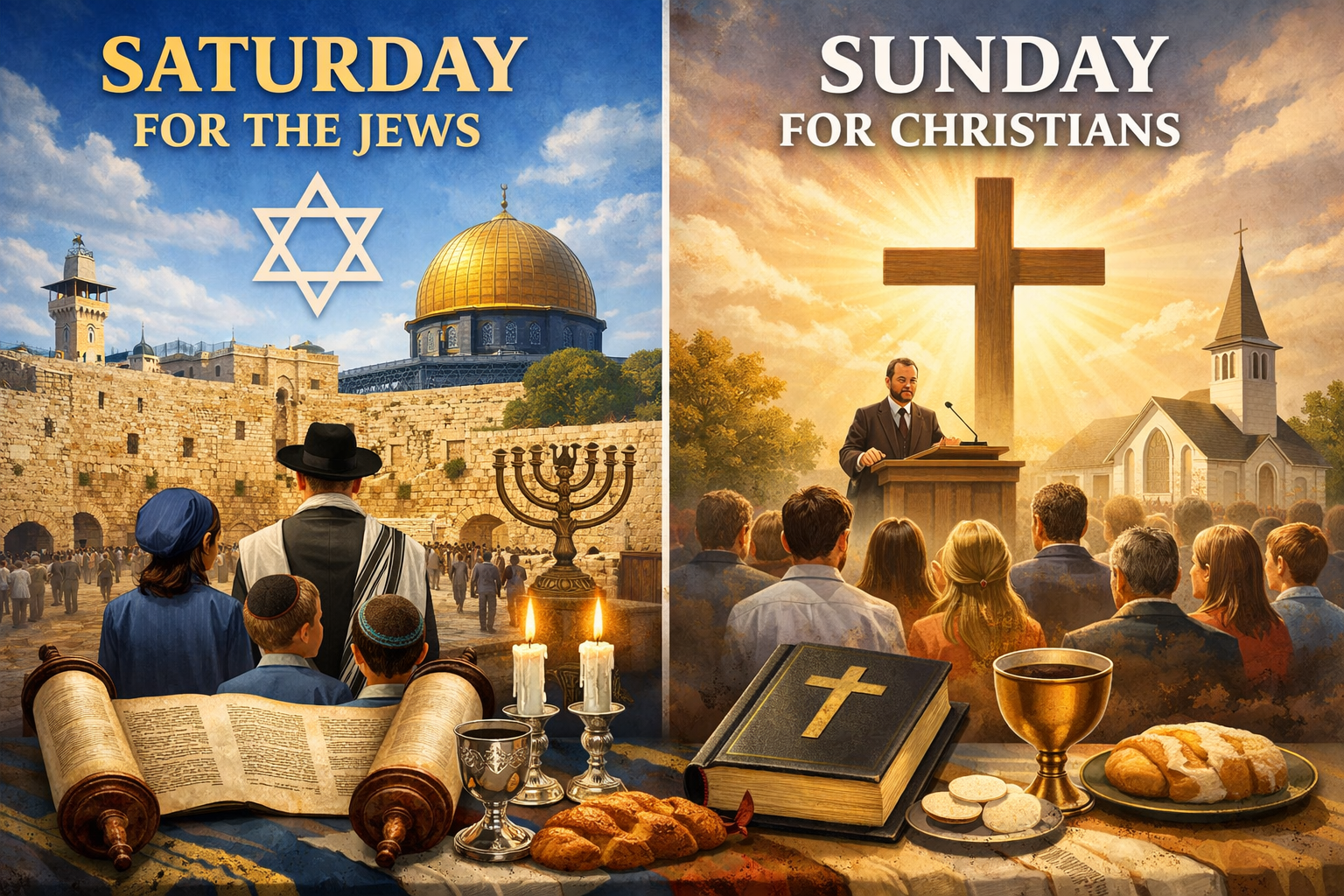
On March 20, 2026, MSN News published an article claiming that keeping Saturday as the Sabbath was intended only for Israel and not for the Christian church. It further falsely stated that neither Jesus nor Paul ever spoke about the Sabbath, using this claim to reject the seventh-day Sabbath altogether. Once again, this type of reporting by the mainstream media aligns perfectly with longstanding Roman Catholic teachings on rest and worship and contributes to the growing movement to promote Sunday within society.
MSN News published the following:
• “The Bible says that the Sabbath, the fourth commandment, was a sign given to the nation of Israel. Christians do not keep the biblical Saturday Sabbath, because Christianity is not Israel, and because the Lord Jesus Christ is our rest. We try our best to keep the moral commandments of the law, which Jesus summarized as “love thy neighbor as thyself.” When listing commandments to follow, as recorded in the New Testament, neither Jesus nor Paul mentioned the Sabbath—just the moral commands.” [1]
First, the argument that the Sabbath belongs only to Israel ignores its origin at Creation. The Sabbath was not introduced at Sinai; it was established in Eden when God rested on the seventh day: “And on the seventh day God ended his work which he had made; and he rested on the seventh day from all his work which he had made. And God blessed the seventh day, and sanctified it: because that in it he had rested from all his work which God created and made.” Genesis 2:2-3.
This took place long before the existence of the Jewish nation, indicating that the Sabbath was designed for all of God’s children. Jesus affirmed the universal application of the Sabbath when He declared, “The sabbath was made for man” (Mark 2:27). The language includes all nations and people, not only Jews. Therefore, to dismiss the Sabbath on the basis that Christians are not Israel is to overlook the clear teachings of the Bible.
Second, while it is true that Jesus offers spiritual rest to the weary (Matthew 11:28), Scripture never presents this rest as a replacement for obedience to God’s commandments. Instead, Christ’s rest addresses the burden of sin, not the removal of the moral law. The idea that spiritual rest eliminates the need for obedience is not biblical. Christ is our righteousness, but it does not eliminate the need for righteous living. Christ being the truth does not eliminate truth. And Christ being our rest does not abolish the Sabbath commandment.
Hebrews 4:9 explicitly states, “There remaineth therefore a rest to the people of God.” The Greek New Testament word for “rest” in the verse is “sabbatismos,” implying Sabbath-keeping. The verse literally says that there remains a “Sabbath-keeping” for the people of God. This indicates that the Sabbath continues to hold relevance even after the cross.
Third, the claim that Christians must only follow parts of the moral law ignores that the Sabbath is part of it. The Ten Commandments, written by the finger of God on stone, represent an unchanging moral standard. The fourth commandment—“Remember the sabbath day, to keep it holy” (Exodus 20:8)—stands in the middle of this law, not apart from it. There is no biblical basis for removing one commandment while retaining the other nine. To do so undermines the integrity of the entire law, as James 2:10 warns that breaking one point makes one guilty of all.
Fourth, the claim that neither Jesus nor Paul emphasized the Sabbath is not true. It’s a lie. Jesus Himself kept the Sabbath regularly, as seen in Luke 4:16, where it was His custom to attend synagogue on that day. Moreover, in Matthew 24:20, Christ instructed His followers to pray that their flight from Jerusalem would not occur on the Sabbath—an event that would take place decades after His crucifixion. This demonstrates that He anticipated the continued observance of the Sabbath among His followers.
Likewise, the apostle Paul consistently worshiped and preached on the Sabbath. In Acts 13, Gentiles specifically requested that Paul preach to them “the next sabbath,” and the following week nearly the entire city gathered. Acts 17:2 and Acts 18:4 further show that Paul reasoned in the synagogues every Sabbath, engaging both Jews and Gentiles. This pattern reflects not a temporary accommodation, but an established practice in the early Christian church.
Fifth, while love is indeed the fulfillment of the law (Romans 13:10), it does not replace the law. Paul himself illustrates this by listing commandments such as “Thou shalt not steal” and “Thou shalt not kill” immediately after affirming love as the fulfilling of the law. In the same way, the Sabbath commandment expresses love toward God by setting aside sacred time for Him and love toward others by ensuring rest for all. To remove the Sabbath on the basis of love is to misunderstand love’s relationship to obedience.
The Sabbath serves as a sign of God’s authority as Creator and a symbol of loyalty to Him (Ezekiel 20:12; Exodus 20:11). In the final message of Revelation, God’s people are described as those who “keep the commandments of God, and the faith of Jesus” (Revelation 14:12). The Sabbath, therefore, is not a side issue but a central expression of obedience and worship.
The claim that Christians are not required to keep the biblical seventh-day Sabbath, Saturday, does not come from the Holy Scriptures. The Sabbath was established at Creation, upheld by Christ, practiced by the apostles, and embedded within God’s moral law. Far from being abolished, it remains a lasting sign of God’s authority and a call to faithful obedience.
Sources
[1] https://www.msn.com/en-us/news/us/what-religion-do-the-ten-commandments-establish/ar-AA1Z34UD
 0
0 0
0 0
0
Amen.
“What religion do the Ten Commandments establish?”
Very simple, thr religion of God the Creator, Redeemer, and Restorer.
Just as was stated in this article, the 7th Day Sabbath instituted at the end of creation is God’s Memorial, His sign, and His seal.
So therefore it is of no coincidence that God put the 7th Day Sabbath right in the middle of the 10 Commandments God’s Holy and Moral Law.
This gives no one any right to claim, change, or alter His Law.
Why? Because God already claim it; His sign and seal is in the midst of it.
It also gives God every right to set the standard or parameters of what true relgion is. After all He is Created us and this planet and the universe.
Anyone who establishes a religion, who claim Christ but keep a different day as holy when it is not are usurpers and are seeking God’s crown, His title, His authority, and His position.
This is why God tells us not to have other gods before Him. This is IDOLATRY! And not to make any graven images or any likeness of anything that is in heaven above, or that is in the earth beneath…
God warns us all from attempting to usurp His authority, or worshipping false gods.
Sun-day worship comes from pagan sun worship “dies solis”.
“The Bible says that the Sabbath, the fourth commandment, was a sign given to the nation of Israel. Christians do not keep the biblical Saturday Sabbath, because Christianity is not Israel, and because the Lord Jesus Christ is our rest. We try our best to keep the moral commandments of the law, which Jesus summarized as “love thy neighbor as thyself.” When listing commandments to follow, as recorded in the New Testament, neither Jesus nor Paul mentioned the Sabbath—just the moral commands.”
First of all we do no find any of this in God’s Holy Word.
Why would you leave out the first and great commandment?
To love the Lord thy God with all thy heart…. ”
(It is written:
“37 Jesus said unto him, Thou shalt love the Lord thy God with all thy heart, and with all thy soul, and with all thy mind.
38 This is the first and great commandment.
39 And the second is like unto it, Thou shalt love thy neighbour as thyself.
40 On these two commandments hang all the law and the prophets. ”
Matthew 22:37-40 KJV)
My queation, where is a thus sayest the Lord?
There are no Scriptures that says:
• a Sabbath for the Jews
• a Sabbath of the Jews
However, you can find over 20 times where God refer to the 7th Day Sabbath as, “my Sabbaths”. This clearly shows ownership – God’s authority.
You can also find in many places, “Lord of the Sabbath”. Christ Jesus said that He is Lord of the Sabbath:
“1 At that time Jesus went on the sabbath day through the corn; and his disciples were an hungred, and began to pluck the ears of corn, and to eat.
2 But when the Pharisees saw it, they said unto him, Behold, thy disciples do that which is not lawful to do upon the sabbath day.
3 But he said unto them, Have ye not read what David did, when he was an hungred, and they that were with him;
4 How he entered into the house of God, and did eat the shewbread, which was not lawful for him to eat, neither for them which were with him, but only for the priests?
5 Or have ye not read in the law, how that on the sabbath days the priests in the temple profane the sabbath, and are blameless?
6 But I say unto you, That in this place is one greater than the temple.
7 But if ye had known what this meaneth, I will have mercy, and not sacrifice, ye would not have condemned the guiltless. 8 For the Son of man is Lord even of the sabbath day. ”
Matthew 12:1-8 KJV
Even the Pharisees had perverted the religion of God by adding to God’s Commandments, their own commandments – the “commandments of men”.
Christ Jesus told them that He is Lord of the Sabbath, He set the standard and parameters of religion.
“8 This people draweth nigh unto me with their mouth, and honoureth me with their lips; but their heart is far from me.
9 But in vain they do worship me, teaching for doctrines the commandments of men. ”
Matthew 15:8-9 KJV
But those that claim Christ as their Lord, unlike the Pharisees of old they do not add, but take away from God’s Commandments, and most importantly the one Commandment that is a sign of God’s authority as Creator, Redeemer, and Restorer.
Adding or taking away is a sin and there are stalk warnings from God to those who do so: Deuteronomy 4:2, Revelation 22:18,19.
It is God’s plan to find and setup a peculiar people to Himself that keep all of His Commandments; He found them in Abraham. Abraham’s descendants multiplied and God called thrm Israel. Nevertheless, Christ had to come to reprove sin and false religions:
“11 For the grace of God that bringeth salvation hath appeared to all men,
12 Teaching us that, denying ungodliness and worldly lusts, we should live soberly, righteously, and godly, in this present world;
13 Looking for that blessed hope, and the glorious appearing of the great God and our Saviour Jesus Christ;
14 Who gave himself for us, that he might redeem us from all iniquity, and purify unto himself a peculiar people, zealous of good works. ” Titus 2:11-14 KJV
“18 And the LORD hath avouched thee this day to be his peculiar people, as he hath promised thee, and that thou shouldest keep all his commandments; 19 And to make thee high above all nations which he hath made, in praise, and in name, and in honour; and that thou mayest be an holy people unto the LORD thy God, as he hath spoken. ”
Deuteronomy 26:18-19 KJV