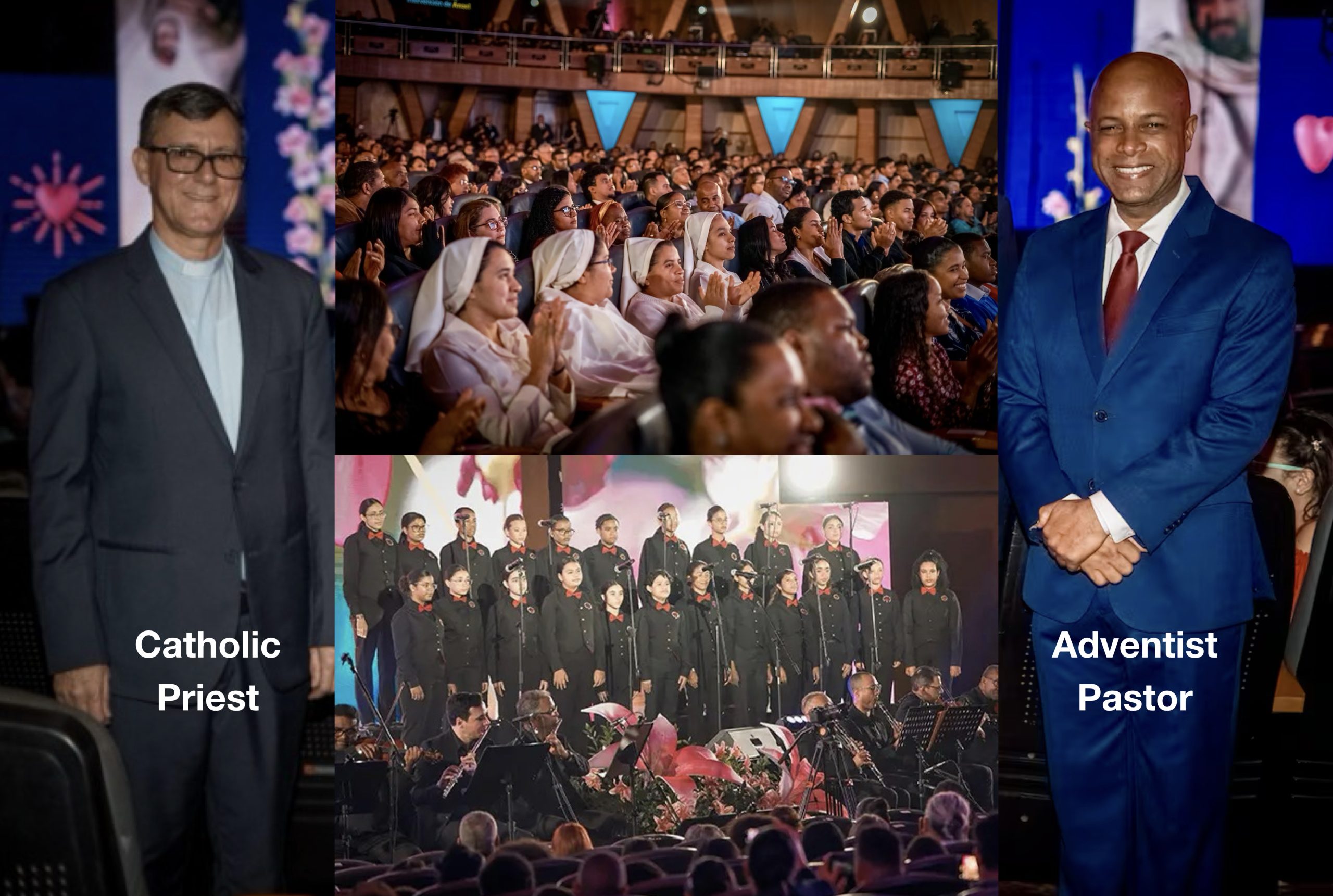
Seventh-day Adventists in the Dominican Republic joined more than 1,000 worshippers from various faith traditions—including Roman Catholics, Latter-day Saints, and members of the Church of God—for an interfaith Easter devotional and musical concert held on April 2, 2026. The event emphasized themes of unity, a shared common message, building bridges, love, and oneness. Through music, worship, and ecumenical messages, participants set aside doctrinal differences in favor of a collective celebration of Easter titled “In Him, We Are One.” [1]
El Caribe News published the following about the ecumenical Easter celebration:
• “More than a thousand people gathered in the Aula Magna of the Autonomous University of Santo Domingo to hear voices that not only sang but also shared a common message. Representatives from various Christian communities came together on the same stage to share, from their own traditions, a common testimony: Jesus Christ lives.” [2]
• “This gathering, organized by The Church of Jesus Christ of Latter-day Saints and titled the Interfaith Easter Musical Devotional ‘He Lives,’ became a space where music and faith served as a bridge between churches that, although diverse in doctrine, found a point of unity in the figure of Christ and the meaning of Easter.” [2]
The Latter Day Saints who sponsored the event described the same Easter interfaith event as follows:
• “We live in a world that often emphasizes differences, that divides and separates. But Jesus Christ invites us to something higher: to love one another, to understand one another, and to walk together. What we have experienced tonight demonstrates that when faith and goodwill come together, we can find harmony. In Him, we are one.” [3]
The clergy included:
• Roman Catholic Priest Jorge William Hernández Díaz. [3]
• Ysaura Chalas, coordinator of the Faith and Joy Catholic Foundation. [3]
• Miguel Ángel Tenorio and Hugo Montoya, from the Latter-day Saints. [3]
• Bishop Mauro Vargas, from the Church of God. [3]
• Pastor Robert Hernández, leader and representative of the Seventh-day Adventist Church. [3]
Finally, More Faith News described the same event in the following context:
• “The Catholic Church choir, the Seventh-day Adventist Church choir, the Dominican National Children’s Choir, and members of The Church of Jesus Christ of Latter-day Saints participated. Each performance offered a distinct perspective, but all conveyed the same message: that Jesus Christ is at the center of our faith, regardless of tradition. Therefore, more than a concert, it was a space where music helped to connect the attendees spiritually. Worship became a common language.” [4]
Let’s be clear—this is not some harmless cooperation; it is the blatant betrayal of our sacred trust and the erosion of our unique identity. When Seventh-day Adventists step onto a shared platform with the Roman Catholic Church and other religious bodies in an ecumenical Easter celebration, they are “building bridges” to Rome and burning their connection to the Three Angels’ Message that God Himself established. Our movement was raised up with a distinct prophetic mandate rooted in the Book of Revelation—to call people out of confusion, not to harmonize with it.
When doctrinal differences are intentionally set aside in favor of a “common message,” the very truths that define us—God’s law, the Sabbath, the sanctuary, and the Three Angels’ Messages—are cast aside by the wayside. Unity that requires silence on God’s truth is not biblical unity; it is a compromise. And compromise, when repeated often enough, turns into abandonment. This is how our brothers and sisters lose their way. The language used—“we are one,” “shared faith,” and “common message”—is ”the very ecumenical agenda long advanced by Rome.
When Adventist Church leaders participate in these forums, they reinforce the idea that differences do not matter—that all paths are spiritually equivalent, provided that Christ is named. But that is, precisely, the deception against which prophecy warns. A church called to proclaim the voice of God by giving the final message to the world now runs the risk of becoming, instead, the voice of the world. If we are not careful, the movement raised up to stand apart will end up gradually becoming absorbed into the current culture, and, in doing so, it will lose not only its message but also its very reason for existing.
“In a special sense Seventh-day Adventists have been set in the world as watchmen and light bearers. To them has been entrusted the last warning for a perishing world. On them is shining wonderful light from the word of God. They have been given a work of the most solemn import—the proclamation of the first, second, and third angels’ messages. There is no other work of so great importance. They are to allow nothing else to absorb their attention” (Testimonies, Vol. 9, p. 19).
Sources
[4] https://masfe.org/noticias/mil-asisten-concierto-interreligioso-iglesia-jesucristo/
 0
0 0
0 0
0
It is a backsliding church that lessens the distance between itself and the Papacy.
The church that holds to the word of God is irreconcilably separated from Rome. Protestants were once thus apart from this great church of apostasy, but they have approached more nearly to her, and are still in the path of reconciliation to the Church of Rome. Rome never changes. Her principles have not altered in the least. She has not lessened the breach between herself and Protestants; they have done all the advancing. But what does this argue for the Protestantism of this day? It is the rejection of Bible truth which makes men approach to infidelity. It is a backsliding church that lessens the distance between itself and the Papacy.
It is souls like Luther, Cranmer, Ridley, Hooper, and the thousands of noble men who were martyrs for the truth’s sake, who are the true Protestants. They stood as faithful sentinels of truth, declaring that Protestantism is incapable of union with Romanism, but must be as far separated from the principles of the Papacy as is the east from the west. Such advocates of truth could no more harmonize with “the man of sin” than could Christ and his apostles. In earlier ages the righteous felt that it was impossible to affiliate with Rome, and, though their antagonism to this system of error was maintained at risk of property and life, yet they had courage to maintain their separation, and manfully struggled for the truth. Bible truth was dearer to them than wealth, honor, or even life itself. They could not endure to see the truth buried under a mass of superstition and lying sophistry. They took the word of God in their hands, and raised the standard of truth before the people, boldly declaring that which God had revealed unto them through diligent searching of the Bible. They died the cruelest of deaths for their fidelity to God, but by their blood they purchased for us liberties and privileges that many who claim to be Protestants are easily yielding up to the power of evil. But shall we yield up these dearly bought privileges? Shall we offer insult to the God of heaven, and, after he has freed us from the Romish yoke, again place ourselves in bondage to this antichristian power? Shall we prove our degeneracy by signing away our religious liberty, our right to worship God according to the dictates of our own conscience?
ST February 19, 1894
It is a backsliding church that lessens the distance between itself and the Papacy.
The church that holds to the word of God is irreconcilably separated from Rome. Protestants were once thus apart from this great church of apostasy, but they have approached more nearly to her, and are still in the path of reconciliation to the Church of Rome. Rome never changes. Her principles have not altered in the least. She has not lessened the breach between herself and Protestants; they have done all the advancing. But what does this argue for the Protestantism of this day? It is the rejection of Bible truth which makes men approach to infidelity. It is a backsliding church that lessens the distance between itself and the Papacy.
It is souls like Luther, Cranmer, Ridley, Hooper, and the thousands of noble men who were martyrs for the truth’s sake, who are the true Protestants. They stood as faithful sentinels of truth, declaring that Protestantism is incapable of union with Romanism, but must be as far separated from the principles of the Papacy as is the east from the west. Such advocates of truth could no more harmonize with “the man of sin” than could Christ and his apostles. In earlier ages the righteous felt that it was impossible to affiliate with Rome, and, though their antagonism to this system of error was maintained at risk of property and life, yet they had courage to maintain their separation, and manfully struggled for the truth. Bible truth was dearer to them than wealth, honor, or even life itself. They could not endure to see the truth buried under a mass of superstition and lying sophistry. They took the word of God in their hands, and raised the standard of truth before the people, boldly declaring that which God had revealed unto them through diligent searching of the Bible. They died the cruelest of deaths for their fidelity to God, but by their blood they purchased for us liberties and privileges that many who claim to be Protestants are easily yielding up to the power of evil. But shall we yield up these dearly bought privileges? Shall we offer insult to the God of heaven, and, after he has freed us from the Romish yoke, again place ourselves in bondage to this antichristian power? Shall we prove our degeneracy by signing away our religious liberty, our right to worship God according to the dictates of our own conscience?
ST February 19, 1894
It required a desperate struggle for those who would be faithful to stand firm against the deceptions and abominations which were disguised in sacerdotal garments and introduced into the church. The Bible was not accepted as the standard of faith. The doctrine of religious freedom was termed heresy, and its upholders were hated and proscribed. GC 45.2
After a long and severe conflict, the faithful few decided to dissolve all union with the apostate church if she still refused to free herself from falsehood and idolatry. They saw that separation was an absolute necessity if they would obey the word of God. They dared not tolerate errors fatal to their own souls, and set an example which would imperil the faith of their children and children’s children. To secure peace and unity they were ready to make any concession consistent with fidelity to God; but they felt that even peace would be too dearly purchased at the sacrifice of principle. If unity could be secured only by the compromise of truth and righteousness, then let there be difference, and even war. GC 45.3
If unity could be secured only by the compromise of truth and righteousness, then let there be difference, and even war.
I see why some people can never win souls, as they only criticize the ones who are doing something.
If the church loses its identity because it decides to join other faiths in lifting up Jesus, then the church never had an identity to start with.
I wonder how any of us would reach people of other faiths if all we do is tear them down and never interact with them.
And let it be remembered, it is the boast of Rome that she never changes. GC88 580.3
In this day, God has called His church, as He called ancient Israel, to stand as a light in the earth. By the mighty cleaver of truth,—the messages of the first, second, and third angels,—He has separated a people from the churches and from the world, to bring them into a sacred nearness to Himself. He has made them the depositories of His law, and has committed to them the great truths of prophecy for this time. Like the holy oracles committed to ancient Israel, these are a sacred trust to be communicated to the world. ST January 25, 1910, par. 11
But the Lord is dishonored and his cause reproached by his people being in bondage to the world. They are in friendship with the world, the enemies of God. Their only hope of salvation is to separate from the world, and zealously maintain their holy, peculiar character. 9LtMs, Ms 104, 1894, par. 13
Here is the what happened to Jesus
1Now the tax collectors and sinners were all gathering around to hear Jesus. 2 But the Pharisees and the teachers of the law muttered, “This man welcomes sinners and eats with them.”
Luke 15:1-2
Guess Jesus has a different view as to who to interact with.
Friendship with the world is enmity with God