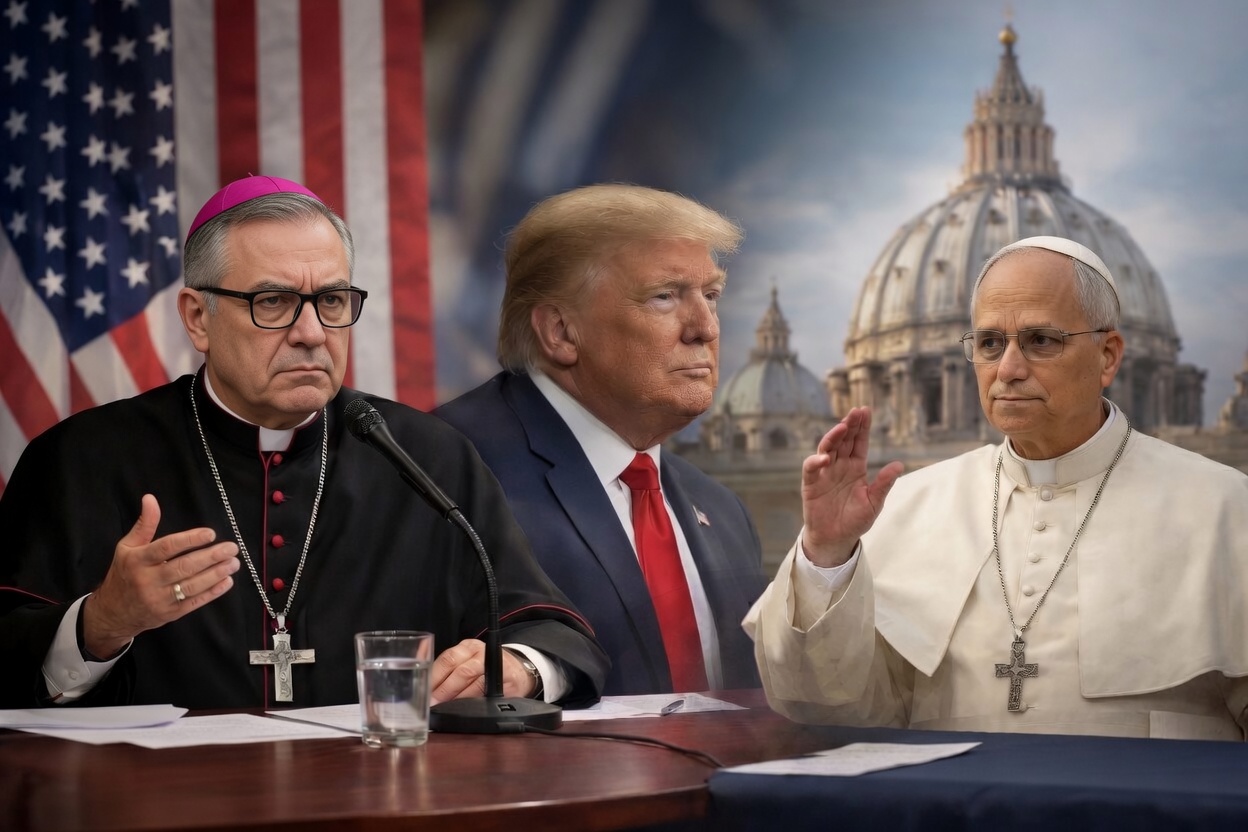
The clash between Pope Leo XIV and President Donald Trump over the military actions in Iran and tensions tied to Venezuela has put the world on a collision course between moral authority and state power. While the Pope condemns the conflicts, Donald Trump defends them as necessary. Beneath it all lies a struggle over who defines right and wrong in war—the voice of the church or the authority of the state? These conflicts have turned into a historic global showdown between spiritual and political power.
Bishop Robert Barron serves as a member of Trump’s Religious Liberty Commission, meaning he is directly involved in advising the federal government on issues related to religious freedom, public policy, and the role of faith in American life. On April 20, 2026, Bishop Barron issued a statement addressing the tensions between Pope Leo XIV and Donald Trump, appealing to the Catechism of the Catholic Church as a guide for defining the proper relationship between the papacy and the presidency moving forward.
Bishop Robert Barron made the following statement:
• “There is a way past the absurd and deeply divisive ‘war’ between the President and the Pope, which has been enthusiastically ginned up by the press. And it is indicated in the Catechism of the Catholic Church, paragraph 2309 to be precise. After laying out the various criteria for determining a just war—proportionality, last resort, declaration by a competent authority, reasonable hope of success, etc.—the Catechism points out that ‘the evaluation of these conditions for moral legitimacy belongs to the prudential judgment of those who have responsibility for the common good’.” [1]
• “The assumption is that the just war principles function, to use the technical term, as heuristic devices, designed to guide the practical decision-making of those civil authorities who have to adjudicate matters of war and peace. The role of the Church, therefore, is to call for peace and to urge that any conflict be strictly circumscribed by the moral constraints of the just war criteria. But it is not the role of the Church to evaluate whether a particular war is just or unjust. That appraisal belongs to the civil authorities, who, one presumes, have requisite knowledge of conditions on the ground.” [1]
• “The posing of those questions—indeed the insistence upon their moral relevance—belongs rightly to the Church, but the answering of them belongs to the civil authorities.” [1]
• “The Pope has said, on numerous occasions, that he is not a politician and that his role is not the determination of any nation’s foreign policy. But he has just as clearly said that he will continue to speak for peace and for moral constraint. In making both of these claims, he is operating perfectly within the framework of paragraph 2309 of the Catechism. If we understand that the Pope and the President have qualitatively different roles to play in the determination of moral action in regard to war, we can, I hope, extricate ourselves from the completely unhelpful narrative of Pope vs. President.” [1]
If you strip away the extensive wording, Robert Barron is essentially arguing that while the Church does not make the final decision to go to war, it does establish the moral rules that must guide those decisions. By appealing to the Catechism of the Catholic Church, he is asserting that the Church—through Pope Leo XIV—establishes what is morally acceptable, while political leaders, including the U.S. president, are responsible for applying those moral principles in practice.
So while Robert Barron claims the Pope isn’t telling Donald Trump what to do, he still places Pope Leo XIV as the moral authority above the President in determining the legitimacy and boundaries of military action. In other words, Rome defines the moral limits of war, and the sitting U.S. president is expected to operate within those boundaries.
Here we have a Roman Catholic bishop who sits on an influential panel involved in shaping national policy, appealing to the Catholic Catechism as a guide for the U.S. president. The model being proposed is that Pope Leo XIV defines the moral order of what is right and wrong in a given war or conflict, and the president, operating within those parameters, is expected to act accordingly.
No. In the United States, the guiding authority for shaping the decisions of national leaders is the Constitution—not any religious document such as the Catholic Catechism. Ecclesiastical doctrine must never serve as the governing standard for public policy. When this happens, the Pope indirectly guides the actions of the president. Even without issuing direct orders, the Pope’s role becomes that of moral authority, telling our leaders what they must do.
When religious influence, such as the Catholic Catechism, begins to shape our foreign and domestic policies, it reflects a growing union between Church and State that raises serious concerns regarding constitutional matters and religious freedom. This type of alignment is seen as laying the groundwork for what is described as the “image of the beast,” where civil power ultimately enforces religious authority.
“And he had power to give life unto the image of the beast, that the image of the beast should both speak, and cause that as many as would not worship the image of the beast should be killed.” Revelation 13:15.
Sources
[1] https://x.com/bishopbarron/status/2046261775532732636?s=61&t=ZNH09CzGb1I4ug-XFFjPyg
 0
0 0
0 0
0
What is the ‘Stone’ in Daniel 2: 34, 35? Where does it hit the Image? And what comes with the ‘Stone’ in Verse 44? What does the ‘kingdom’ do to the image? Religion as a whole, will not tell their congregations that incorporation under the STATE by their religion creates the ‘Image’ for it’s self. This violates the first 2 commandments of the Creator of the Universe. 99% of all CHURCHES are incorporated under their government, and it appears that this is for all religions. This condition gives the government a right to enforce any religious dogma upon the People. Hence, “Come out of her my people, and partake not of her sins, that ye receive not of her plagues” Revelation 18: 4 KJV Bible. CHURCH and STATE united is the ‘Iron and Clay’.
The words from Bishop Robert Barron shows clearly who is calling the shots in the Washington D.C. Many people think that it’s the U.S president is the one who is calling the shots but they are deceiving themselves? ” They are dead wrong?” We read the following words from the inspiration writings (spirit of prophecy). Roman Catholic principles will be taken under care and protection by the state. This national apostacy will speedily followed by national ruin. -(Review and Herald) June 15, 1897. So according to the Catholic catechism paragraph# 2309, the U.S president is required not to go beyond the limits in war as prescribed by the Papacy. The Roman Catholic principles clearly supersede the constitution of the United States just as the spirit of prophecy predicted. Also there is another excerpt to prove who calls the shots in Washington D.C- Priest D.S Phelan , Western Watchman, June 27,1912, – The Pope is the ruler of the world. All the emperors, all the Kings, all the princes, all the Presidents of the world are as these altar boys of mine. So, as we know it’s the duty of altar boy to listen to his superiors in this case the priest on what to do and what not to do?
In the recent past , we have heard the spat between Pope Leo XIV, and President Donald Trump over the Iran war in the middle east. But the world believes this falsehood, this is what we call ” Hegelian dialectic” where two people are engaged in a concert blaming each other for cause of the problem (thesis) and then look for a solution (anti-thesis) . create a problem ,then criticize but in reality you are opposed to the one common cause you are upto, this is what the two individuals are pretending. Pope Leo XIV, Pretends that he is a ”man of peace” but if you do a thorough research the Papacy has committed evil and untold atrocities especially to the faithful christians who are opposed to their dogma. From the book of History of rationalization of Europe volume II, It says, … The Church of Rome has shed more blood than any other institution that has ever existed in the history of the mankind. Including the two world wars.
The Papacy is the only power that dictates the world leaders on how to run the world affairs from the days of dark ages upto date. This power has been existence for 1,900 years, and all the nations of the world have been taking orders from the Popes and submitting to their authority. If you ‘re a leader of a particular country and fail to take heed to Pope’s agenda then you automatically become a marked man as it happened against Venezuela’s Maduro. So, in these final hours of closing scenes of the earth’s history the Papacy is going to be a force to reckon with especially in the religious front where the new world order will have the most impact. The papacy is working behind the scenes inorder to gain the world prominence.
All this is happening immediately after the eighth king of Revelation 17, Pope Francis, went to perdition. I tried to warn you, but you think you know everything Andy Roman, and refuse to be taught. You wont even let my comments be printed here because of your superior attitude. Now, Satan will soon appear as an angel of light in the form of the “stately fair person the world looks up to in reverence”, Pope Francis, and lead the world with lightning speed to perdition and it is on your head that you refused to test this message.