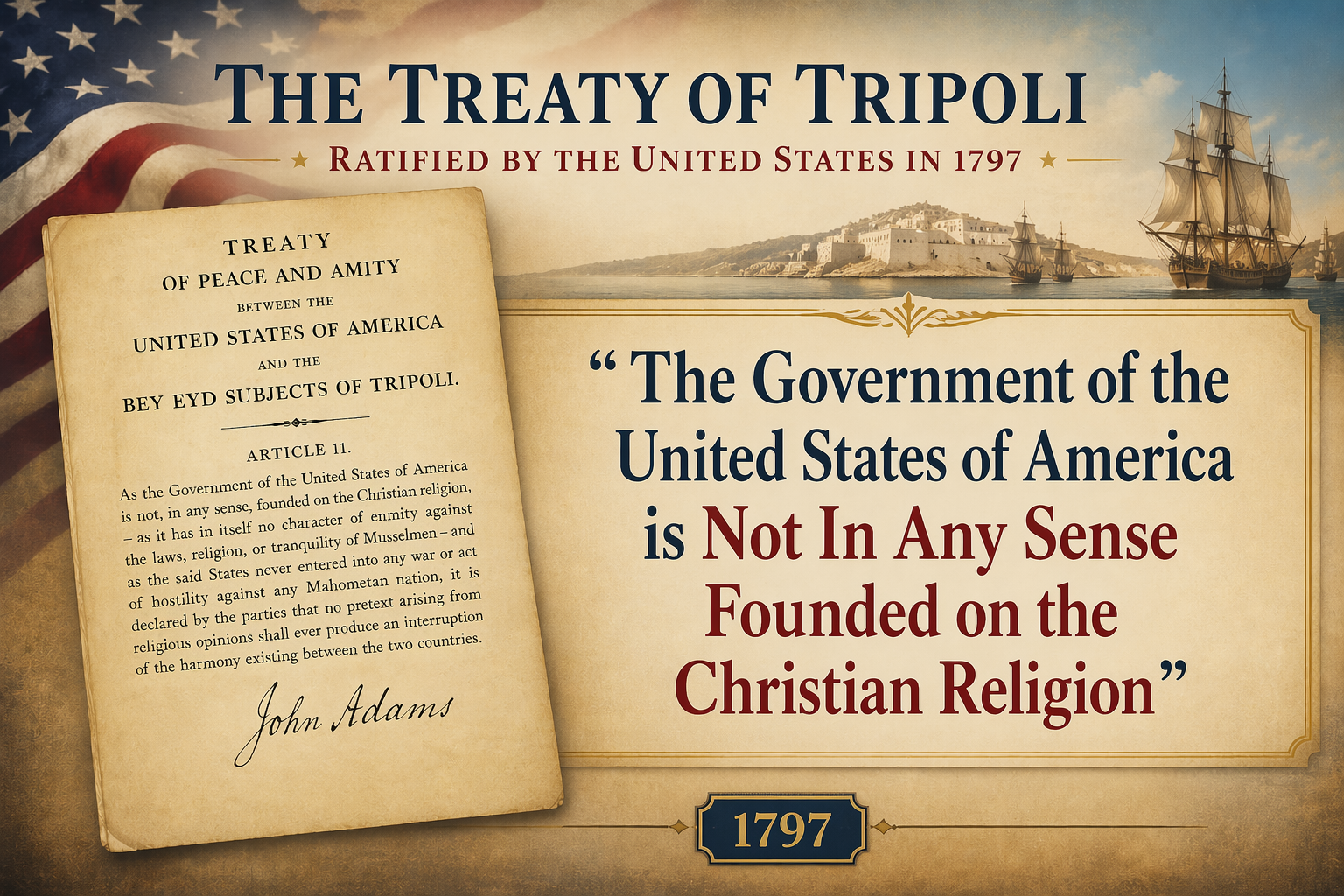
The historical record leaves little room for doubt. The Treaty of Tripoli—negotiated during the era of George Washington and ratified under the presidency of John Adams by a unanimous United States Senate—constitutes a clear and authoritative statement from the very generation that forged the nation. Its declaration that the United States “is not in any sense founded upon the Christian religion” reflects the founders’ deliberate commitment to separating civil authority from religious establishment while still protecting the free exercise of faith. We are not left to speculate about their intent or purpose; they told us plainly through both their words and their actions.
The real confusion today does not come from a lack of historical evidence, but from a growing misunderstanding—especially among some modern Christians—of the nation’s original principles and the constitutional role of religion in public life. What we are witnessing today is a willful departure from history and a disregard for the very truths that have been plainly set before us. Many Catholic, Evangelical, and other Christian nationalist voices strongly assert that the United States was founded as a distinctly Christian nation. However, this claim is not fully supported by the historical record or by the actions of the Founding Fathers. The founders deliberately established a constitutional system of government that avoided the establishment of Christianity as the official religion, safeguarding liberty of conscience for all people.
The Treaty of Tripoli, Article 11, states the following:
• “As the government of the United States of America is not in any sense founded on the Christian Religion, as it has in itself no character of enmity against the laws, religion or tranquility of Musselmen, and as the said States never have entered into any war or act of hostility against any Mehomitan nation, it is declared by the parties that no pretext arising from religious opinions shall ever produce an interruption of the harmony existing between the two countries” (Treaty of Tripoli, Article 11). [1]
Through their actions, the Founding Fathers made it clear that the primary concern of the U.S. government was the protection of religious freedom—not the advancement of a state religion. In their design, individuals—not the government—would define matters of faith and religious practice in the United States. The founders ensured that, in no official capacity, would the nation function as a Christian republic. In this context, the Treaty of Tripoli served an important diplomatic purpose. It assured the people of Tripoli—then part of the Muslim Ottoman Empire—that the agreement being made was between two sovereign governments, not between two competing religious systems.
This statement directly challenges the claim promoted by many Christian nationalist movements that America was founded as a Christian state, and it reinforces the nation’s original commitment to religious neutrality in matters of faith. The founders intentionally avoided establishing, promoting, or privileging one religious tradition over others. All of this history now appears to be slipping away. The Founding Fathers carefully established a clear constitutional foundation of religious neutrality, which is now being steadily set aside in favor of a different vision for the nation.
What was once a government committed to protecting liberty of conscience for all is now being reshaped by efforts that seek to elevate Christian traditions into society through government policies. Today, we now see developments such as the White House Faith Office under the current President, which is being used to promote legislation that favors Christianity. Efforts to elevate Sunday as a universal day of rest through public policy proposals—particularly those advanced by organizations like The Heritage Foundation—raise serious concerns about the future of religious liberty. This marks a profound shift from the original intent of our nation’s founders and raises serious concerns about the loss of true religious liberty in America.
Whenever religious advocacy groups begin to petition the state to endorse or enforce a particular brand of radical Christianity, such behavior inevitably places pressure on those whose beliefs differ, thereby undermining freedom of conscience. True religious liberty is not preserved by imposing Christian uniformity through law but by protecting the right of every individual to live according to their convictions, free from government preference or coercion.
The historical record is clear: the United States was founded on the principle of religious liberty, not religious establishment. The framers intentionally built a system that protected freedom of conscience for all, ensuring that government would neither impose nor favor any particular faith. When that boundary is crossed and when the state begins to elevate religious traditions, it departs from its original design and puts liberty at risk. The preservation of true religious liberty depends on maintaining that clear and essential separation—once it is compromised, liberty itself is placed in jeopardy.
“Our country shall repudiate every principle of its Constitution as a Protestant and republican government, and shall make provision for the propagation of papal falsehoods and delusions, then we may know that the time has come for the marvelous working of Satan and that the end is near” (Testimonies, Vol. 5, p. 451).
Sources
[1] https://avalon.law.yale.edu/18th_century/bar1796t.asp
 0
0 0
0 0
0
Absolutely.
There is a big difference between a Christian Nation and a nation founded on Christian Principles.
And the most striking of those principles is not forcing your religion, even if it is Christianity on anyone.
In other words, it is never Christian or Christ-like to force anything on anyone, even Christianity, no matter the cost or the situation, as dire as it may be.
The same God, who never changes, allowed Adam and Eve to exercise the freedom and liberty to choose to love Him through obedience to His Commandments, or disobey Him. We know the conclusion to this, and even how dire and sorrowful the consequence of sin is, God never forced them. And even now in the Redemption process, Christ calls gently in longsuffering to us all, that we should repent. 2 Peter 3:9
No where in the Holy Word of God you can find an instance of God forcing anything on anyone.
They lie against God when they claim Him in their efforts of war and enforcing morality. Because the Scriptures are clear:
“Now the Lord is that Spirit: and where the Spirit of the Lord is, there is liberty. ”
2 Corinthians 3:17 KJV
Now God prophesied this will happen. And it is:
a lamb.” The lamblike horns indicate youth, innocence, and gentleness, fitly representing the character of the United States when presented to the prophet as “coming up” in 1798. Among the Christian exiles who first fled to America and sought an asylum from royal oppression and priestly intolerance were many who determined to establish a government upon the broad foundation of civil and religious liberty. Their views found place in the Declaration of Independence, which sets forth the great truth that “all men are created equal” and endowed with the inalienable right to “life, liberty, and the pursuit of happiness.” And the Constitution guarantees to the people the right of self-government, providing that representatives elected by the popular vote shall enact and administer the laws. Freedom of religious faith was also granted, every man being permitted to worship God according to the dictates of his conscience. Republicanism and Protestantism became the fundamental principles of the nation. These principles are the secret of its power and prosperity. The oppressed and downtrodden throughout Christendom have turned to this land with interest and hope. Millions have sought its shores, and the United States has risen to a place among the most powerful nations of the earth.
But the beast with lamblike horns “spake as a dragon. And he exerciseth all the power of the first beast before him, and causeth the earth and them which dwell therein to worship the first beast, whose deadly wound was healed; … saying to them that dwell on the earth, that they should make an image to the beast, which had the wound by a sword, and did live.” Revelation 13:11-14.
The lamblike horns and dragon voice of the symbol point to a striking contradiction between the professions and the practice of the nation thus represented. The “speaking” of the nation is the action of its legislative and judicial authorities. By such action it will give the lie to those liberal and peaceful principles which it has put forth as the foundation of its policy. The prediction that it will speak “as a dragon” and exercise “all the power of the first beast” plainly foretells a development of the spirit of intolerance and persecution that was manifested by the nations represented by the dragon and the leopardlike beast. And the statement that the beast with two horns “causeth the earth and them which dwell therein to worship the first beast” indicates that the authority of this nation is to be exercised in enforcing some observance which shall be an act of homage to the papacy.
Such action would be directly contrary to the principles of this government, to the genius of its free institutions, to the direct and solemn avowals of the Declaration of Independence, and to the Constitution. The founders of the nation wisely sought to guard against the employment of secular power on the part of the church, with its inevitable result—intolerance and persecution. The Constitution provides that “Congress shall make no law respecting an establishment of religion, or prohibiting the free exercise thereof,” and that “no religious test shall ever be required as a qualification to any office or public trust under the United States.” Only in flagrant violation of these safeguards to the nation’s liberty, can any religious observance be enforced by civil authority. But the inconsistency of such action is no greater than is represented in the symbol. It is the beast with lamblike horns—in profession pure, gentle, and harmless—that speaks as a dragon.” Ellen White ‘Great Controversy’, pages 440.2- 442.2
“Providence has given to our people the choice of their rulers, and it is their duty – as well as privilege and interest – of our Christian nation to select and prefer Christians for their rulers.”
First Chief-Justice of the U.S. Supreme Court
– John Jay
“We have staked the whole future of our new nation, not upon the power of government; far from it. We have staked the future of all our political constitutions upon the capacity of each of ourselves to govern ourselves according to the moral principles of the Ten Commandments.”
– James Madison