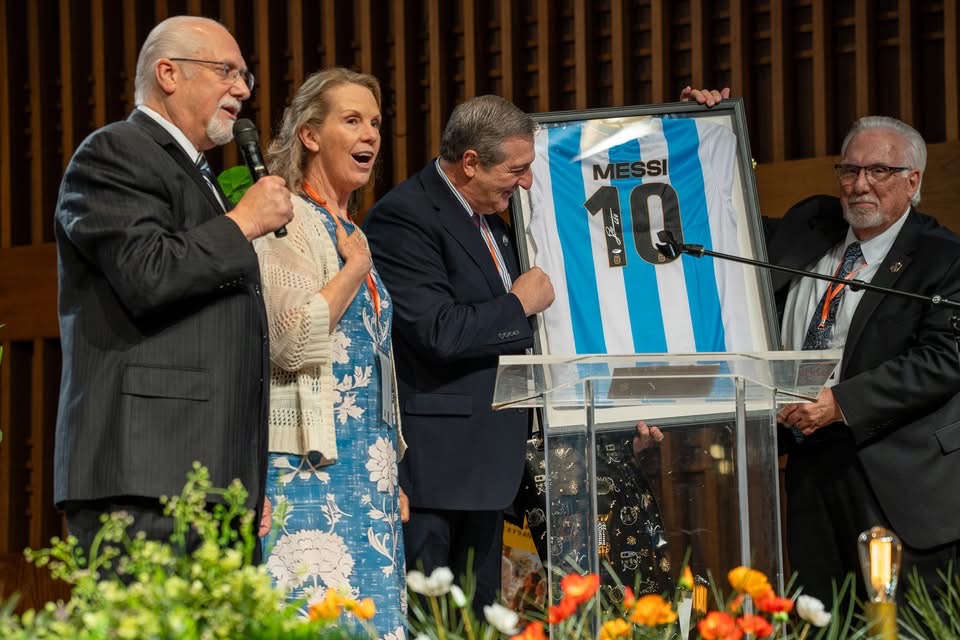
On April 26, 2026, during the 32nd Southwestern Union Constituency Session, retiring Vice President Osvaldo Rigacci was presented with a signed Lionel Messi jersey by fellow Southwestern Union Vice President Tony Anobile. The Messi memorabilia was described as “a big thank you” for Rigacci’s “nearly 44 years of denominational service.” Images of the signed jersey were subsequently shared on the Southwestern Union’s Facebook page. [1]
A signed Lionel Messi jersey is a highly valuable luxury collectible, often worth a substantial amount of money, making it an extravagant gift when presented by a church—especially one that publicly emphasizes gospel mission, sacrifice, and advancing the kingdom of Christ. In a mission-focused ministry, where resources are often directed toward evangelism, outreach, aiding the needy, and supporting spiritual work, such a gift can send mixed messages that appear inconsistent with the self-sacrificing nature of ministry, biblical stewardship, and the principles of humility and self-denial.
Church leadership frequently calls members to support the gospel through faithful giving, modest living, and self-less service; therefore, publicly celebrating and showcasing an extravagant signed commemorative jersey can project a very different set of values than those often promoted from the pulpit or in ministry appeals.
No clarification was provided as to whether the signed Lionel Messi jersey was privately donated or purchased using church funds. Regardless, the public optics of showcasing celebrity memorabilia on social media for the world to see—especially for church members in poorer nations to observe—comes across as extravagant, tone-deaf, and worldly. This is especially true in an era when professional soccer has become, for many, a cultural phenomenon plagued with idolatry, with figures such as Lionel Messi, Cristiano Ronaldo, Diego Maradona, and Pelé being often venerated to god-like status by devoted fans.
It is time for members to prayerfully ask questions and engage with leadership regarding whether the church’s time, emphasis, priorities, public witness, example, and resources are being used wisely and in harmony with its gospel mission. There is certainly nothing wrong with recognizing the hard work, dedication, and sacrifice of those retiring from denominational service; however, a simpler form of recognition that more clearly reflects humility, stewardship, and the spirit of Christ would be far more consistent with the mission and example of Christian ministry.
Sources
 0
0 0
0 0
0
How much time is spent by intelligent human beings in horse racing, cricket matches, and ball playing! But will indulgence in these sports give men a desire to know truth and righteousness? Will it keep God in their thoughts? Will it lead them to inquire, How is it with my soul? CT 456.1
Some of the most popular amusements, such as football and boxing, have become schools of brutality…. Other athletic games, though not so brutalizing, are scarcely less objectionable because of the excess to which they are carried. They stimulate the love of pleasure and excitement, thus fostering a distaste for useful labor, a disposition to shun practical duties and responsibilities…. Thus the door is opened to dissipation and lawlessness, with their terrible results. 98Education, 210, 211. FLB 238.4
The true Christian will not desire to enter any place of amusement or engage in any diversion upon which he cannot ask the blessing of God. FLB 238.5
“Ye adulterers and adulteresses, know ye not that the friendship of the world is enmity with God? whosoever therefore will be a friend of the world is the enemy of God.” James 4:4 KJV