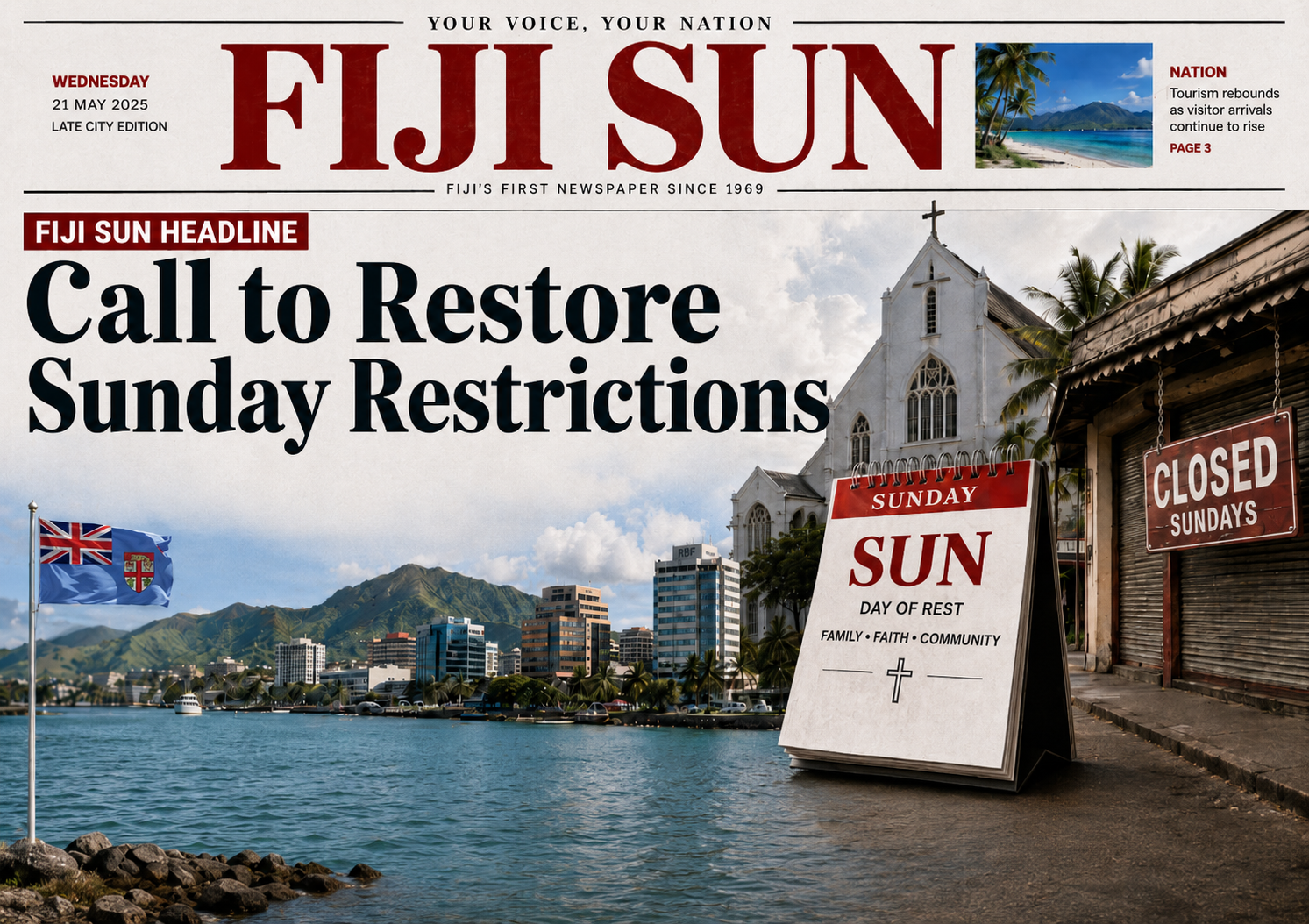
On Sunday, May 10, 2026, the Fiji Sun, Fiji’s largest online platform and daily newspaper, published a call to restore Sunday restrictions in the island nation as a means of reversing what many see as the loss of its Christian identity. The article referenced a submission made to the Constitution Review Commission by concerned citizens, who argued that the decline in respect for Sunday as a day of rest and worship has weakened the nation’s moral and social standards.
The Fiji Sun reported the following:
• “A call to reinstate Fiji’s long-abandoned Sunday restrictions has resurfaced during constitutional consultations in the Lau Group, with a submission from Vanuabalavu urging leaders to formally restore laws regulating Sunday activities.” [1]
• “The submission was made before the Constitution Review Commission by Samani Koroi Biukitukuna, who argued Fiji should return to stricter Sunday observance in line with its Christian traditions.” [1]
• “Mr Biukitukuna told commissioners that in earlier decades, Sundays were widely respected as a day of worship, rest and family time, with business activity, sports and public work largely paused in many communities.” [1]
• ” Mr Biukitukuna said the easing of Sunday observance over time had weakened social discipline and contributed to growing moral and social concerns. ‘When businesses remain open and sports continue on Sundays, people no longer treat the day as holy,’ he said.” [1]
• “We are slowly losing our identity as a Christian nation.’ He said formalizing Sunday restrictions would help restore respect, discipline and spiritual values within communities.” [1]
• “Mr Biukitukuna also said such a move would not discriminate against other faiths, but would instead reflect Fiji’s historical and cultural foundations. ‘I am not against other religions,’ he said. ‘Everyone should have freedom to worship, but Christianity has always been the foundation of Fiji.” [1]
Sunday laws discriminate against Sabbath keepers because they provide legal preference to one religious day—Sunday—while placing an unfair burden on those who observe the biblical Sabbath from Friday sunset to Saturday sunset. For Sabbath keepers, closing their businesses, resting, or worshiping on Saturday is a matter of conscience and obedience to God. However, when the state mandates that they also close or limit work on Sunday, Sabbath keepers are compelled to forfeit two days of labor, whereas those who observe Sunday only forfeit one.
This creates unequal treatment under the law by protecting the religious practice of the majority while punishing the minority. That is why Sunday legislation makes it harder for Sabbath keepers to live, work, and provide for their families.
In a free society, the state must remain neutral in religious matters and uphold equal rights for all citizens. When the government gives legal preference to Sunday as the official day of rest, it stops being neutral and begins favoring the religious tradition of the majority over the convictions of the minority.
Sources
 0
0 0
0 0
0
I see your point but non Sabbath keepers already have an extra day to labor as few of them actually keep Sunday holy.
This just makes it go from 7 versus 6 workdays to 6 versus 5 workdays.
Use Sunday for work around the home instead of business.
While I agree that you should be allowed to take the true Sabbath off for rest and worship, they would have to take Sunday off as well. Asking an employer to open on Sundays, when they are generally closed for business, is not right either.
Thank you.