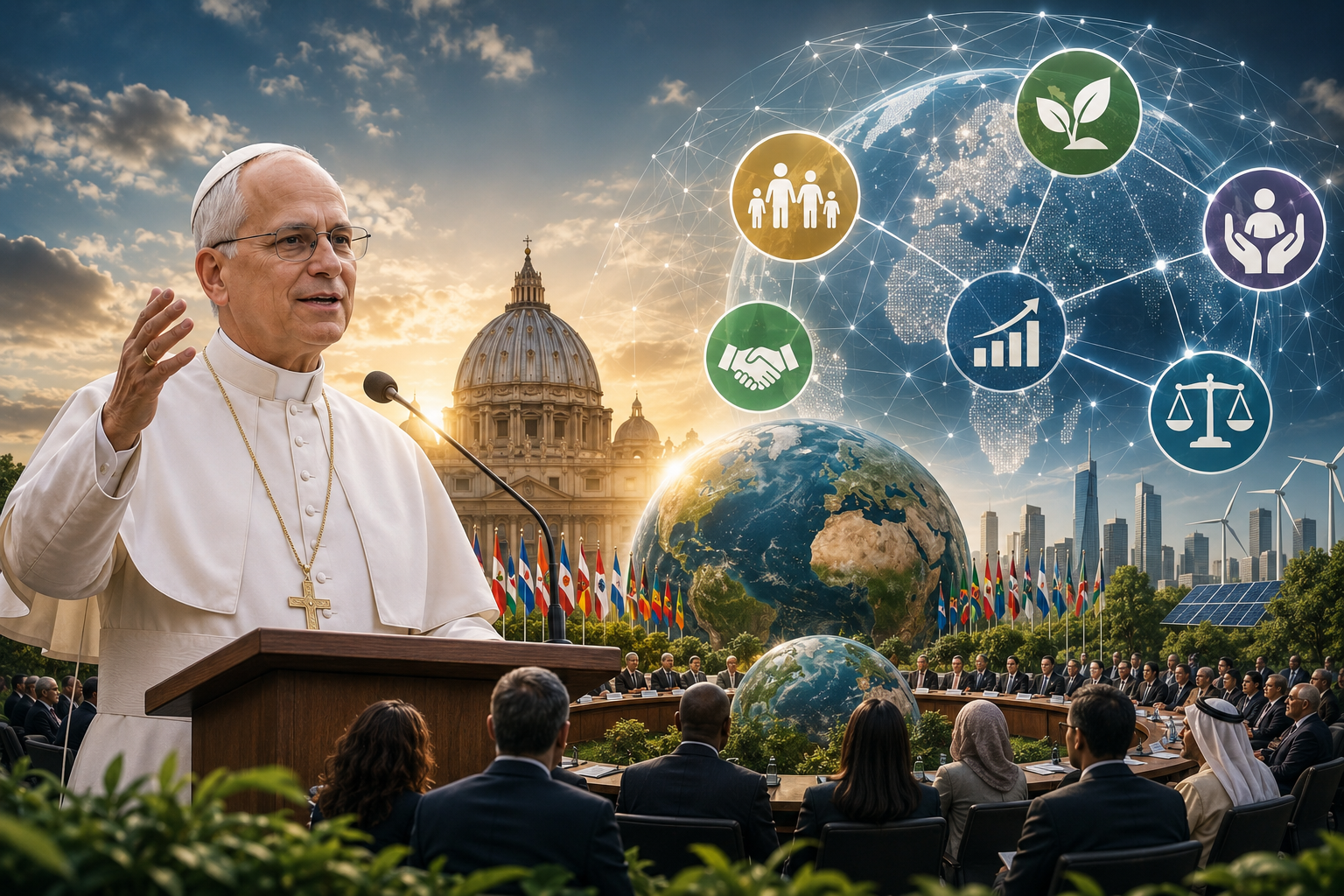
On June 16, 2026, Pope Leo XIV delivered a video message to the Austrian World Summit, an international conference on sustainability and climate change held in Vienna. In his address, the Pontiff advocated for a just transition toward a global economic model geared toward the common good and urged religious, political, and community leaders to collaborate in addressing the world’s pressing challenges. He also linked the current environmental, economic, and social crises to the solutions outlined in his encyclical Magnifica Humanitas, presenting its principles as the answer to creating greater solidarity, sustainability, and international cooperation.
The Holy See Press Office released the following statements made by Pope Leo at the world summit:
• “The Church has always been aware that the ecological question has a moral dimension. Indeed, the environmental crisis is not an isolated issue, but rather the ecological aspect of the contemporary socio-economic crisis.” [1]
• “This perspective underlines the profound ethical foundations to which I drew attention in my recently published Encyclical Letter Magnifica Humanitas, namely the equal dignity of all human beings and the value of fundamental human rights, both of which can be adequately ensured through the proper implementation of the principles of the common good, the universal destination of goods, subsidiarity, solidarity and social justice.” [1]
• “It is here, I think, that religious leaders and communities can offer a special insight for supporting ambitious social and environmental efforts.” [1]
• “In this regard, it is not merely desirable but also genuinely possible that the progress at COP30 can be followed up with a just transition toward societies where the common good takes precedence over profit, and economic models are rooted in solidarity and human dignity.” [1]
• “We also need the development of a new person-centered international financial framework to ensure that all countries, especially the poorest and those most vulnerable to climate disasters, can reach their full potential, with the dignity of their citizens respected.” [1]
What began under Pope Francis with repeated calls for an ecological conversion is continuing under Pope Leo XIV, who is presenting Magnifica Humanitas as a comprehensive vision for addressing the world’s social, economic, environmental, and moral crises. Rather than offering spiritual guidance, the Papacy is advancing a global political framework that seeks to shape public policy, economic systems, and international cooperation.
The Vatican is increasingly positioning itself as a moral authority capable of providing direction for the nations of the world. Governments, institutions, and religious organizations are showing growing interest in Rome’s vision of the “common good,” a Catholic teaching that has gained significant traction and is expanding the Pope’s influence in international affairs. While Rome’s initiatives are often presented as pathways to peace, sustainability, and human development, Bible prophecy warns of the dangers that arise when religious and political influence are consolidated into a single global authority.
As the world becomes increasingly receptive to Catholic social teaching, Sunday rest emerges as a unifying principle capable of saving society. Sunday is being promoted as the common good that can strengthen family life, protect workers’ rights, encourage religious participation, and promote care for creation. These developments are significant, as they reveal that the world is moving toward the very conditions foretold in Scripture—a closer union of religious and civil power that will ultimately threaten liberty of conscience and elevate human tradition above the Word of God, just as described in the book of Revelation.
“And the ten horns which thou sawest are ten kings, which have received no kingdom as yet; but receive power as kings one hour with the beast. These have one mind, and shall give their power and strength unto the beast.” Revelation 17:12, 13
Sources
[1] https://press.vatican.va/content/salastampa/en/bollettino/pubblico/2026/06/16/260616a.html
 0
0 0
0 0
0
Non stop calls for global government and economic system from one Pope after another, after another, after another. Constantly and consistently calling for and as far as possible, facilitating this vision. The vision of a global governing structure and economic system that would unquestionably bring about the necessary elements of the beast system described in the book of Revelation, whose arrival spells the final events of, and end of this world.
The Pope’s, Vatican, and their minions continually seeking to unite the entire world religiously, politically, and economically, under her moral guidance. The exact opposite of what God intentionally established at the tower of Babel, in order to prevent the unification of humanity in rebellion against God once again, unto His judgment of universal destruction once again. This will happen according to God’s own timing and no one else’s. Nevertheless, the Papacy is right to continually seek for such, if she intends to be the moral leader of this final act of rebellion against God. She needs to stay out front of the situation, by being the predominant self proclaimed authority in the minds of the many, when God gives the go ahead.
According to this papal leader, as many before him, we really need to address the major problem of individuals making profit for themselves, their families, and or those they wish to make donations to. To replace such abject evil, with a system of the common good, by which they may define and thereby also properly spend and or apply such profits. Never mind the countless billions the papacy receives from governments the world over every year, with or without the consent of their citizens. Or God only knows how much in tithes or offerings she receives from over a billion adherents as well, not to mention her countless business endeavors. She and her religious and political allies must now have control over all the profits individuals or businesses make as well. Since they are obviously not knowledgable enough to make decisions regarding their own monies according to the dictates of the common good, which is of course defined by all by the Papacy itself.
The constant wealth distribution the Papacy always speaks of and is and has been actively facilitating, which she is proud enough to basically brag about in Papal Encyclicals. Is simply not enough. All her accomplishments in transferring the wealth of nations from one to another via the movement of mass corporations and businesses throughout them, government wealth shifting mandates among them as well, and let us not forget mass migrations unto major wealth redistribution from the citizens of nations to the migrants entering them, among other methods. Are simply not enough. She and her cohorts must have greater control over all economics, through a global economic system which she and they have control of. For purposes of the common good, of course. Which the Papacy does and will define for all of us as well, of course. So be it, when God says it is time for all of this to end. Amen.
Rev 13:11 And I beheld another beast coming up out of the earth; and he had two horns like a lamb, and he spake as a dragon. 12 And he exerciseth all the power of the first beast before him, and causeth the earth and them which dwell therein to worship the first beast, whose deadly wound was healed. 13 And he doeth great wonders, so that he maketh fire come down from heaven on the earth in the sight of men, 14 And deceiveth them that dwell on the earth by the means of those miracles which he had power to do in the sight of the beast; saying to them that dwell on the earth, that they should make an image to the beast, which had the wound by a sword, and did live. 15 And he had power to give life unto the image of the beast, that the image of the beast should both speak, and cause that as many as would not worship the image of the beast should be killed. 16 And he causeth all, both small and great, rich and poor, free and bond, to receive a mark in their right hand, or in their foreheads: 17 And that no man might buy or sell, save he that had the mark, or the name of the beast, or the number of his name. 18 Here is wisdom. Let him that hath understanding count the number of the beast: for it is the number of a man; and his number is Six hundred threescore and six.