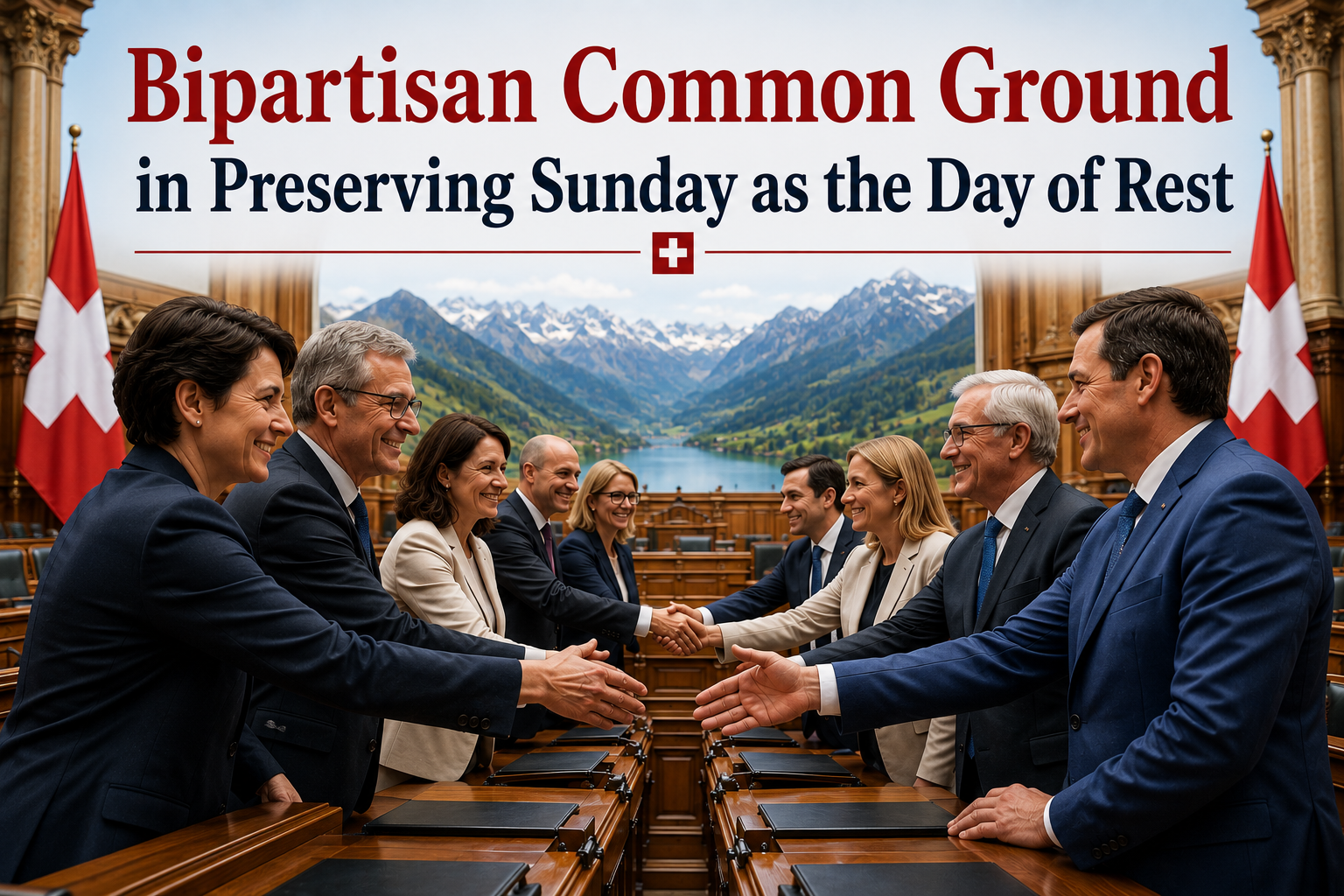
On Tuesday, June 9, 2026, the Council of States, the upper chamber of Switzerland’s Federal Assembly, voted against a proposal to make shop opening hours more flexible. In a bipartisan vote of 22 to 21, lawmakers from across the political spectrum chose not to consider a measure that would have permitted up to twelve Sundays of extended shopping hours each year.
The Swiss Parliament published the following news:
• “No green light for up to twelve Sunday shopping days per year: The Council of States has voted against making shop opening hours more flexible. It rejected a corresponding bill and intends to maintain the current limit of four Sunday shopping days per year.” [1]
• “When it comes to Sundays, federal law applies, specifically the labor law. Until now, municipalities and cantons have been allowed to designate a maximum of four Sundays per year for Sunday trading.” [1]
• “The proposal is antisocial, endangers the health of employees, and disregards democratic decisions, the left-wing members of the council argued during the preliminary debate. Carlo Sommaruga (SP/GE), for example, spoke of a frontal attack on the rights of workers.” [1]
• “People in this sector are already suffering from difficult working conditions. Sommaruga emphasized the importance of Sunday as a communal day of rest, especially for workers and their families.” [1]
• “Opponents argue that a free Sunday strengthens social cohesion. They contend that it should not serve the purpose of increasing consumption.” [1]
• “Representatives of the SVP and the center-right also weighed in: ‘Shopping is merely spread over an extra day, while costs for personnel, operations, and infrastructure increase,’ said Andrea Gmür-Schönenberger (center/LU).” [1]
• “Jakob Stark (SVP/TG) spoke of the ‘Sunday alliance.’ Any potential economic advantages would not outweigh the social disadvantages. ‘The value of Sunday must be preserved,’ Stark asserted.” [1]
What makes the Swiss vote particularly significant and prophetic is that the effort to protect Sunday as the day of rest is uniting lawmakers from both the political left and right. In an era of deep political polarization, few issues are capable of bringing together socialists, labor rights advocates, centrists, conservatives, and nationalists. Yet, Sunday rest remains one of those rare causes that transcend traditional political divides, even in highly secularized societies.
This demonstrates an important reality: Sunday rest enjoys great popularity and has the backing of the entire political spectrum. Although the arguments for securing Sunday as the official day of rest may vary from the different political parties, the conclusion is the same: Sunday rest must be preserved. Sunday laws do not depend exclusively on the support of a single party or ideology. This bipartisan support explains why any Sunday closing measures are a matter of great significance in any society—regardless of which political party is in power.
Sources
[1] https://www.parlament.ch/de/services/news/Seiten/2026/20260609121955229194158159026_bsd088.aspx
 0
0 0
0 0
0
Leave a Reply