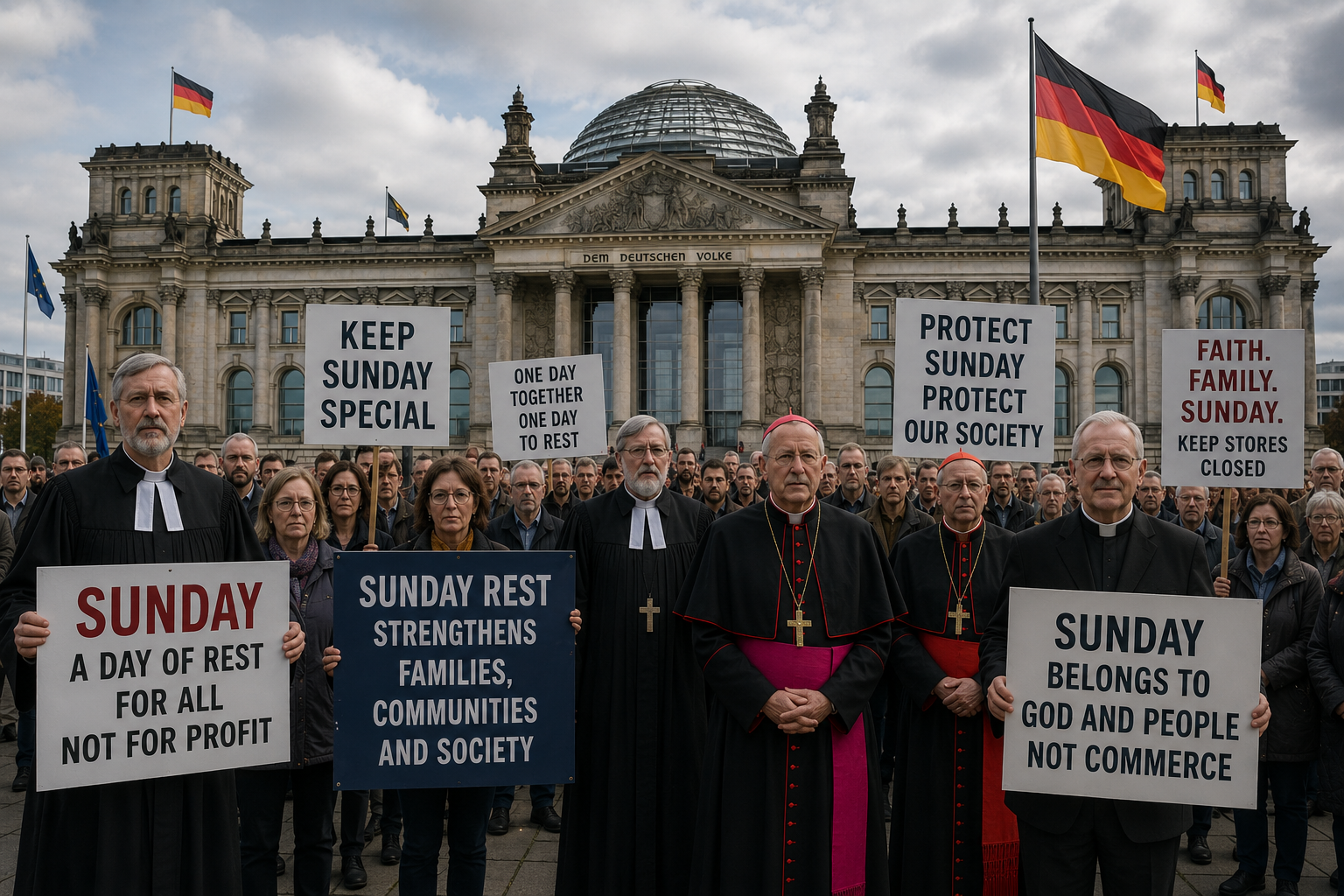
On July 7, 2026, the Evangelical Church in Germany reported that the nation is once again debating whether to expand Sunday store openings. Business and political voices are calling for greater commercial flexibility, but the church is pushing back, defending Sunday as a protected day of rest for society. Sunday is once again being treated not only as a day of worship but also as a public institution that the state is expected to preserve. The debate reveals the ongoing conflict between commerce, labor, family life, religion, and the state’s role in preserving Sunday as a common day of rest.
The Evangelical Church of Germany published the following:
• “Should more shopping be allowed on Sundays? Opinions differ. The Protestant Church is against it.” [1]
• “A controversial debate has erupted over allowing more shops to open on Sundays: CDU politician Christian von Stetten, chairman of the Bundestag’s Committee on Economic Affairs, spoke in favor of it, as did FDP leader Wolfgang Kubicki. The Evangelical Church in Germany (EKD) is opposed.” [1]
• “A spokesperson for the Evangelical Church in Germany (EKD) told the Düsseldorf-based newspaper ‘Rheinische Post’ on Tuesday that a day off on Sunday is valuable for society as a whole, regardless of whether a person believes in God or not. ‘We need one day a week when as many people as possible have time off at the same time,’ he added.” [1]
• “CDU politician Stetten told the Bild newspaper (Tuesday) that he was in favor of a generous expansion of the existing regulations. FDP leader Kubicki also told the newspaper: ‘Genuine flexibility is urgently needed. Anyone who wants to keep shops closed by force shouldn’t complain about dying city centers.” [1]
• “The CDU/CSU parliamentary group in the Bundestag does not want a general abolition of the Sunday trading ban but is pushing for modern working time regulations. ‘Sunday remains a day for family, relaxation, and community,’ deputy parliamentary group leader Sepp Müller (CDU) told Bild.” [1]
• “Previously, several representatives of the retail sector had advocated for allowing more shops to open on Sundays. The current federal government, a coalition of the Christian Democrats and Social Democrats, intends to permit bakeries, confectioneries, and libraries to extend their opening hours on Sundays. However, there are currently no plans for other sectors.” [1]
Repeatedly, we are being reminded that Sunday still holds a special and protected place in the laws and culture of Europe. And this is not just a European issue—it is something that is also coming to America. This debate goes beyond whether stores should be open on Sundays. The fundamental question is whether the government should be empowered to protect, promote, or eventually enforce Sunday as the common day of rest for everyone.
Every renewed call to defend Sunday by law shows how easily religious tradition can become a matter of public policy. Revelation 13 warns that the final crisis will center on worship, obedience, and authority. In the end, the issue will be about whether people will follow God’s commandments or the traditions of men backed by the power of the state.
Sources
[1] https://www.evangelisch.de/inhalte/256965/07-07-2026/debatte-um-mehr-ladenoeffnungen-sonntagen
 0
0 0
0 0
0
Leave a Reply