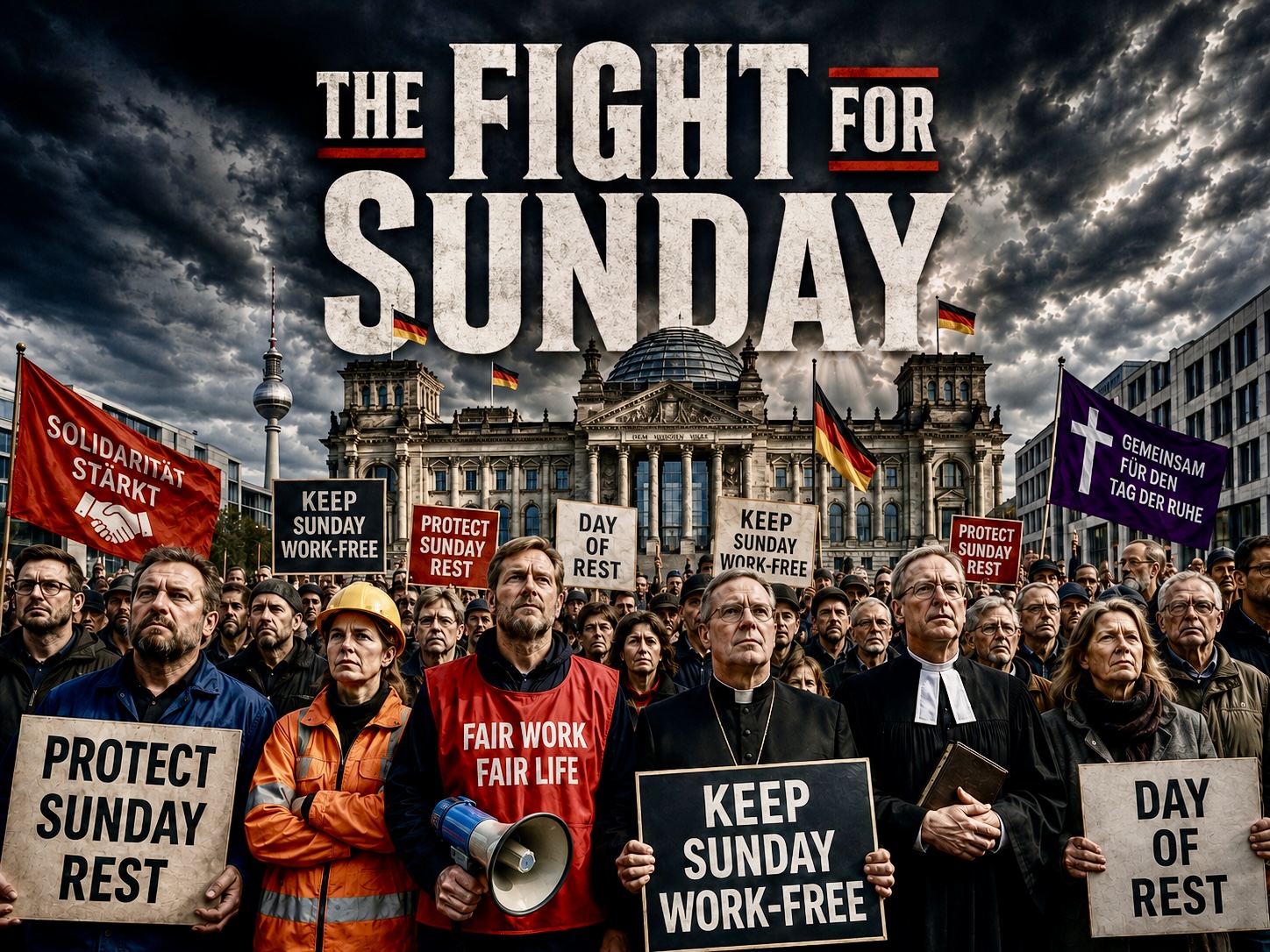
In Germany, the battle over Sunday rest is intensifying as political, economic, and religious forces dig in for a growing confrontation. Faced with China’s enormous economic power and increasing global competition, some German leaders and business groups are calling for long-standing Sunday restrictions to be loosened. Recent government proposals aimed at revitalizing the economy have included allowing certain commercial activities on Sundays, while major retailers are pressing for Sunday-closing laws to be relaxed nationwide. Churches and labor unions, however, have vowed to resist these efforts and preserve Sunday as a work-free day.
The South China Morning Post published the following on July 27, 2026:
• “Germany’s drive to compete with Chinese imports is colliding with its long-standing tradition of Sunday rest, with policymakers and retailers now asking whether a century-old consensus still fits an economy struggling to regain its competitiveness.” [1]
• “The latest flashpoint came in early July, when the country’s coalition government unveiled a package of measures to boost Germany’s competitiveness, including plans to let bakeries, confectioneries and public libraries operate longer on Sundays from the start of next year.” [1]
• “However, retail and business associations argue that the changes do not go far enough.” [1]
• “The shop closing law is, in my view, a relic of the past,” Peter Adrian, president of the German Chamber of Commerce and Industry, said in mid-July. “Retailers should be left to decide whether they want to open their stores on Sundays or not.” [1]
• “Opposition comes chiefly from unions and churches. Sunday work in retail was “an attack by employers on the work-life balance of more than 3 million retail employees,” Silke Zimmer, a member of the United Services Trade Union’s federal executive board, said in the magazine Politik & Kommunikation in July, calling Sunday the only reliable day off for many workers.” [1]
• “The union has said it would take the fight to the Federal Constitutional Court if necessary.” [1]
• “Church leaders have also long warned that regular Sunday work would erode society’s one shared day off.” [1]
What is unfolding is a direct struggle over whether Sunday rest should remain protected and enforced throughout German society. These developments are placing Sunday rest laws squarely at the center of Germany’s national debate. The government has already proposed expanding Sunday operations for bakeries, confectioneries, and public libraries, while powerful business organizations are demanding much broader changes that would allow retailers themselves to decide whether to open on Sundays.
On the other side, labor unions and churches are preparing for a determined resistance. Unions have described expanded Sunday commerce as an assault on the work-life balance of millions of employees and have threatened to take the matter before Germany’s Federal Constitutional Court. Church leaders are likewise defending Sunday as society’s common day of rest. This means Sunday observance is no longer a minor cultural issue—it has become a major national struggle involving government policy, economic survival, workers’ rights, religious influence, and constitutional law.
Across Europe, and the rest of the world, churches, labor unions, employers’ organizations, and political advocates are promoting a synchronized, work-free Sunday as necessary for family life, workers’ health, social cohesion, and spiritual activity. This is why the Sunday issue will not simply disappear. Sunday legislation can be presented under many attractive labels: workers’ rights, family preservation, mental health, social unity, economic fairness, environmental protection, or national tradition.
Germany is not an isolated controversy—it is one battlefield in a widening international struggle. The debate will continue, changing its language and justification, until Sunday is strictly enforced by civil authority in the United States and throughout the world. When that crisis comes, the question will be whether human governments have the right to exalt Sunday, the counterfeit day of worship, as the legally protected day of rest.
“The Word of God teaches that these scenes are to be repeated as papists and Protestants shall unite for the exaltation of the Sunday. The prophecy of Revelation 13 declares that the power represented by the beast with lamb-like horns shall cause the earth and them which dwell therein to worship the papacy” (Great Controversy, p. 578).
Sources
 0
0 0
0 0
0
Leave a Reply