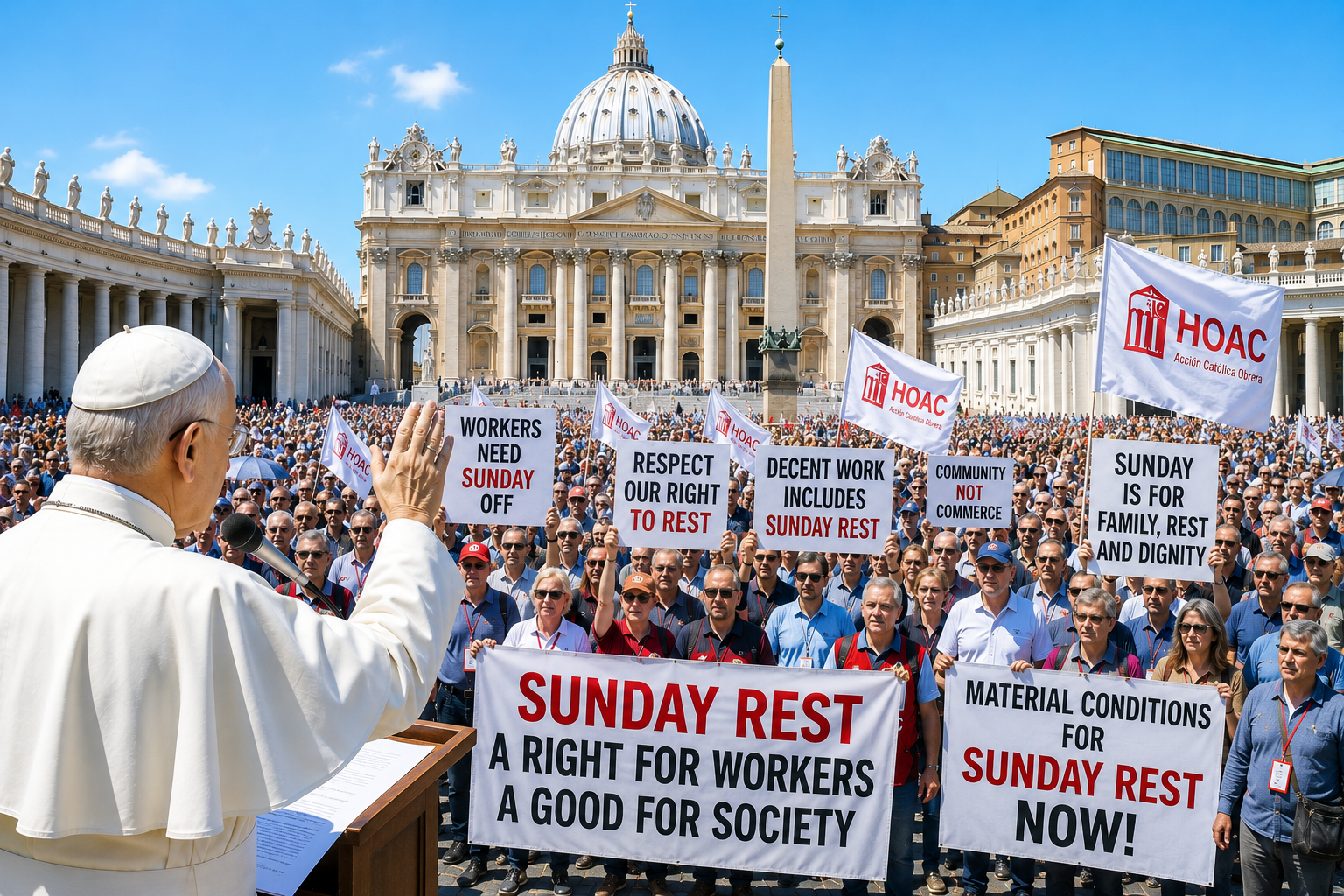
On August 16, 2026, Noticias Obreras, a Spanish digital labor publication published by the Workers’ Brotherhood of Catholic Action (HOAC), took Pope Leo XIV’s August 12 appeal to sanctify Sunday and transformed it into a call to advocate for Sunday rest for workers. In an article titled “Leo XIV Calls for Creating Conditions so that Work Does Not Prevent People from Enjoying Sunday,” the publication argued that working conditions and economic structures must be adjusted so that Sunday can be protected as a common day of rest. Significantly, the article calls for tangible or “material conditions” that would make Sunday rest possible for working people.
Noticias Obreras published the following:
• “The pontiff recalled that Sunday constitutes, according to the Council Fathers, the ‘foundation and core of the entire liturgical year’ and recalled the teaching of John Paul II in Dies Domini, where it is presented as ‘the day of the Lord, the day of the Church, the day of man’ and, finally, ‘the day of days’.” [1]
• “Leo XIV’s request thus introduces a material reality into a fundamentally liturgical reflection: there are working people who cannot take Sunday off and whose working conditions hinder their participation in community life.” [1]
• “The Pope emphasized the collective and in-person dimension of the celebration. The Christian community, he explained, makes its communion visible when it gathers and actively participates. Therefore, he pointed out that the assembly “cannot be replaced by a merely virtual presence, nor is it reduced to a merely passive gathering.” [1]
• “The reference connects with a demand that Christian workers’ organizations in Europe have maintained for years: to preserve Sunday as a common time for rest, family and social relationships, community participation and, for believers, the celebration of faith.” [1]
• “The call of Leo XIV now recovers this question from its Christian roots. Sunday appears not only as an individual religious precept, but as a shared time whose celebration also requires material conditions that make it possible.” [1]
This development is significant because the Pope’s appeal is already being translated from religious language into labor and economic demands. On August 12, 2026, Pope Leo XIV explicitly described Sunday as the “Day of the Lord,” said that sanctifying Sunday fundamentally involves the Eucharist, and urged communities to create the “best possible conditions” so that people who must work on Sundays can attend Mass.
Then, just four days later, Noticias Obreras, published by Spain’s Workers’ Brotherhood of Catholic Action (HOAC), took that appeal directly into the world of labor. The publication argued that the Pope’s statement introduces a “material reality” into the Sunday question because employment conditions can prevent workers from resting, participating in community life, and practicing their religion. It then explicitly connected Leo’s appeal with the long-running campaign of Christian workers’ organizations across Europe to preserve Sunday as common time for rest, family and social relationships, community participation, and religious observance.
This is precisely why anything that the Pope says with regard to Sunday cannot be viewed as an innocent appeal for Catholics to attend Mass. Once Pope Leo states that society should create economic and working conditions that make Sunday observance possible, the world listens, and employers, unions, businesses, governments, labor laws, shopping regulations, and working schedules become affected. That is precisely what Noticias Obreras has now done: it took a papal appeal regarding Sunday worship and connected it to the restructuring of working conditions so that Sunday may function as society’s common day of rest.
This is where Revelation 13 becomes relevant. The book of Revelation describes the final crisis as beginning with religious influence ultimately working through civil and economic power until Sunday worship becomes enforced by law:
“And he had power to give life unto the image of the beast, that the image of the beast should both speak, and cause that as many as would not worship the image of the beast should be killed. And he causeth all… that no man might buy or sell, save he that had the mark” Revelation 13:15–17.
Notice how religion, civil authority, economic pressure, and worship eventually converge. That is why we have to watch the Sunday movement and the efforts to pass legislation even when they are initially presented as labor reforms rather than explicitly religious laws. What is especially noteworthy is the phrase “material conditions.” Religion is no longer being discussed only as a personal or individual practice. The argument being presented here is that work schedules, commerce, labor protections, economic structures, and society itself should be arranged in a manner favorable to Sunday rest.
What we are witnessing is the Sunday question moving from biblical theology into the workplace through labor laws. The Pope speaks of sanctifying Sunday and enabling Sunday Mass, and Catholic labor advocates respond by saying employment structures must make Sunday available. Rome is increasingly providing a bridge between religious doctrine and public policy. Today the language is rest, family, community, dignity, and workers’ rights. The next step will be, “What laws are necessary to guarantee these rights?”
Sources
 0
0 0
0 0
0
The Pope knows exactly what he is doing. This is not unfolding by accident; it is part of a larger, preplanned agenda whose ultimate course and outcome were revealed by God in Bible prophecy long ago.