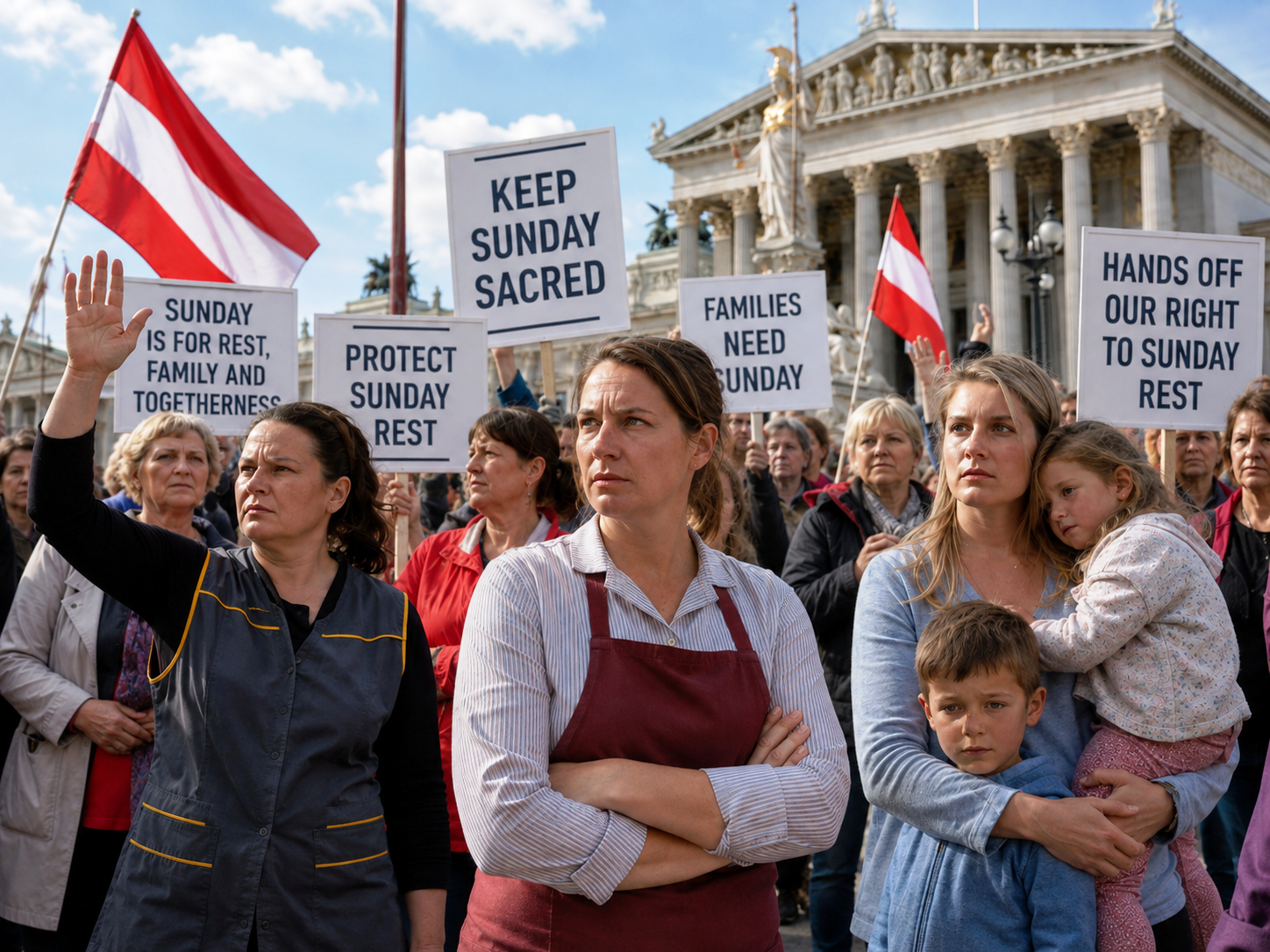
As politicians and retailers in Austria push to weaken Sunday-trading restrictions and increase Sunday openings [1], labor unions are fighting back, insisting that Sunday remain a nationally protected, common day of rest for workers and families. This conflict is becoming increasingly prominent, showing that the Sunday question in Europe continues to intensify. The Austrian Trade Union Federation (ÖGB) has entered the debate directly, calling for “Hands Off Sunday!” in the title of a press release published on August 5, 2026.
The ÖGB’s statement regarding Sunday rest was as follows:
• “Nationwide Sunday openings for retail would be a direct attack on the quality of life of thousands of employees and their families. Anyone who wants to make Sunday work the norm is ignoring the reality in the stores and at the cash registers.” [2]
• “97% of retail employees are clearly against Sunday work. Politicians must not ignore this clear mandate.” [2]
• “For many, Sunday is the only reliably free day—for rest, family, and social participation. Especially in an industry where around 70% of the workforce is female and childcare options are lacking on Sundays.” [2]
• “Employees are already suffering from staff shortages, high workloads, and having to fill in at short notice. Extending opening hours would exacerbate these problems without any demonstrable benefit. Ultimately, it only risks a shift in revenue to the detriment of smaller businesses.” [2]
• “Anyone who speaks of the population’s wishes is deliberately ignoring the facts: Across all federal states and age groups, the majority of Austrians are clearly against Sunday openings.” [2]
What we are seeing in Austria is significant because labor arguments are being used to justify preserving Sunday as the national day of rest. Sunday is increasingly being defended as something necessary for families, workers, and quality of life. That is precisely how Sunday legislation can gain broad public support without initially appearing to be religious.
People should rest, and there is nothing wrong with workers wanting time for rest and family—those are legitimate concerns. The danger arises when Sunday is made by law the common, protected day of rest for society. Once that happens, the civil power requires everyone to observe Sunday. In practice this shifts regular work and commerce onto Saturday, creating economic and social pressure that creates conflicts for those who conscientiously keep God’s seventh-day Sabbath.
The real issue is who has the authority to designate sacred rest time. God has already designated the seventh day. Scripture never transferred the sanctity of the seventh-day Sabbath to Sunday. The biblical command still declares that “the seventh day is the sabbath of the Lord thy God” (Exodus 20:10). When governments, churches, unions, and society unite around legally protecting another day, the controversy ultimately becomes one of human authority versus divine authority.
Sources
 0
0 0
0 0
0
The pressure is increasing and the dragon is angry against those who keep God’s true Sabbath.