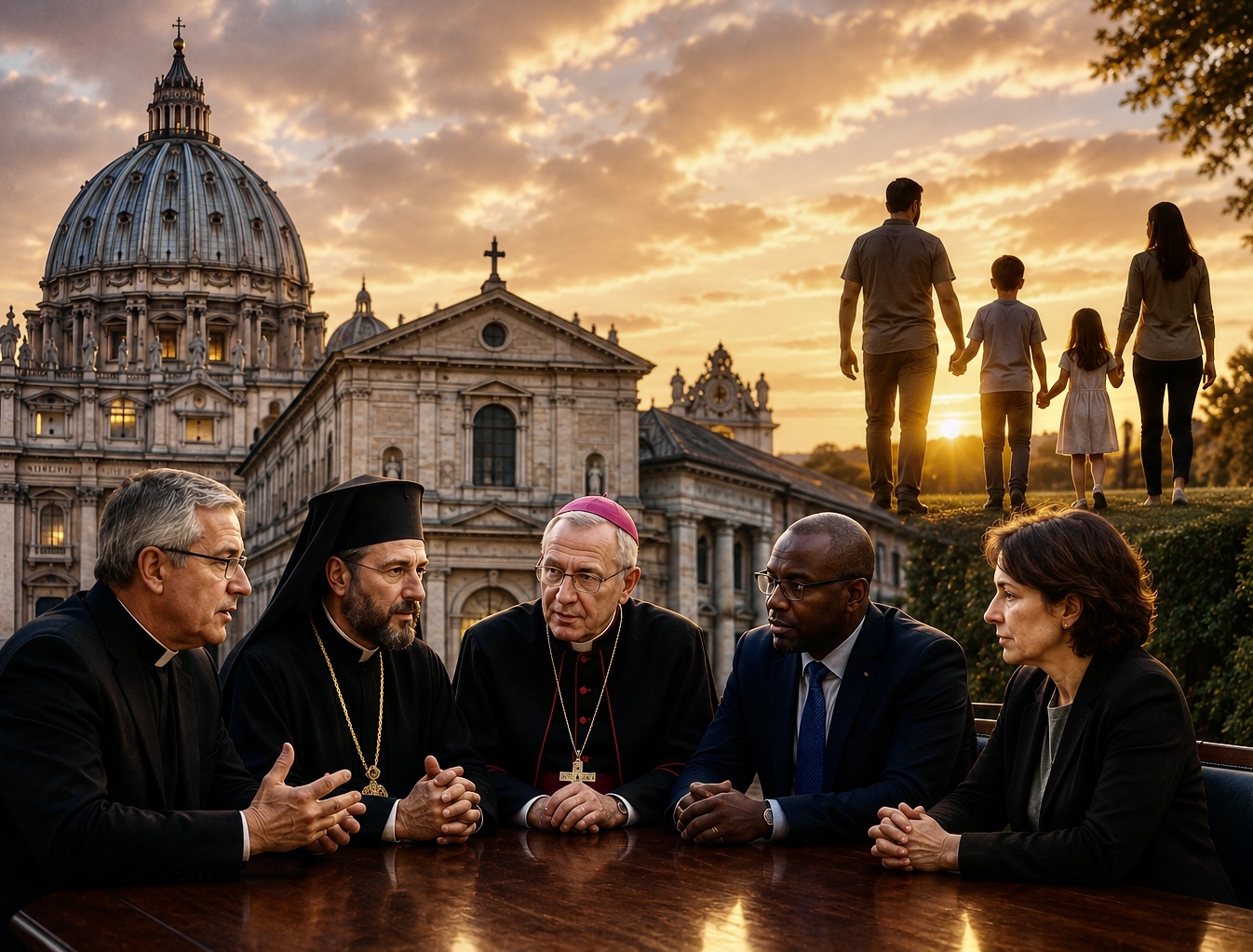
On August 31, 2026, Vatican News weighed in on the ongoing debate regarding attempts to relax Sunday closing laws in Austria, expressing support for preserving Sunday as a common day of rest. In an article titled “Austria: Churches Oppose the Erosion of Sunday Rest,” Vatican News cited the Catholic Bishop of Graz-Seckau, Wilhelm Krautwaschl—spokesperson for the Sunday Alliance, an organization committed to maintaining Sunday as a day of rest nationwide—who argued that expanding Sunday shopping opportunities would undermine what he described as the “right” to a shared day of rest.
Vatican News reported the following:
• “The nationwide alliance for Sunday rest in Austria has once again spoken out against any further expansion of Sunday trading hours.” [1]
• “The spokesperson for the Sunday Alliance, Bishop Wilhelm Krautwaschl of Graz, warned in a recent statement on his diocese’s website against further erosion of the shared right to a day of rest on Sunday.” [1]
• “The Diocese of Graz-Seckau signaled its clear rejection of any expansion of this model in Styria. Peter Hochegger of the Diocesan Fund for Work and Education emphasized … Sunday as a shared day off for rest and relaxation.” [1]
• “Bernhard Schwarzenegger, managing director of the fund (Catholic Diocesan Fund for Work and Education), described the largely work-free Sunday as a “high social asset.” He said it creates time for family and friends, as well as space for reflection and relaxation.” [1]
• “The Catholic Workers’ Movement of Styria also spoke out against further liberalization of shop opening hours.” [1]
• “The Austrian Sunday Alliance, which has been advocating for the protection of Sundays as a day of rest since 2001, explicitly understands Sunday as a broad social concern. Its members include church institutions, trade unions, the Chamber of Labor, and other social organizations. Its goal is to protect Sunday as a shared day of rest from a gradual expansion of working and consumption hours.” [1]
Austria’s nationwide Sunday Alliance, with its influential Catholic constituents, is bringing together church organizations, labor unions, and other groups around the effort to preserve Sunday as a common, legally protected day of rest. The debate over Sunday closing laws is therefore not merely an isolated labor or economic dispute; it represents a broader nationwide church-labor coalition mobilizing to preserve Sunday as society’s common weekly day of rest.
This is significant because Rome, through Vatican News, is amplifying these arguments and giving the campaign for Sunday rest a much broader religious and public voice. The case for Sunday protection is not being presented as simply a religious question; it is increasingly being connected with workers’ rights, family life, recreation, social well-being, and national unity. By combining religious and secular arguments, the movement to preserve Sunday as the common day of rest is connected to a much broader spectrum of society.
This is precisely the kind of universal consensus Rome has long sought to build around Sunday rest. The plan is not simply to persuade Catholics to attend Mass on Sunday but to establish Sunday as the common weekly day of rest for society as a whole and to secure the legislation needed to protect it.
“The Word of God teaches that these scenes are to be repeated as papists and Protestants shall unite for the exaltation of the Sunday. The prophecy of Revelation 13 declares that the power represented by the beast with lamb-like horns shall cause the earth and them which dwell therein to worship the papacy—there symbolized by the beast like unto a leopard” (Great Controversy, p. 578).
Sources
 0
0 0
0 0
0
Leave a Reply