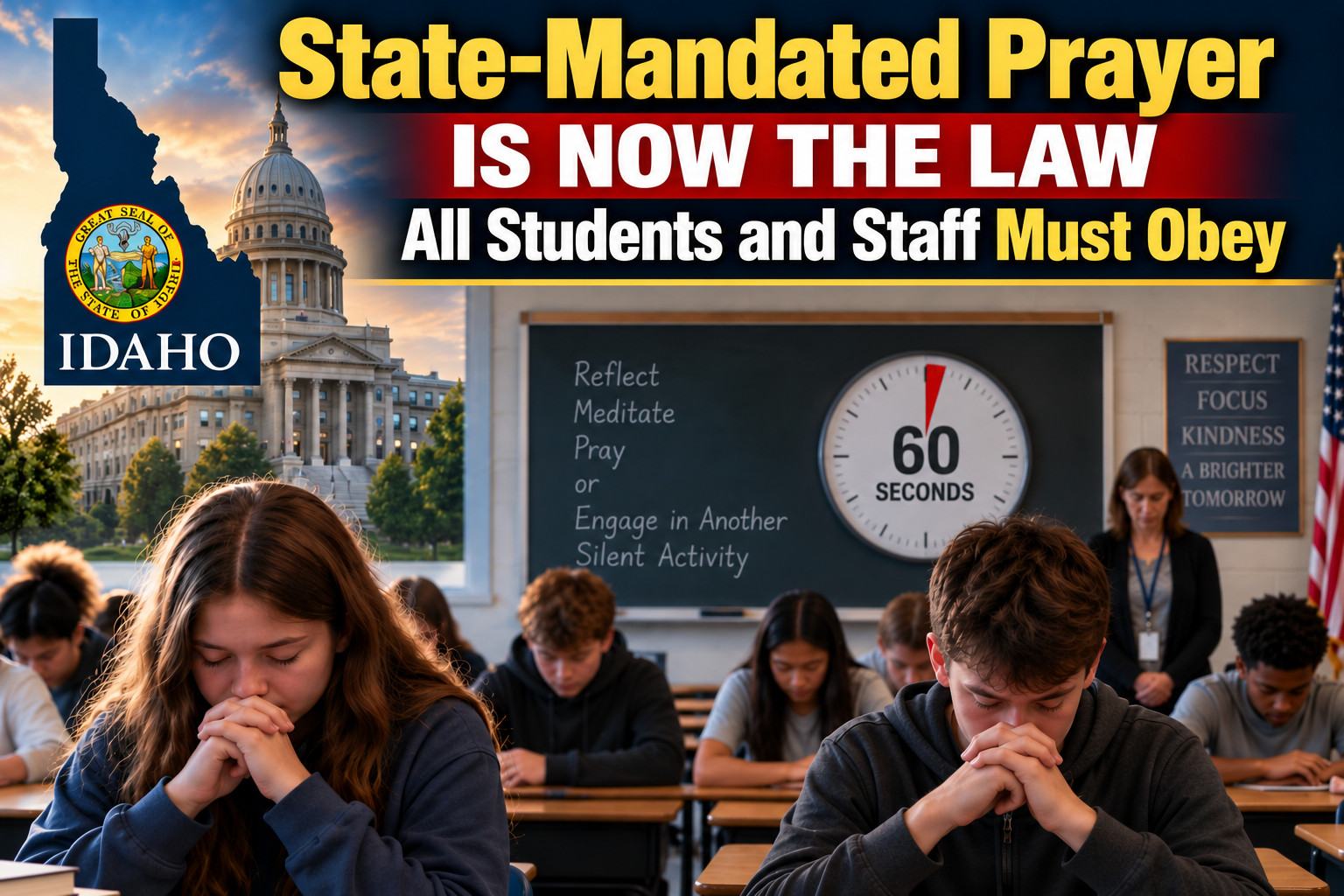
Idaho public schools are now implementing a state-mandated daily 60-second moment of silence at the beginning of every school day under House Bill 623. The requirement applies to every grade in every Idaho public school. During this period, students and staff are directed to use the time to “reflect, meditate, pray, or engage in another silent activity.” School districts must also notify families, giving parents an opportunity to discuss with their children how they wish to use this designated period.
KXLY 920 News and Talk Radio reported the following on September 7, 2026:
• “There’s a change happening at the start of each school day in Idaho this year. Students and staff now start each day with 60 seconds of silence. The moment of silence was made law by House Bill 623.” [1]
• “It requires that “at or near the beginning of each school day, in all grades and in all Idaho public schools, teachers or school employees in charge of classrooms shall provide for a brief period of silence for a minimum of sixty (60) seconds with the participation of every pupil in the classroom.” [1]
• “The law says students may use the time to “reflect, meditate, pray, or engage in another silent activity.” During that period, the law says, “no other activities should take place.” [1]
Unlike voluntary school prayer or Bible clubs, which depend upon individual students to initiate these, this new law establishes a state-required observance for students and staff throughout the entire state. Although the statute has the appearance of being neutral, by permitting reflection, meditation, prayer, or another silent activity, this law officially institutionalizes a daily time in public schools during which prayer is officially mandated by law.
If the government can force every public school in an entire state to stop what they are doing for 60 seconds, five days a week, to observe a state-sponsored time set aside for prayer and meditation, then the government can most certainly require people to stop working and doing business on Sunday for another state-sponsored time set aside for rest and worship. The question is not whether it is 60 seconds or 24 hours. The bigger question and the more serious issue is whether the government should have the power to force people to observe a designated time that is connected with a religious practice.
The answer to that is an emphatic “No.” That is not the job of the state; that is the work of the Holy Spirit. Prayer has spiritual value when it comes from faith, conviction, and a willing heart—not government compulsion. Protecting a student’s freedom to pray is religious liberty; compelling everyone to participate in a state-designated religious exercise is coercion.
Sources
 0
0 0
0 0
0
I appreciate much of your work and have used your information to help keep my congregation updated on religious liberty issues. However, the title of this article is misleading and does not reflect the facts. There is no mandated prayer going on in Idaho public schools. There is a 60 second silence in which students can choose to pray or not. This does not establish religion. While it may set a precedent for future actions, this is not state-sponsored prayer.
It always starts out innocently. Trade unions started out innocently to—look at what they’re involved in today. I live in Poland, and I really don’t like it.
For over 100 years all public schools began with prayer or a brief reading of the KJV Bible. The stated reason was to teach Catholic kids to accept the Protestant Bible in place of their Catholic Bible. We had very few problems prior to the 1962 decision brought to court by crazed atheist Madeline Murray O’Hare. A compliant court gave them the decision against these practices. Atheists got their way for years on all other subjects. Now people who were not alive then do not know this history. They think that this has always been. Trade unions did not start out innocently. Violence was a way of life.
Look up Rabbi Schneerson and his role in the moment of silence initiative as well as his role in establishing the department of education alongside President Carter, and then look up Public law 102-14. Things will start to become a bit more clear what is really taking shape in this country.