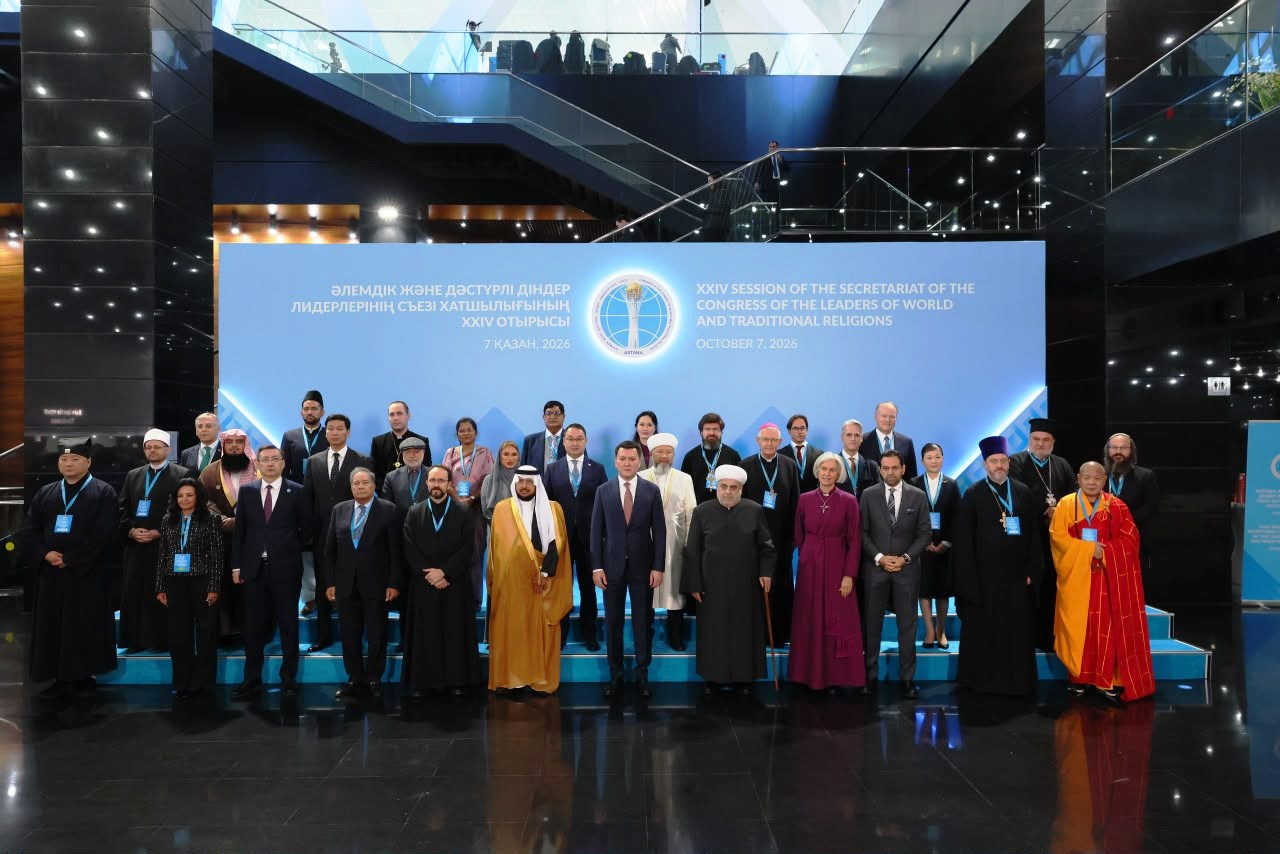
On October 7, 2026, the 24th Meeting of the Secretariat of the Congress of Leaders of World and Traditional Religions was held in Astana, Kazakhstan. Representatives of Islam, Christianity, Judaism, Hinduism, Buddhism, Taoism, Shinto, and the Bahá’í joined government officials and representatives of international organizations to adopt a document titled “The Role of Religions in Combating Climate Change.” Various religious and government leaders came together with the stated goal of turning interreligious dialogue into concrete action, presenting the so-called global ecological crisis as an urgent challenge requiring a common interreligious response.
This event closely reflects the Vatican’s vision of bringing the world’s religious traditions together around the shared themes of “care for our common home,” ecological conversion, and increased interreligious cooperation to address global environmental concerns. The Astana Time published the following on October 7, 2026:
• “Religious leaders and international experts gathered in Astana on Oct. 7 to discuss how faith communities can contribute to addressing pressing challenges, with artificial intelligence, climate change and the rights of children with incurable diseases among the key issues on the agenda.” [1]
• “The discussions took place at the 24th Meeting of the Secretariat of the Congress of Leaders of World and Traditional Religions, which brought together representatives of Islam, Christianity, Judaism, Hinduism, Buddhism, Taoism, Shinto and the Baha’i Faith, as well as government officials, international organizations and experts from 20 countries.” [1]
• “Participants considered two draft international documents: the Code of Ethics for the Use of Artificial Intelligence in the Religious Sphere and the Role of Religions in Combating Climate Change … the documents reflect the need to strengthen the practical role of spiritual diplomacy amid growing global instability.” [1]
The Catholic Church and the Holy See are directly involved in this international interreligious climate initiative. Fides, the Vatican news agency operated by the Pontifical Mission Societies, reported on October 7, 2026, that the Holy See’s Dicastery for Interreligious Dialogue participated in the meeting through its representative, Jesuit Father Laurent Basanese:
• “The Catholic Church’s presence in this process is far from marginal. Pope Francis’ visit to the seventh Congress in 2022 was a particularly significant moment, reaffirming the value of the Congress as an international forum for interreligious dialogue.” [2]
• “In 2025, Pope Leo XIV’s message to the eighth Congress likewise emphasized the importance of ‘working together,’ recalling that dialogue does not require differences to be erased, but can instead transform them into opportunities for cooperation.” [2]
• “Father Laurent Basanese, SJ, Head of Office at the Dicastery for Interreligious Dialogue, is taking part in the Secretariat session.” [2]
• “The challenge today is to turn dialogue into concrete initiatives. The Astana Congress is seeking to build the kind of moral consensus without which even regulations risk remaining ineffective. The aim is to create common ground.” [2]
What is especially concerning is that Fides, a Vatican news agency, explicitly states that solutions emerge when a religious moral authority can assist government and international regulatory bodies—which it described as “ineffective.” The strategy is to build a common moral consensus among the world’s religions—with Rome playing a prominent role—that can actually support and help governments advance concrete initiatives.
The Vatican’s argument is that religious leaders possess a unique moral authority capable of influencing communities and helping to turn global climate commitments into practical action. In this model, religious cooperation does not remain confined to dialogue; it becomes the powerful catalyst for mobilizing society and governments to support, adopt, and implement international environmental regulations.
There is also a direct United Nations connection to this ecumenical-Vatican event. Nihal Saad of the United Nations Alliance of Civilizations told the gathering that religious communities have the capacity to mobilize people in support of national and international environmental initiatives and global commitments. İnformasiya Agentliyi published the following on October 7, 2026:
• “Religious communities and leaders can contribute to the fight against climate change by raising awareness, promoting responsible behavior, and fostering dialogue at the community level, Director of the United Nations Alliance of Civilizations Nihal Saad said at the 24th meeting of the Secretariat of the Congress of Leaders of World and Traditional Religions in Astana.” [3]
• “She noted that religious communities, through their ability to engage with the public and mobilize community efforts, can contribute to national and international initiatives to ensure environmental sustainability and fulfill global commitments. Nihal Saad also drew attention to the common principles that unite various religious traditions in matters of environmental protection.” [3]
The climate message is clearly moving beyond traditional interreligious dialogue toward coordinated global action. Religious bodies are increasingly seeking to shape public policy and international initiatives through what they describe as a common moral consensus. In these discussions, we see representatives of the Vatican, the United Nations, governments, international organizations, and the world’s major religious traditions coming together around shared environmental objectives. These developments reflect the fulfillment and culmination of the appeals made under Pope Francis and continued under Pope Leo to treat the ecological crisis as an urgent moral issue requiring coordinated action and cooperation among religions, governments, international institutions, and society.
The trajectory is significant: Pope Francis repeatedly linked the care of our common home to the recovery of a shared weekly day of rest—Sunday. As this theme continues to unfold under the pontificate of Pope Leo XIV—including his own call to sanctify Sunday for the sake of caring for creation—we must closely observe how soon these appeals will also influence governments, international regulatory bodies, and, ultimately, the laws by which society is governed.
Sources
[1] https://astanatimes.com/2026/10/religious-leaders-explore-faiths-role-in-tackling-global-challenges/
 0
0 0
0 0
0
Leave a Reply