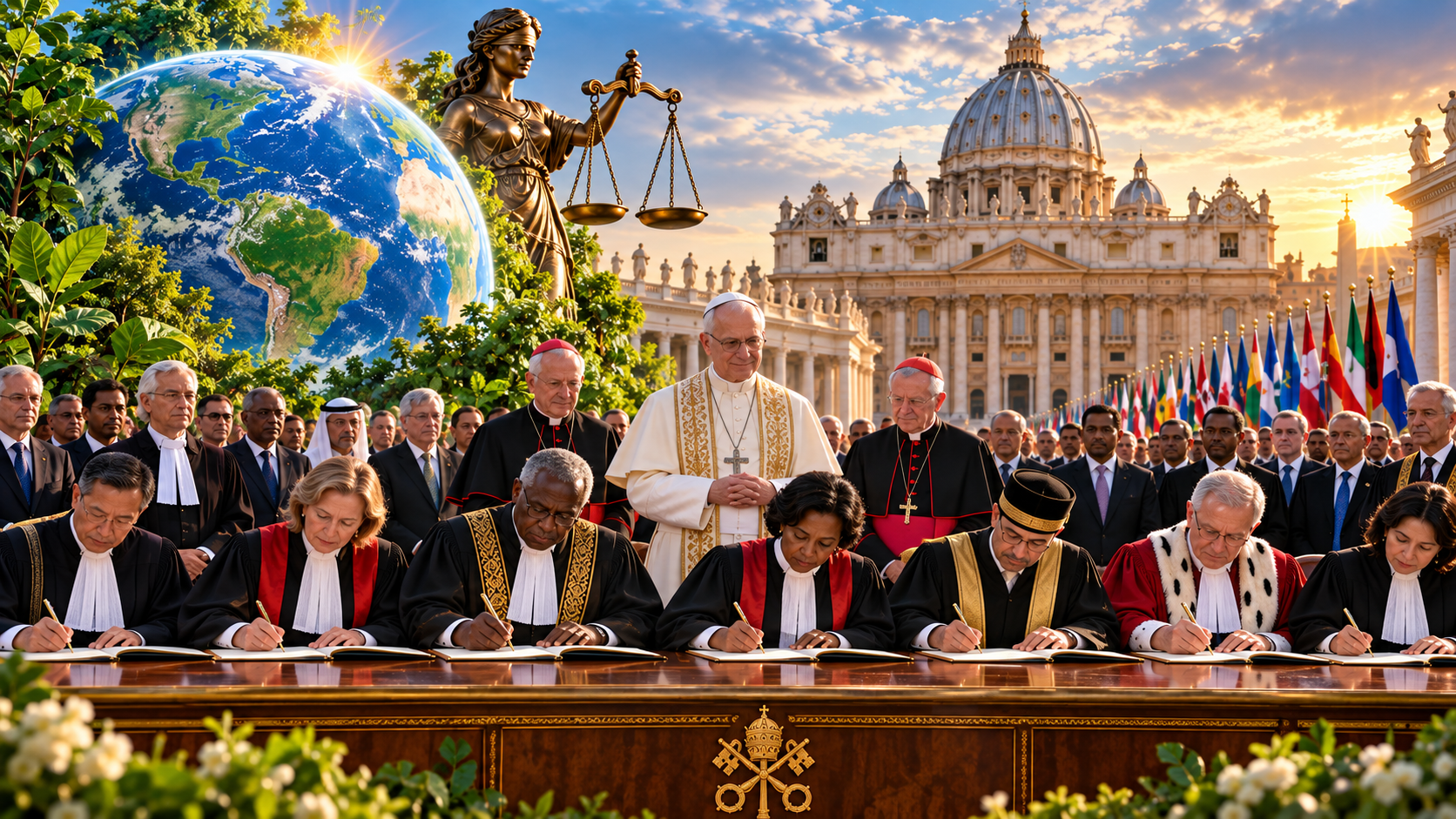
Laudato Si’, Fratelli Tutti, and Magnifica Humanitas are much closer to legal implementation. An international gathering of representatives from national supreme courts, international tribunals, judges, judicial officials, and legal experts took place at the Vatican on October 6–7, 2026. The gathering concluded with the signing of a declaration that defines climate actions as a matter of legal action. It also connects papal encyclicals to judicial decision-making in an effort to influence climate policies and legal action worldwide. According to Vatican News, the declaration draws upon three papal encyclicals—Laudato Si’, Fratelli Tutti, and Magnifica Humanitas—presenting their teachings as central principles in the pursuit of climate justice.
Vatican New published the following on October 10, 2026.
• “The meeting, held on October 6 and 7 at the headquarters of the Pontifical Academy of Social Sciences, brought together representatives of judiciaries, national and international courts, academic institutions, and organizations involved in the defense of human rights and the environment.” [1]
• “The declaration signed at the close of the conference maintains that the climate crisis cannot be addressed solely from a scientific and political perspective, but also constitutes a legal problem.” [1]
• “In this context, the document emphasizes the responsibility of judicial bodies to ensure that decisions, omissions, and activities under review respect fundamental rights, existing legal obligations, and due process guarantees.” [1]
• “The proposal thus aims to strengthen the legal tools available to address environmental conflicts and promote coordinated judicial responses among different countries.” [1]
• “Another central theme of the document is the relationship between climate justice and the Social Doctrine of the Church, with special reference to the teachings of Pope Francis. The declaration establishes a connection between the encyclicals Laudato Si’, Fratelli Tutti , and Magnifica Humanitas.” [1]
• “The document suggests that these principles can help guide judicial work on climate issues, linking environmental protection with human dignity, institutional responsibility, and the pursuit of the common good.” [1]
• “The closing sessions included the participation of judicial authorities and specialists from Europe, Latin America, the Caribbean and the United States.” [1]
• “Among the participants were Mattias Guyomar, President of the European Court of Human Rights; Iván Mauricio Lenis Gómez, President of the Supreme Court of Justice of Colombia; César Manuel Diesel Junghanns, Minister of the Supreme Court of Justice of Paraguay; Orlando Aguirre Gómez, President of the Supreme Court of Justice of Costa Rica; and João Cura Mariano, President of the Supreme Court of Justice of Portugal.” [1]
• “Also participating were Verónica Gómez, judge of the Inter-American Court of Human Rights; Gabriela Lenz de Lacerda, president of COPAJU Brazil; Rebeca Xicohténcatl Corona, president of COPAJU Mexico; and representatives from the academic, environmental and judicial fields of various countries.” [1]
• “The closing remarks were delivered by Roberto Andrés Gallardo, who emphasized the centrality of Pope Francis’s social teachings and his call to judges to exercise their responsibilities in defense of social justice and human dignity.” [1]
Here we see judges and representatives of national and international courts looking to Rome’s teachings for guidance on climate change, environmental protection, and legal responsibility. This development reveals the growing relationship between the Vatican and judicial institutions worldwide and the plan to incorporate papal teachings in legislation, litigation, and judicial decisions.
According to the prophetic warnings of Revelation 13, 17, and 18, Rome will exercise far-reaching influence over the nations, ultimately leading to the enforcement of religious decrees through civil authority. Pope Francis’ encyclical Laudato Si’ explicitly advocates Sunday as a day of rest, while Pope Leo’s Magnifica Humanitas calls for labor laws to be implemented that ensure the proper balance between work, leisure, and rest.
The next step will be to continue with initiatives aimed at consolidating Sunday as a common day of rest by promoting restrictions on commercial activity on that day. Unfortunately, a so-called “climate connection” between Sunday and environmental action is currently being established. Proposals for Sunday rest already exist in various parts of the world, although their link to any specific judicial action has not yet been seen—until now.
The prophetic warning is unmistakable: when religious teachings begin shaping the exercise of civil authority, the separation between church and state is removed. What started as an innocent appeal for environmental protection and a common day of rest is now showing teeth as judicial powers are calling for Papal teachings to be enforced through the power of the state.
Sources
 0
0 0
0 0
0
“The Papal Church will never renounce its claims to infallibility. It continues to consider as correct all the persecutions that took place in the past against those who disagreed with its dogmas, and, if such an opportunity arises, will it not repeat the same actions? Let only the secular governments remove the restrictions imposed and return the former power to Rome – the former persecutions and tyranny will immediately resume.
(“The Great Controversy”. Chapter 35).