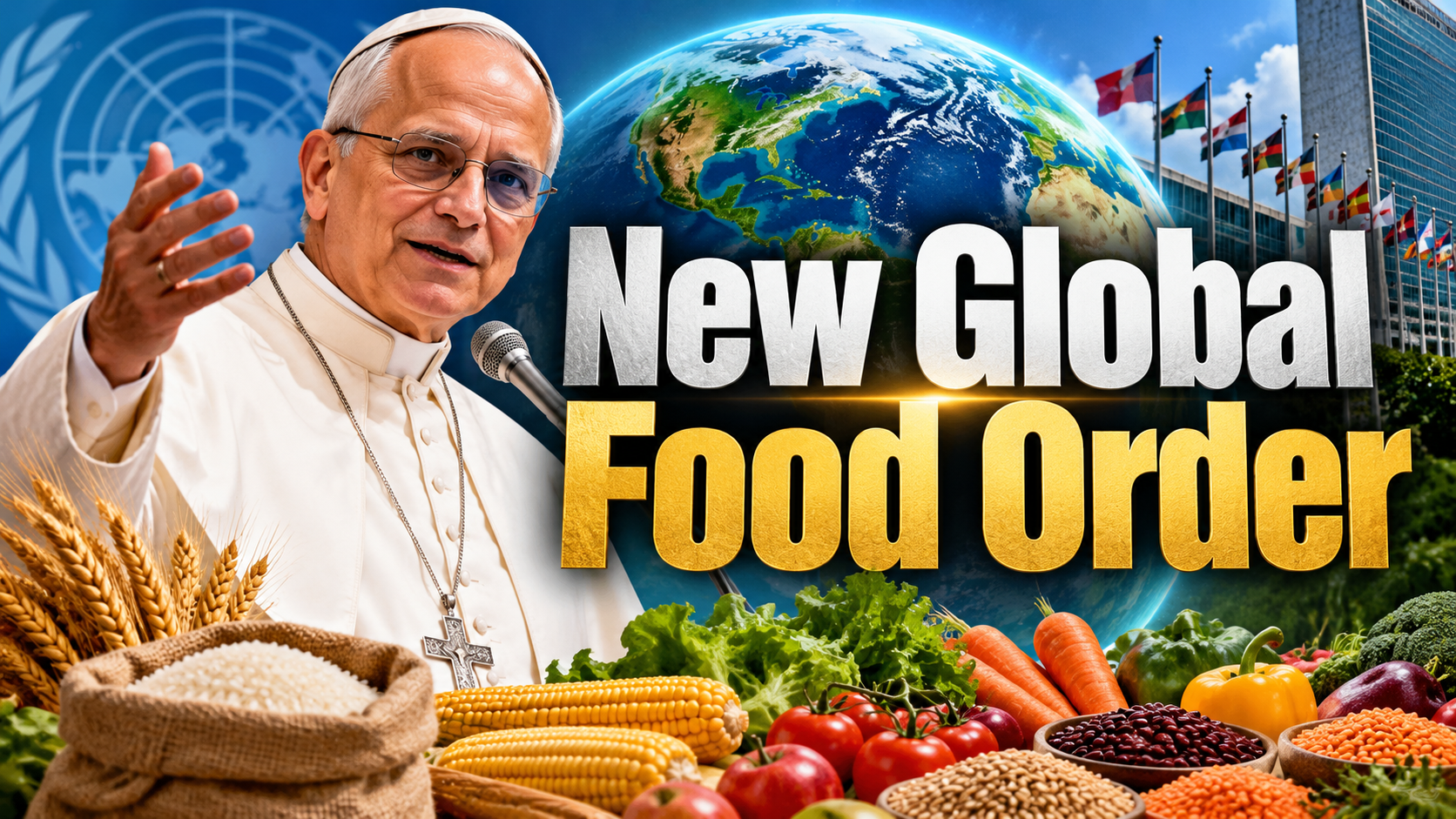
In a message issued for World Food Day on October 16, 2026, Pope Leo XIV called upon the Food and Agriculture Organization (FAO) of the United Nations and its member states to pursue significant changes in global agricultural and economic systems. Specifically, the Pope called for “a new global food order” grounded in human dignity, solidarity, and the Catholic Church’s vision of the “universal common good.”
Once again, Rome is seeking to influence international relations, economic systems, and government policymaking by advancing its moral and social doctrines as principles for global governance. In his official message, dated October 12, 2026, Pope Leo XIV made the following statements, published by the Holy See Press Office:
• “The theme for this year’s World Food Day is “Innovate Today. Nourish Tomorrow” … Mr. Director-General, I encourage the Food and Agriculture Organization, and its member States, not to settle for abstract analyses or declarations of limited effectiveness.” [1]
• “The irresponsible use of technology for exclusively selfish interests, rather than for the common good, not only violates the principle of solidarity, but also disregards humanity’s duty to safeguard creation.” [1]
• “Now is the time for moral audacity. A new global food order is essential — one in which technological innovation is unconditionally subordinated to respect for God-given human dignity and the universal common good.” [1]
•, “Furthermore, there is an urgent ethical imperative to redirect resources invested in the war industry toward sustainable agricultural research and the regeneration of degraded soils.” [1]
•, “This likewise involves protecting water as an inalienable common good.” [1]
•, “Bread should be neither an instrument of geopolitical pressure nor a volatile financial asset. Nor must it ever be used as a weapon of war. Indeed, it is a terrible offense against human dignity to prevent bread from reaching any person or to destroy the means by which it is produced.” [1]
According to Bible prophecy, bread will, in fact, be used to exert “geopolitical pressure” and as a “weapon of war” to compel the world to worship the first beast of Revelation 13. The very things the Pope promotes—feeding the hungry, protecting water resources, and preventing the exploitation of the poor—will be used against those who refuse to accept his vision of solidarity, the common good, and a Sunday dedicated to creation, during the final crisis.
“And that no man might buy or sell, save he that had the mark, or the name of the beast, or the number of his name.” Revelation 13:17.
If you receive Rome’s mark of the beast, you will be able to have food and water and participate in the economy of the new world order that is soon to come. Unfortunately, according to the Word of God, you will also receive the seven last plagues and lose eternal life:
“And the third angel followed them, saying with a loud voice, If any man worship the beast and his image, and receive his mark in his forehead, or in his hand, The same shall drink of the wine of the wrath of God, which is poured out without mixture into the cup of his indignation; and he shall be tormented with fire and brimstone in the presence of the holy angels, and in the presence of the Lamb: And the smoke of their torment ascendeth up for ever and ever: and they have no rest day nor night, who worship the beast and his image, and whosoever receiveth the mark of his name.” Revelation 14:9-11.
The Bible describes a time when economic participation will be restricted, and those who refuse to submit to the authority of the beast will face severe consequences. Faithfulness to God will soon cost His people their employment, their financial security, their ability to buy and sell, and even their lives. The final test will reveal whether people are willing to obey the commandments of God when obedience comes at the expense of their earthly security.
This issue will center on the commandments of God, the seventh-day Sabbath, and the enforcement of Sunday observance through civil authority. The question is not whether the world will provide us with bread, but whether we will remain faithful to the Bread of Life—even when the world threatens to take everything else away.
“Because thou hast kept the word of my patience, I also will keep thee from the hour of temptation, which shall come upon all the world, to try them that dwell upon the earth.” Revelation 3:10.
Sources
 0
0 0
0 0
0
Leave a Reply