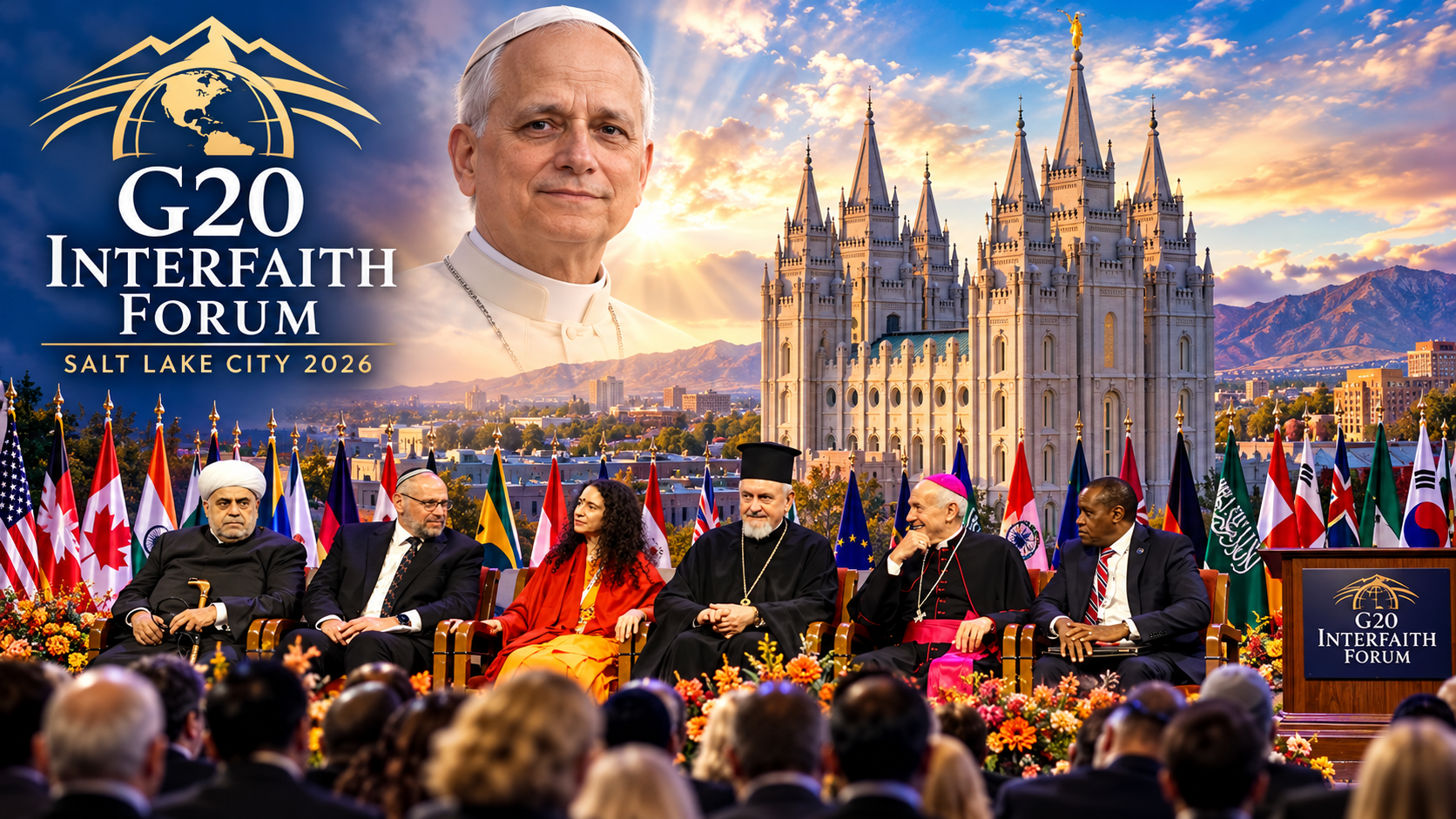
Dallin H. Oaks, President of The Church of Jesus Christ of Latter-day Saints, whom church members recognize as their living prophet and spiritual leader guided by divine revelation, welcomed religious and civic leaders from around the world to the historic Salt Lake Tabernacle in Salt Lake City, Utah, for the opening ceremony of the 2026 G20 Interfaith Forum, held October 15–17, 2026. Representatives from the Roman Catholic, Protestant, Seventh-day Adventist, Eastern Orthodox, Muslim, Hindu, Jewish, and Latter-day Saint faith communities participated in this international gathering. The purpose of the G20 Interfaith Forum is to bring together religious leaders from diverse faith traditions, government officials, and international organizations to strengthen interreligious cooperation, advance shared social and political objectives, and influence global policymaking through the collective voice and coordinated efforts of religious communities.
Representing Pope Leo XIV at this event was the Archbishop Gabriele Caccia, the Vatican Ambassador to the United States. The Pope’s representative read a message sent on behalf of Pope Leo XIV by Cardinal Pietro Parolin, Secretary of State of the Holy See. In it the Pope expressed his hope that the forum would be “a shining example of the solidarity of the human family” and contribute to strengthening the commitment of nations to “the universal principles of human dignity, religious freedom and the common good.”
Eternal World Television Network, a prominent Catholic programming network, published the following on October 19, 2026:
• The apostolic nuncio then read from a message sent by Vatican Secretary of State Cardinal Pietro Parolin on behalf of Pope Leo, who expressed hope that the event would be “a shining example of the solidarity of the human family.” [1]
• Leo also called for deepening of ties between nations in support of “the universal principles of human dignity, religious freedom, and common good.” The pope further called for “gentleness and respect” in discussions among attendees and conveyed his prayers and “an abundance of the Most High’s blessings” for the forum’s success. [1]
Archbishop Gabriele Caccia also presented Pope Leo XIV’s encyclical Magnifica Humanitas to the religious leaders and policymakers gathered at the G20 Interfaith Forum, promoting its teachings as the moral guide for addressing artificial intelligence, human dignity, and the future of society. Once again, we see Rome advancing its religious and moral agenda on the global stage, seeking to influence not only religious communities but also international policymaking. On October 16, 2026, the Roman Catholic Diocese of Salt Lake City published the following:
• What kind of human future are we building together?” said Archbishop Caccia in his remarks … That question is at the center of Pope Leo XIV’s encyclical letter Magnifica Humanitas, the archbishop pointed out, adding that in the document the pope “reminds us that each generation bears responsibility for shaping its time in a very way which is worthy of the human person and open to a more fraternal future.” [2]
The G20 Interfaith Forum, like so many other global gatherings today, has become a platform for extending Papal social teachings beyond the Roman Catholic Church and into the discussions, priorities, and policy agendas of Protestant, Orthodox, Muslim, Jewish, Hindu, and other religious communities. Under the shared agenda of peace, solidarity, human dignity, and the common good, Rome continues to expand the reach and influence of its religious and social doctrines, shaping interfaith cooperation and international policymaking.
Seventh-day Adventist Participation
On the official speakers list for the 2026 G20 Interfaith Forum, two Seventh-day Adventist leaders appear: 1) Dr. Juvenal Balisasa, an Associate Director of Education at the General Conference of Seventh-day Adventists, and 2) Dr. Nicholas P. Miller, a professor at Washington Adventist University. They are listed alongside the Pope’s representative, Archbishop Gabriele Caccia, Apostolic Nuncio to the United States of America, along with other religious leaders. [3]
The argument used to justify Adventist participation in these global ecumenical events is religious liberty. However, this claim collapses under the Pope’s own words. Pope Leo XIV greeted the G20 Interfaith Forum by calling for both “religious freedom and the common good”—two opposing principles. True religious liberty is a God-given right that stands above the common good. Rome, by contrast, subordinates religious liberty to the universal common good. The Protestant view holds liberty of conscience as an absolute duty before God, who stands above all human authority. Therefore, Rome’s common good – which will be used to justify Sunday laws – and biblical religious liberty cannot be harmonized; they contradict each other.
Second, Seventh-day Adventists have been given two works that must be linked together, not just one. We are commanded to faithfully proclaim the distinctive truths entrusted to us as a people and to uphold and defend the sacred principles of religious liberty. God presents them as a single banner that has been passed down through history and is now committed to His people in the last days.
“The banner of truth and religious liberty held aloft by the founders of the gospel church and by God’s witnesses during the centuries that have passed since then, has, in this last conflict, been committed to our hands. The responsibility for this great gift rests with those whom God has blessed with a knowledge of His word. We are to receive this word as supreme authority” (Acts of the Apostles, pp. 68–69).
“The banner of truth and religious liberty which these reformers held aloft has in this last conflict been committed to us” (Testimonies for the Church, vol. 6, p. 402).
We have two responsibilities—proclaiming the truth and defending religious liberty. We are grateful for the Spirit of Prophecy, which speaks with unmistakable clarity and removes the confusion surrounding what so many today attempt to blur, minimize, or justify. These inspired counsels completely undermine the argument that Seventh-day Adventist leaders can willfully participate in Rome-sponsored ecumenical forums that openly promote Papal encyclicals and religious unity among the churches, only to justify their involvement by claiming that they are merely there to advocate for religious liberty. Even Rome professes to defend religious liberty! Merely repeating what Rome already advocates is not the distinctive prophetic mission entrusted to the Seventh-day Adventist Church. Please consider this solemn warning from the servant of the Lord:
“Let not those who have the truth as it is in Jesus give sanction, even by their silence, to the work of the mystery of iniquity. Let them never cease to sound the note of alarm. Let the education and training of the members of our churches be such that the children and youth among us shall understand there are to be no concessions to this power, the man of sin. Teach them that although the time will come when we can wage the war only at the risk of property and liberty, yet the conflict must be met, in the spirit and meekness of Christ; the truth is to be maintained and advocated as it is in Jesus. Wealth, honor, comfort, home—everything else—is to be a secondary consideration. The truth must not be hid, it must not be denied or disguised, but fully avowed, and boldly proclaimed” (Selected Messages, Book 2, p. 369).
How can we reconcile this inspired warning with voluntarily participating in ecumenical gatherings organized to advance the Pope’s agenda while remaining silent about the distinctive truths God has entrusted to us? Our mission is not to offer a version of religious liberty that Rome can comfortably applaud while the everlasting gospel, the commandments of God, the seventh-day Sabbath, the warning of Revelation 13 and 14, and the prophetic warnings concerning the papal system remain unspoken. The Third Angel’s Message is a message about religious liberty.
Ellen White says we must not give sanction “even by our silence.” We can defend liberty of conscience without participating in movements whose goal is a one-world religious harmony and consolidation. The three angels’ messages were not entrusted to the remnant church to be hidden behind diplomatic pleasantries, ecumenical convenience, or interfaith harmony. They were entrusted to us to be proclaimed to every nation, kindred, tongue, and people.
We need religious liberty and the Third Angel’s Message – a warning against the beast; its image and mark are warnings against violating the rights and conscience of others. We certainly don’t need religious liberty based upon Papal encyclicals and doctrines. When we separate the banner of religious liberty and the banner of truth, Rome celebrates:
“The great conflict is between the commandments of God and the requirements of the beast. It is because the saints are keeping all ten of the commandments that the dragon makes war upon them. If they will lower the standard and yield the peculiarities of their faith, the dragon will be at peace; but they excite his ire because they have dared to raise the standard and unfurl their banner in opposition to the Protestant world, who are worshiping the institution of papacy” (Testimonies for the Church, Vol. 1, p. 223).
“You have entertained the opinion that the reason why the world is so much opposed to us as a people is that we are too unsocial, too plain in our dress, and too strict in regard to amusements, withdrawing ourselves from them too much in practice as well as in precept. You have thought that if we would be less exclusive and would mingle more with the world, their opinions and impressions of us would be greatly modified. But no greater mistake could affect the human mind. Said Christ: ‘If ye were of the world, the world would love his own: but because ye are not of the world, but I have chosen you out of the world, therefore the world hateth you.” (Testimonies, Vol. 5, p. 433).
Sources
[1] https://www.ewtnnews.com/world/us/apostolic-nuncio-urges-human-centered-technology-g20-forum
[2] https://dioslc.org/news/g20-interfaith-forum-meets-in-utah
[3] https://www.g20interfaith.org/speaker-highlight/
 0
 0
 0
If Seventh-day Adventist religious liberty leaders were truly standing firm in defense of religious freedom, they would boldly expose and warn against the greatest threats to liberty of conscience, rather than remaining silent.
“Men are closing their eyes to the real character of Romanism and the dangers to be apprehended from her supremacy. The people need to be aroused to resist the advances of this most dangerous foe to civil and religious liberty.” (The Great Controversy, p. 566)