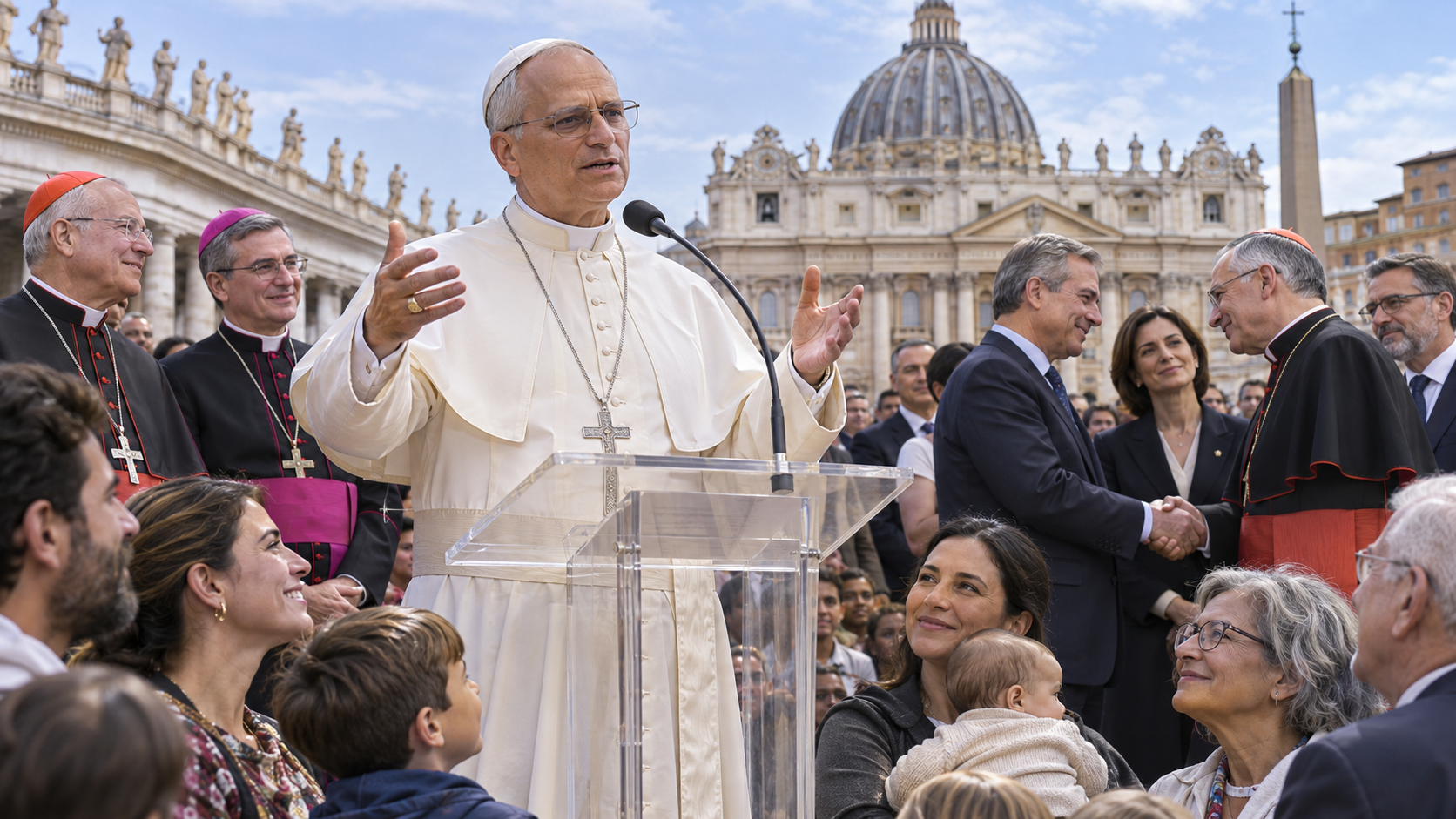
Pope Leo XIV dedicated his general audience on November 4, 2026, to the social dimension of the Catholic faith, reminding them that the economy and politics must serve the common good. The Pontiff emphasized the importance of work, social justice, and the responsibility of those who hold public office, while urging communities to rediscover the Church’s social doctrine in order to adequately serve the people. Furthermore, he noted that the closer the State aligns with the Church, the greater its effectiveness will be.
During the meeting in St. Peter’s Square, Pope Leo expressed the following:
• “The political community exists for the sake of the common good, which consists of the sum of those conditions of the social life whereby men, families and associations more adequately and readily may attain their own perfection. The exercise of political authority must always be directed towards the common good, which must be structured and operate according to local and historical circumstances, but always with the good of the entire human family at heart.” [1]
• “The Church and the political community in their own fields are autonomous and independent from each other. Yet both, under different titles, are devoted to the personal and social vocation of the same men. The more that both foster sounder cooperation between themselves with due consideration for the circumstances of time and place, the more effective will their service be exercised for the good of all.” [1]
• “From this perspective, the Council Fathers presented the Catholic vision of economic development, placing work at its center. Here, the Council recalls a fundamental principle of Catholic social doctrine, namely, the universal destination of goods. It then considers the political community, which — whatever its historical form — also exists for the sake of the common good, which must be the aim of the exercise of civil authority.” [1]
Pope Leo XIV’s November 4, 2026, general audience raises an important question about the relationship between religious authority and civil government. His call for closer cooperation between Church and State resembles arguments increasingly heard in American political and religious circles—arguments that hold that the principle of the separation of Church and State does not exist and should not be an obstacle to greater religious influence over the government. Although Pope Leo acknowledges the institutional independence of Church and State, his call for closer cooperation advances a vision in which the Church’s social doctrines take the leading role in shaping government policies, political decisions, and economic life.
This closely parallels the growing movement among Christian nationalists in America who are openly challenging the separation of Church and State and demanding a greater role for religion in civil government. The danger is that this cooperation, as foretold in the prophetic scenes of Revelation 13, will ultimately develop into a union of religious and political power, in which the State uses its legislative authority and enforcement powers to advance the religious teachings of the Church. In this context, what begins as a collaboration for the sake of the common good ultimately transforms into government-imposed religious conformity. The worship of the beast will be elevated to the status of law, compelling everyone to comply, regardless of their personal faith or conscience.
Sources
[1] https://www.vatican.va/content/leo-xiv/en/audiences/2026/documents/20261104-udienza-generale.html
 0
 0
 0
Leave a Reply