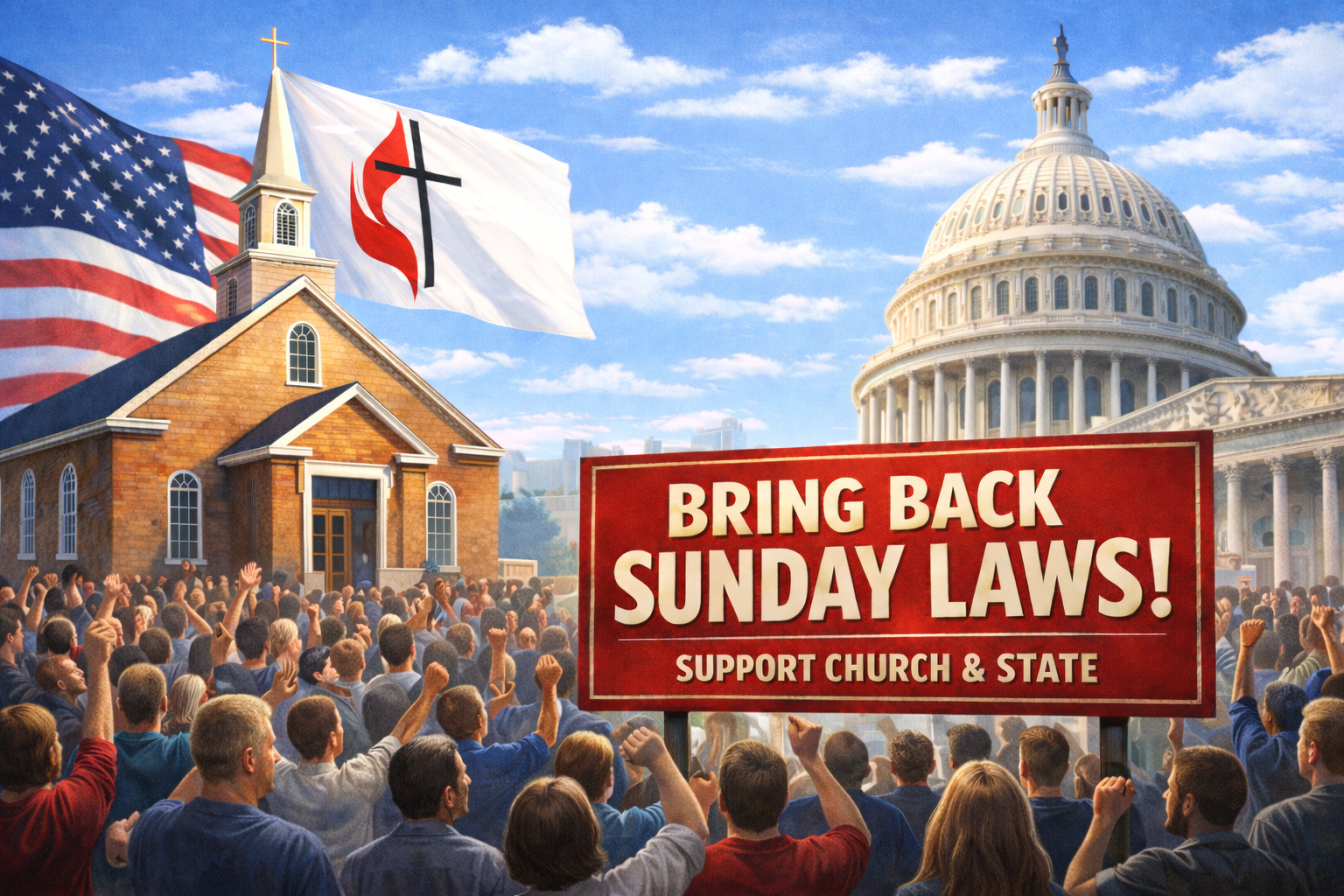
On March 2, 2026, Bishop David Bard, Chair of the Committee on Faith and Order in the United Methodist Church, spoke about the need to revive the civil structures that once played a beneficial role in supporting religious life in America. He pointed out that “Sunday closing laws were seen as support for Christian churches” and that they made “inviting people to participate in our church a bit easier.”
The bishop was highlighting a period in American history when Sunday laws restricted commercial activity so that society as a whole paused for worship and rest. He explained that these “social pressures” encouraged participation in Sunday worship, acknowledging that government policies once created a favorable environment for churches. In other words, Sunday worship was not entirely voluntary but was reinforced by legal and cultural pressures.
Bishop David Bard expressed the following remarks:
• “I chair the Committee on Faith and Order, which is charged with giving leadership to The United Methodist Church in reflecting upon, discerning and living out matters of faith, doctrinal teaching, order, and discipline in the midst of mission and ministry in the church and world.” [1]
• “On the Sunday I was in Copenhagen, many of us attended a United Methodist church … One of the things that struck me was the intertwining of church and crown, church and state, in Danish history.” [1]
• “While we have no long history of a state church in the United States, we certainly have a long history of broad social and cultural support for and reinforcement of participation in religious communities. Sunday closing laws were seen as support for Christian churches.” [1]
• “Just as the state church in Denmark no longer functions as it once did, so, too, have most of the broad social and cultural supports for religious participation eroded in the United States. People no longer assume that most of their coworkers belong to a religious community.” [1]
• “In light of that, the church’s task has become more challenging. It is one thing to have broad social forces that encourage religious participation. That makes inviting people to participate in our church a bit easier, though truth be told, we relied too long on such social pressures to do our work for us.” [1]
• “We have a task, and it is no longer supported by the social and cultural contexts it once was.” [1]
• “I think people want to see people of faith speak about and work for the common good. We will wade into some uncomfortable territory here, as the common good concerns our shared life in political communities. We need to continually raise questions about how we promote the flourishing of all, how we create a more beloved community.” [1]
• “We need to engage in actions for the common good with a generous spirit and kind, compassionate hearts.” [1]
The Bishop lamented that these social supports—namely, Sunday laws—have “eroded,” essentially making the church’s work more difficult for them. His comparison with Denmark’s historical union of church and state reinforces the idea that religious institutions often benefit when church doctrines are supported by civil authority. His argument points back to a time when Sunday laws helped strengthen churches and normalize Christian worship in society. By emphasizing the loss of these supports, he indirectly implies that the church would benefit if society once again promoted religious participation through public mandates.
Furthermore, when the Bishop David Bard speaks about Christians engaging politically to promote the “common good,” he opens the door for the church to influence the state through public policy. The concept of the “common good” has historically been used by many religious leaders to justify legislation that reflects Christian moral values. In this context, speaking positively about Sunday laws while simultaneously encouraging the church to engage politically is to advocate for Sunday laws.
By presenting Sunday closing laws as helpful to churches and lamenting their disappearance, the argument clearly points toward the idea of reviving these laws in order to strengthen religious participation. The logic is that the government can and should support Sunday observance in order to benefit both the church and society.
“The enforcement of Sunday-keeping on the part of Protestant churches is an enforcement of the worship of the papacy—of the beast” (Great Controversy, p. 448).
Sources
[1] https://michiganumc.org/we-have-good-news-to-tell/
 0
0 0
0 0
0
I think on MAY 17TH Trump is going to bring this to the forefront finally.
“I think people want to see people of faith speak about and work for the common good.”
The “common good”. This phrase did not come from the Methodist or any other, except from Rome. This is Babylon’s wine, and every nation and church is intoxicated with her wine/false teachings; these teachings are not Biblical:
“And there followed another angel, saying, Babylon is fallen, is fallen, that great city, because she made all nations drink of the wine of the wrath of her fornication. ”
Revelation 14:8 KJV
“The professors of religion of the present day, in every church, are lovers of the world, conformers to the world, lovers of creature comfort, and aspirers after respectability. They are called to suffer with Christ, but they shrink from even reproach…. Apostasy, apostasy, apostasy, is engraven on the very front of every church; and did they know it, and did they feel it, there might be hope; but, alas! they cry, ‘We are rich, and increased in goods, and stand in need of nothing.’”—Second Advent Library, tract No. 39.
The great sin charged against Babylon is that she “made all nations drink of the wine of the wrath of her fornication.” This cup of intoxication which she presents to the world represents the false doctrines that she has accepted as the result of her unlawful connection with the great ones of the earth. Friendship with the world corrupts her faith, and in her turn she exerts a corrupting influence upon the world by teaching doctrines which are opposed to the plainest statements of Holy Writ.
Rome withheld the Bible from the people and required all men to accept her teachings in its place. It was the work of the Reformation to restore to men the word of God; but is it not too true that in the churches of our time men are taught to rest their faith upon their creed and the teachings of their church rather than on the Scriptures? Said Charles Beecher, speaking of the Protestant churches: “They shrink from any rude word against creeds with the same sensitiveness with which those holy fathers would have shrunk from a rude word against the rising veneration of saints and martyrs which they were fostering…. The Protestant evangelical denominations have so tied up one another’s hands, and their own, that, between them all, a man cannot become a preacher at all, anywhere, without accepting some book besides the Bible…. There is nothing imaginary in the statement that the creed power is now beginning to prohibit the Bible as really as Rome did, though in a subtler way.”—Sermon on “The Bible a Sufficient Creed,” delivered at Fort Wayne, Indiana, Feb. 22, 1846.” ‘Great Controversy’, pages 388.1 – GC 388.3
CATECHISM OF THE CATHOLIC CHURCH
A day of grace and rest from work ………………..
2188 In respecting religious liberty and the common good of all, [b]Christians should seek recognition of Sundays and the Church’s holy days as legal holidays.[/b] They have to give everyone a public example of prayer, respect, and joy and defend their [b]traditions[/b] as a precious contribution to the spiritual life of society. If a country’s legislation or other reasons require work on Sunday, the day should nevertheless be lived as the day of our deliverance which lets us share in this “festal gathering,” this “assembly of the firstborn who are enrolled in heaven.”[125]