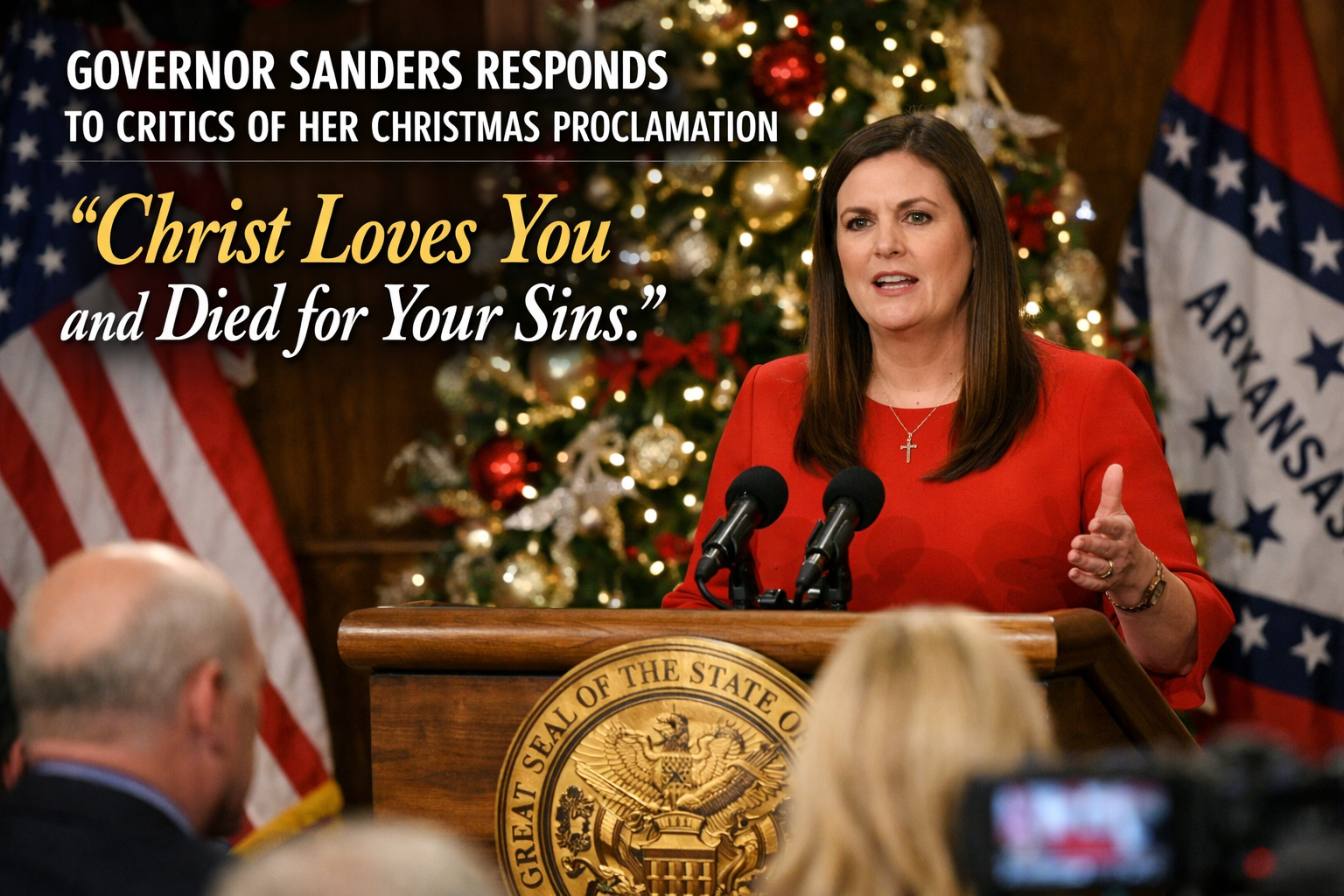
Arkansas Governor Sarah Huckabee Sanders responded to her critics who questioned her authority and motives for issuing an official faith proclamation calling on state workers to honor Christ by granting them an additional paid day off on December 26 to celebrate the birth of Jesus. Rather than backing down under accusations of using her position as governor to proclaim Christian theology as part of an official state function, Sanders doubled down—using her office of governorship to unapologetically affirm on official state letterhead that Jesus loves even her critics and that he died for their sins too. [1]
The @FFRF took issue with me closing state offices to celebrate Christmas and sent a letter demanding I rescind my proclamation.
Christmas isn’t a just a holiday, it’s the celebration of Jesus Christ’s birth. Meaning matters, we won’t pretend otherwise.
See my response here ⤵️ pic.twitter.com/UciehY3GtS
— Sarah Huckabee Sanders (@SarahHuckabee) December 22, 2025
Governor Sanders sent a clear message: she was not interested in accommodating others or softening religious language to satisfy critics. The move demonstrates that politicians today are more than willing to use the machinery of state authority to elevate Christian observance, even when challenged by those insisting government remain religiously neutral.
We have never been closer to a Sunday law than we are today, as politicians increasingly use the full weight of their offices to openly and publicly advance church doctrine through official proclamations, government platforms, and state authority. “Christianity” is today being celebrated and normalized through public policy language, endorsed from podiums, signed onto official letterhead, and promoted as a moral solution for society at large. Remarkably, very few see this as a dangerous union of church and state, where religious beliefs are no longer merely protected but actively promoted by civil power.
Both history and prophecy warn that when the state begins to elevate and promote religious observances, it sets the stage for religious legislation. It is only a matter of time before these same politicians—already comfortable using their authority to advance Christian doctrine—begin calling for Sunday to be formally respected as the Lord’s Day through legal means. Under the banner of reversing moral corruption, national decline, the breakdown of the family, overworked laborers, and the loss of faith, these leaders will appeal to unity, rest, and national renewal to justify stricter Sunday-closing measures.
“It will be declared that men are offending God by the violation of the Sunday-sabbath, that this sin has brought calamities which will not cease until Sunday observance shall be strictly enforced, and that those who present the claims of the fourth commandment, thus destroying reverence for Sunday, are troublers of the people, preventing their restoration to divine favor and temporal prosperity” (Great Controversy, p. 590).
Sources
[1] https://x.com/SarahHuckabee/status/2003180808413311039
 0
0 0
0 0
0
“Critics”?
This type of behavior or conduct is not Godly character; it is becoming more prevelent in those whose responsibility it is to serve the people, and not the people’s responsibility to serve them.
We can see this in all areas of society.
Especially when it comes to a man-made so called holi-day; when man makes their own way of worship it’s offensive to God – look at Cain and Abel Genesis 4.
Only God knows how we are to relate to Him; it would be a spectacle if some stranger were to come up to you and tell you that they are married to you:
“23 But the hour cometh, and now is, when the true worshippers shall worship the Father in spirit and in truth: for the Father seeketh such to worship him.
24 God is a Spirit: and they that worship him must worship him in spirit and in truth. ”
John 4:23-24 KJV
“The worship of God does not consist in outward ceremonies, or the observance of man-made creeds. Said Christ, “In vain they do worship me, teaching for doctrine the commandments of men.” [Matthew 15:9.] And again, “God is a spirit; and they that worship him must worship him in spirit and in truth.” [John 4:24.]
Christ came to our world at a time when moral power was fast disappearing from among men. Genuine religion had become corrupted. In its place formality and legalism had reared the most rigid exactions. A round of superstitions and externals was made essential, while inward piety was, in a great measure, only a pretense. As the necessity for purity of heart was lost sight of, outward forms and ceremonies multiplied. Wickedness of every kind triumphed. The Bible was misapplied, and modelled to suit the ideas and imaginations of men. The cleansing of hands and cups and utensils was considered of more consequence than the purification of the soul. From age to age these maxims and traditions had been cherished; and with each succeeding age additional inventions had been received with credulity, thus closing the way for the presentation of righteousness and truth.
Christ came at a time when he was most needed to set before a perishing world the truth in its purity. He came to remove the mass of rubbish which had confused their spiritual understanding and perverted true worship, that the plan of salvation should not become buried under a mass of erroneous theories, a complication of maxims, falsehoods, and authoritative dogmas. He did not require submission to the assertions and theories of man’s invention. He firmly and continuously resisted the sayings which rabbis, priests, and rulers had woven into the framework of truth, declaring before the assembled multitudes: “Ye teach for doctrines the commandments of men; ye make void the law of God through your traditions.” [ 11LtMs, Ms 80, 1896, par. 1 – 11LtMs, Ms 80, 1896, par. 3