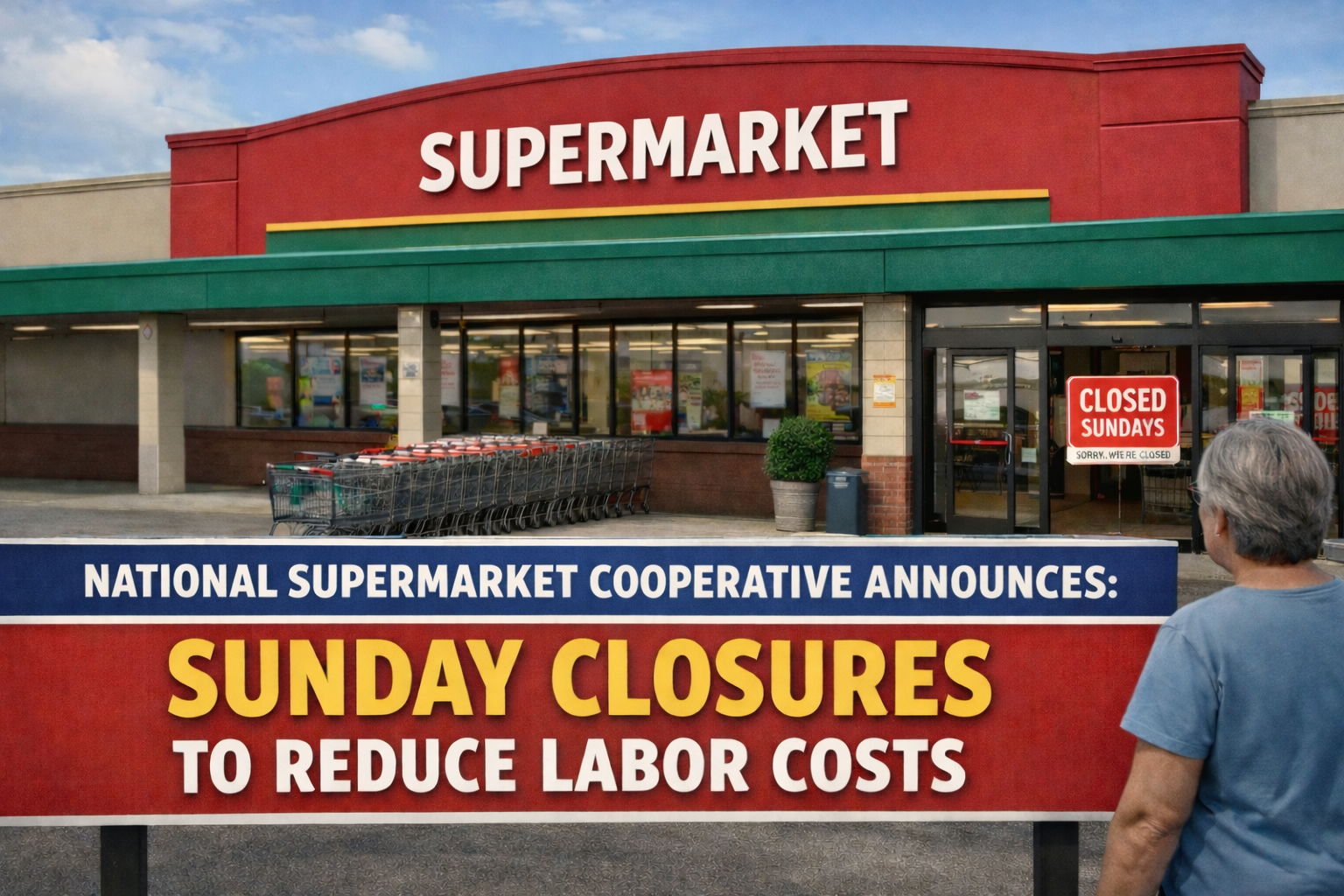
The National Association of Consumer Cooperatives (ANCC-Coop) is Italy’s central organization responsible for coordinating initiatives, shaping policy, and providing unified direction for millions of members within the supermarket retail sector. On January 6, 2026, Ernesto Dalle Rive, president of ANCC-Coop, publicly called for the closure of supermarkets on Sundays. His argument centered on rising labor costs, noting that Sunday wages carry mandatory premiums—approximately 30 percent higher than other days of the week—and that eliminating Sunday operations could allow retailers to recover billions of euros in annual expenses.
This is the very same approach outlined in Project 2025 here in the United States, which calls for amending the Fair Labor Standards Act to require time-and-a-half pay for employees who work on Sundays. What we are now witnessing in Italy demonstrates how such policies function in practice. By significantly increasing labor costs on Sundays, businesses are effectively pressured to close—not by mandate, but by economic penalty. This is part of an increasingly coordinated effort across Europe to reshape social rhythms by redefining Sunday as a normalized day of rest, using financial pressure to discourage commerce and compel compliance.
The local press in Italy reported the following:
• “Ernesto Dalle Rive, president of ANCC-Coop, to which 72 consumer cooperatives belong, with 2024 revenues of 16.4 billion, more than 57 thousand employees in more than 2,200 supermarkets chosen by 9 million customers every week.” [1]
• “As Coop we are making a reflection that we would like to share with the large-scale distribution system: the closure of supermarkets on Sundays in order to arrive at a shared drop point that could provide for six days of shop opening,’ says Dalle Rive.” [1]
• “The decision would make it possible to contain the cost of labor—on Sundays the surcharge is at least 30% of the salary—and recover productivity and efficiency, which, according to the Coop Studies Office for the entire Italian large-scale distribution system, could be worth between 2.3 and 2.6 billion. Resources that could be used to increase promotions ‘and give an answer to our employees who do not want to have to work on Sundays,’ adds Dalle Rive.” [1]
• “Our surveys show that a part of the purchases would move to the other days of the week. For Coop, about one in three Italians do not do their shopping on Sundays.” [1]
Italy’s National Supermarket Cooperative views Sunday closures as a practical response to rising labor costs and growing dissatisfaction with seven-day retail schedules. By pointing out that one in three Italians already avoid shopping on Sundays, the organization seeks to reassure the public that Sunday commerce is not essential. In doing so, ANCC-Coop is encouraging both workers and consumers to adjust to a six-day commercial cycle, effectively shaping behavior and expectations around Sunday as a designated day of rest.
This is how the normalization of Sunday rest works. The proposal to force companies to pay their employees higher wages on Sundays is part of a plan to coordinate the widespread closure of businesses on that day. Workers and retailers come to expect Sundays off as standard, while shoppers will also have to adjust their routines accordingly. Over time, Sunday’s non-commercial status is no longer debated—it is expected.
Sunday closings are not merely about supermarkets shutting their doors one day a week; they represent a deliberate cultural shift in how Sunday itself is being redefined. What is unfolding is the gradual normalization of Sunday as a shared, morally justified day of rest—no longer voluntary, but increasingly presented as a social and economic necessity.
Scripture warns that in the last days civil authority would be used to elevate a false standard of worship through economic pressure (Revelation 13:16–17). The call in Italy to close supermarkets on Sundays reflects the kind of measures that prepare society to accept enforced Sunday rest under the banner of unity, well-being, and social good.
Sources
[1] https://en.ilsole24ore.com/art/supermarkets-closed-on-sunday-cut-costs-AITvuYi
 0
0 0
0 0
0
Leave a Reply