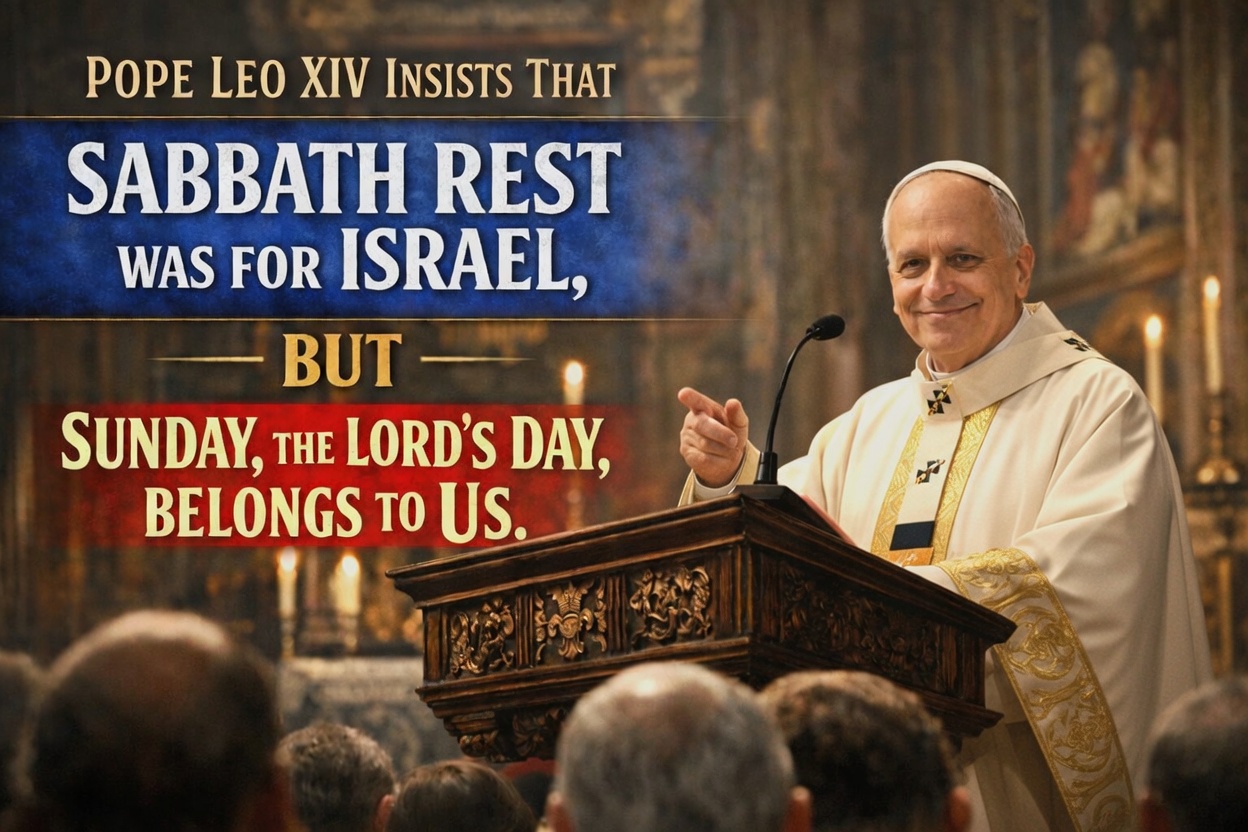
On Sunday, March 15, 2026, during Mass at the Parish of the Sacred Heart of Jesus in Rome, Pope Leo XIV explicitly identified Sunday as “the Lord’s Day” in his homily, linking it with worship, gratitude, and the mystery of life. This language is significant because it reflects Rome’s longstanding effort to attach sacred authority to Sunday while obscuring the biblical Sabbath, thereby openly demonstrating that it still regards itself as having the authority to redefine worship in defiance of the commandments of God.
• “Our Eucharistic celebration today, more than ever, is filled with joy. Indeed, the beauty of our gathering today is set against the backdrop of the Sunday known as ‘Laetare,’ meaning ‘rejoice‘.” [1]
• “Not only that: in the interrogation to which the blind man who can now see is subjected, it is above all Jesus who is put on trial, accused of having violated the Sabbath in order to heal him. Thus, another form of blindness is revealed in those present, one that is different and even more serious: that of failing to see, right before their eyes, the face of God, for which they trade the possibility of a saving encounter for the sterile security afforded by the legalistic observance of a formal discipline. Faced with such obtuseness, Jesus does not stop, showing that no “Sabbath” can stand in the way of an act of love. After all, the meaning of the Sabbath rest for the people of Israel – and for us on Sunday, the Lord’s Day – is precisely to celebrate the mystery of life as a gift, in the face of which no one can ignore the cry for help from a brother or sister who is suffering.” [1]
Rome’s words and actions prove that it has not changed, will not change, and never will change. The continued elevation of Sunday as “the Lord’s Day” instead of the seventh-day Sabbath shows that the papal system still claims the very authority prophecy warned about—the authority to think it can change God’s moral law (Daniel 7:25). Rather than submitting to the plain commandment of Scripture, Rome continues to exalt human tradition above divine revelation, proving that the system of apostasy foreseen in prophecy is still alive and active before our eyes.
The Bible teaches that the Sabbath is still binding because it was established by God at Creation, long before there was a Jewish nation, when “God blessed the seventh day, and sanctified it” (Genesis 2:2–3). In the heart of God’s moral law, the Lord commands, “Remember the sabbath day, to keep it holy… the seventh day is the sabbath of the Lord thy God” (Exodus 20:8–11), and Scripture never records God changing this command.
Jesus Himself said, “Think not that I am come to destroy the law” (Matthew 5:17–19), and He declared that “the sabbath was made for man” (Mark 2:27), showing it was made for all of mankind, not for one nation only. Jesus Himself declared, “The Son of man is Lord even of the sabbath day” (Matthew 12:8), showing that the Sabbath belongs to Him as its divine Lord. As Creator, Lawgiver, and Redeemer, Christ did not abolish the Sabbath but identified Himself as its Lord, affirming its sacred authority and enduring significance.
Christ’s followers continued to honor the Sabbath after His death and resurrection (Luke 23:56), and the apostle Paul also preached on that day (Acts 13:42–44; Acts 17:2; Acts 18:4). Finally, the Bible points forward to the new earth, where “from one sabbath to another, shall all flesh come to worship before me, saith the Lord” (Isaiah 66:22–23). These texts show plainly that the seventh-day Sabbath, or Saturday, remains God’s holy day, unchanged and still binding upon His people.
Sources
 0
0 0
0 0
0
The time as ripped now
Sabbath and marriage, are two sacred institutions ordained by God himself in the garden of eden since the memorial creation (Genesis 2:2;3). Therefore these institutions are sacrosanct, so, when Pope Leo XIV, Says ;that sabbath rest was meant for Israel he is absolutely very wrong? Sabbath was ordained by God he created all the living things and non living things and later he created human being on the sixth day, but on the seventh day , he blessed , sanctified, and rested. These are three most important things he did on that day. And he made the sabbath 3,000 years before the existence of the Jews or (Israeli nation). That’s why in the book of Mark 2:27, Christ says; sabbath was made for man, and not man for the sabbath. Therefore , he reffers to himself as the ”Lord of the sabbath”. There is nothing like the so called ” Jewish sabbath or the Christian sabbath”. These terminologies are simply human inventions.
Prophet Isaiah declares in the chapter 66 verse 22 through 23, that in the new heavens and the new earths , all the human beings shall gather in the new city of Jerusalem , gathering to worship him throrought the eternity. Sabbath is going to be God’s sacred day of worship forever here on earth and the new heavens and new earth. Despite all the efforts by Satan to trample down and discard all the truth, there are few faithful true christians who have worshipped in this sacred day throught the centuries and they were not Jews. We must acknowledge the fact the true christians consists of all people from all races, nations and tongues. That’s why in the book of Galatians 3:29 says; for there is no Jew and Greek in the Kingdom of God, the salvation is for all who accept Jesus Christ as the saviour. The ”True Israel today consists of people from all races ranging from Blacks, Whites, Hispanics, Greeks, Latinos, Hindus, Phillipinos etc.
The work of mystery of Iniquity started the way back in the early first centuries of the christian era, when the worldliness was introduced into christianity. The pagan celebrations and practices were introduced into the church. This is after Roman Empire had persecuted and killed about 10 million christians since the days of Emperor Nero, Satan had realised the persecution of Christians was bringing much more christians into the Christ’s fold, and he devised a clever strategy to camouflage as christianity and then he introduced paganism into the christianity. The true sabbath of creation memorial was cast down and trampled upon, and the sun worshippers quickly converted into christianity. The unbiblical doctrines such as immortality of the soul, worship of mary, child baptism, selling of indulgences, and the Sunday worship.
The origin of sunday worship started with Zoroastrian religion an ancient religion of persia which came to be known in the Roman Empire as solis invictus. The worship of mithra in honour of the sun god , this is according to the Catholic Encyclopaedia. Christianity was at the height of persecution in the early centuries from both Jews and the Romans. And the sabbath of the fourth commandment and Sunday the first day of the week were observed, and in some instances the christians who wanted to evade persecutions they rested both Sabbath and Sunday. Since the conflict between Jews and Romans existed prior to the spread of christianity.
So, anything the Jews did the Christians were blamed upon them. The tensions between Christians and Jews peaked upon 2nd Century in the second Jewish- Roman war . Christians began to feel the resentment towards the Jews. They began to view the sabbath as merely as a day of worship for the Jews who persecuted them. Then comes an important transistion of evolution of Sunday worship to Christian day of worship. The conversion of Emperor Constatine into christianity changed the fate of christianty forever, he converted into the christianity and enacted the Sunday observance into law on A.D 321 March 7 . This was made a compulsory day of worship and it was made as an edict. Then on A.D 364 , the Roman Catholic church in the council of Laodicea clearly made Sunday a day of christian worship and has been the tradition upto date. Satan had managed to put his clever deceptions in the christianity and the whole world was forced to fall into the deep darkness. This was beggining of the midnight darkness of the Papacy.
So, in conclusion Sunday worship was never instituted by God himself, it was never revered by Pophets, and Apostles. They never taught or preached about it. It was fundamentally a day dedicated for mithra sunday worship. It was no longer Jesus Christ who was worshipped. This pagan festival cannot the fourth commandment decalogue the biblical sabbath day of worship. The Sunday worship is simply luciferian (satanic worship).
If you call yourself Christian, you are baptized in Christ and have put on Christ by faith through obedience / righteousness by faith; and because Abraham believed by faith, then you are blessed with Abraham, and you are Abraham’s seed and heirs according to the promise:
“6 Even as Abraham believed God, and it was accounted to him for righteousness. 7 Know ye therefore that they which are of faith, the same are the children of Abraham.
8 And the scripture, foreseeing that God would justify the heathen through faith, preached before the gospel unto Abraham, saying, In thee shall all nations be blessed.
9 So then they which be of faith are blessed with faithful Abraham.
10 For as many as are of the works of the law are under the curse: for it is written, Cursed is every one that continueth not in all things which are written in the book of the law to do them.
11 But that no man is justified by the law in the sight of God, it is evident: for, The just shall live by faith.
12 And the law is not of faith: but, The man that doeth them shall live in them. 13 Christ hath redeemed us from the curse of the law, being made a curse for us: for it is written, Cursed is every one that hangeth on a tree:
14 That the blessing of Abraham might come on the Gentiles through Jesus Christ; that we might receive the promise of the Spirit through faith.
16 Now to Abraham and his seed were the promises made. He saith not, And to seeds, as of many; but as of one, And to thy seed, which is Christ.
17 And this I say, that the covenant, that was confirmed before of God in Christ, the law, which was four hundred and thirty years after, cannot disannul, that it should make the promise of none effect. 18 For if the inheritance be of the law, it is no more of promise: but God gave it to Abraham by promise.
19 Wherefore then serveth the law? It was added because of transgressions, till the seed should come to whom the promise was made; and it was ordained by angels in the hand of a mediator.
20 Now a mediator is not a mediator of one, but God is one.
21 Is the law then against the promises of God? God forbid: for if there had been a law given which could have given life, verily righteousness should have been by the law.
22 But the scripture hath concluded all under sin, that the promise by faith of Jesus Christ might be given to them that believe.
23 But before faith came, we were kept under the law, shut up unto the faith which should afterwards be revealed.
24 Wherefore the law was our schoolmaster to bring us unto Christ, that we might be justified by faith.
25 But after that faith is come, we are no longer under a schoolmaster. 26 For ye are all the children of God by faith in Christ Jesus.
27 For as many of you as have been baptized into Christ have put on Christ. 28 There is neither Jew nor Greek, there is neither bond nor free, there is neither male nor female: for ye are all one in Christ Jesus.
29 And if ye be Christ’s, then are ye Abraham’s seed, and heirs according to the promise. ”
Galatians 3:6-14, 16-29 KJV
Abraham had faith by keeping God’s Law and Commandments, and a covenant was made with him and was given a promise:
“1 And when Abram was ninety years old and nine, the Lord appeared to Abram, and said unto him, I am the Almighty God; walk before me, and be thou perfect.
2 And I will make my covenant between me and thee, and will multiply thee exceedingly.
3 And Abram fell on his face: and God talked with him, saying,
4 As for me, behold, my covenant is with thee, and thou shalt be a father of many nations.
5 Neither shall thy name any more be called Abram, but thy name shall be Abraham father of a great multitude; for a father of many nations have I made thee.
6 And I will make thee exceeding fruitful, and I will make nations of thee, and kings shall come out of thee.
7 And I will establish my covenant between me and thee and thy seed after thee in their generations, for an everlasting covenant, to be a God unto thee and to thy seed after thee.
8 And I will give unto thee, and to thy seed after thee, the land wherein thou art a stranger, all the land of Canaan, for an everlasting possession; and I will be their God.
9 And God said unto Abraham, Thou shalt keep my covenant therefore, thou, and thy seed after thee in their generations. 10 This is my covenant, which ye shall keep, between me and you and thy seed after thee; Every man child among you shall be circumcised.
11 And ye shall circumcise the flesh of your foreskin; and it shall be a token of the covenant betwixt me and you. ”
Genesis 17:1-11 KJV
“2 And the Lord appeared unto him, and said, Go not down into Egypt; dwell in the land which I shall tell thee of.
3 Sojourn in this land, and I will be with thee, and will bless thee; for unto thee, and unto thy seed, I will give all these countries, and I will perform the oath which I sware unto Abraham thy father;
4 and I will make thy seed to multiply as the stars of heaven, and will give unto thy seed all these countries; and in thy seed shall all the nations of the earth be blessed:
5 because that Abraham obeyed my voice, and kept my charge, my commandments, my statutes, and my laws. ”
Genesis 26:2-5 KJV
Christians no longer use circumcision as a token between them and God but by baptism with Christ.
Also, let no man deceive you with the traditions of men:
“4 And this I say, lest any man should beguile you with enticing words.
5 For though I be absent in the flesh, yet am I with you in the spirit, joying and beholding your order, and the stedfastness of your faith in Christ.
6 As ye have therefore received Christ Jesus the Lord, so walk ye in him:
7 Rooted and built up in him, and stablished in the faith, as ye have been taught, abounding therein with thanksgiving.
8 Beware lest any man spoil you through philosophy and vain deceit, after the tradition of men, after the rudiments of the world, and not after Christ.
9 For in him dwelleth all the fulness of the Godhead bodily.
10 And ye are complete in him, which is the head of all principality and power:
11 In whom also ye are circumcised with the circumcision made without hands, in putting off the body of the sins of the flesh by the circumcision of Christ:
12 Buried with him in baptism, wherein also ye are risen with him through the faith of the operation of God, who hath raised him from the dead. ”
Colossians 2:4-12 KJV
God’s covenant that He made with Israel is tue same as He made with Abraham, Isaac, and Jacob:
“Then will I remember my covenant with Jacob, and also my covenant with Isaac, and also my covenant with Abraham will I remember; and I will remember the land. ” Leviticus 26:42 KJV
God’s covenant with Abraham and with h8s generations is an Everlasting Covenant:
“And I will establish my covenant between me and thee and thy seed after thee in their generations, for an everlasting covenant, to be a God unto thee and to thy seed after thee. ”
Genesis 17:7 KJV
Gods Law, which is the 10 Commandments and His Covenant. The Covenant is the Law:
“And the LORD said unto Moses, Come up to me into the mount, and be there: and I will give thee tables of stone, and a law, and commandments which I have written; that thou mayest teach them. ”
Exodus 24:12 KJV
“And he was there with the LORD forty days and forty nights; he did neither eat bread, nor drink water. And he wrote upon the tables the words of the covenant, the ten commandments. ”
Exodus 34:28 KJV
“4 Who are Israelites; to whom pertaineth the adoption, and the glory, and the covenants, and the giving of the law, and the service of God, and the promises; 5 Whose are the fathers, and of whom as concerning the flesh Christ came, who is over all, God blessed for ever. Amen. 6 Not as though the word of God hath taken none effect. For they are not all Israel, which are of Israel: 7 Neither, because they are the seed of Abraham, are they all children: but, In Isaac shall thy seed be called. 8 That is, They which are the children of the flesh, these are not the children of God: but the children of the promise are counted for the seed. 9 For this is the word of promise, At this time will I come, and Sara shall have a son. 10 And not only this; but when Rebecca also had conceived by one, even by our father Isaac; 11 (For the children being not yet born, neither having done any good or evil, that the purpose of God according to election might stand, not of works, but of him that calleth;) ”
Romans 9:4-11 KJV
“And this I say, that the covenant, that was confirmed before of God in Christ, the law, which was four hundred and thirty years after, cannot disannul, that it should make the promise of none effect. ”
Galatians 3:17 KJV
“For this is the covenant that I will make with the house of Israel after those days, saith the Lord; I will put my laws into their mind, and write them in their hearts: and I will be to them a God, and they shall be to me a people: ”
Hebrews 8:10 KJV
“10 And confirmed the same unto Jacob for a law, and to Israel for an everlasting covenant:
11 Saying, Unto thee will I give the land of Canaan, the lot of your inheritance:
12 When they were but a few men in number; yea, very few, and strangers in it.
13 When they went from one nation to another, from one kingdom to another people; ”
Psalms 105:10-13 KJV
So wether Jew / Israel or gentile, but by righteousness by faith baptized with Christ, has received the adoption as heirs by promise along with Abraham. They keep God’s Commandments and His Law by faith and not by works, as Abraham and the elders did, and are in an Everlasting Covenant with God, and are distinguished as Gods peculiar people by His Everlasting Sign, the 7th Day Sabbath, with the blessing of sanctification:
“12 And the LORD spake unto Moses, saying,
13 Speak thou also unto the children of Israel, saying, Verily my sabbaths ye shall keep: for it is a sign between me and you throughout your generations; that ye may know that I am the LORD that doth sanctify you.
14 Ye shall keep the sabbath therefore; for it is holy unto you: every one that defileth it shall surely be put to death: for whosoever doeth any work therein, that soul shall be cut off from among his people.
15 Six days may work be done; but in the seventh is the sabbath of rest, holy to the LORD: whosoever doeth any work in the sabbath day, he shall surely be put to death.
16 Wherefore the children of Israel shall keep the sabbath, to observe the sabbath throughout their generations, for a perpetual covenant.
17 It is a sign between me and the children of Israel for ever: for in six days the LORD made heaven and earth, and on the seventh day he rested, and was refreshed.
18 And he gave unto Moses, when he had made an end of communing with him upon mount Sinai, two tables of testimony, tables of stone, written with the finger of God. ”
Exodus 31:12-18 KJV
God’s 7th Day Sabbath was instituted on the last day of Creation which is the last day of the weekly cycle. Whereby God blessed it and sanctified it. It was there before sin and any Jew or gentile:
“And God saw every thing that he had made, and, behold, it was very good. And the evening and the morning were the sixth day. ”
Genesis 1:31 KJV
“1 Thus the heavens and the earth were finished, and all the host of them.
2 And on the seventh day God ended his work which he had made; and he rested on the seventh day from all his work which he had made.
3 And God blessed the seventh day, and sanctified it: because that in it he had rested from all his work which God created and made. ”
Genesis 2:1-3 KJV
Well said.