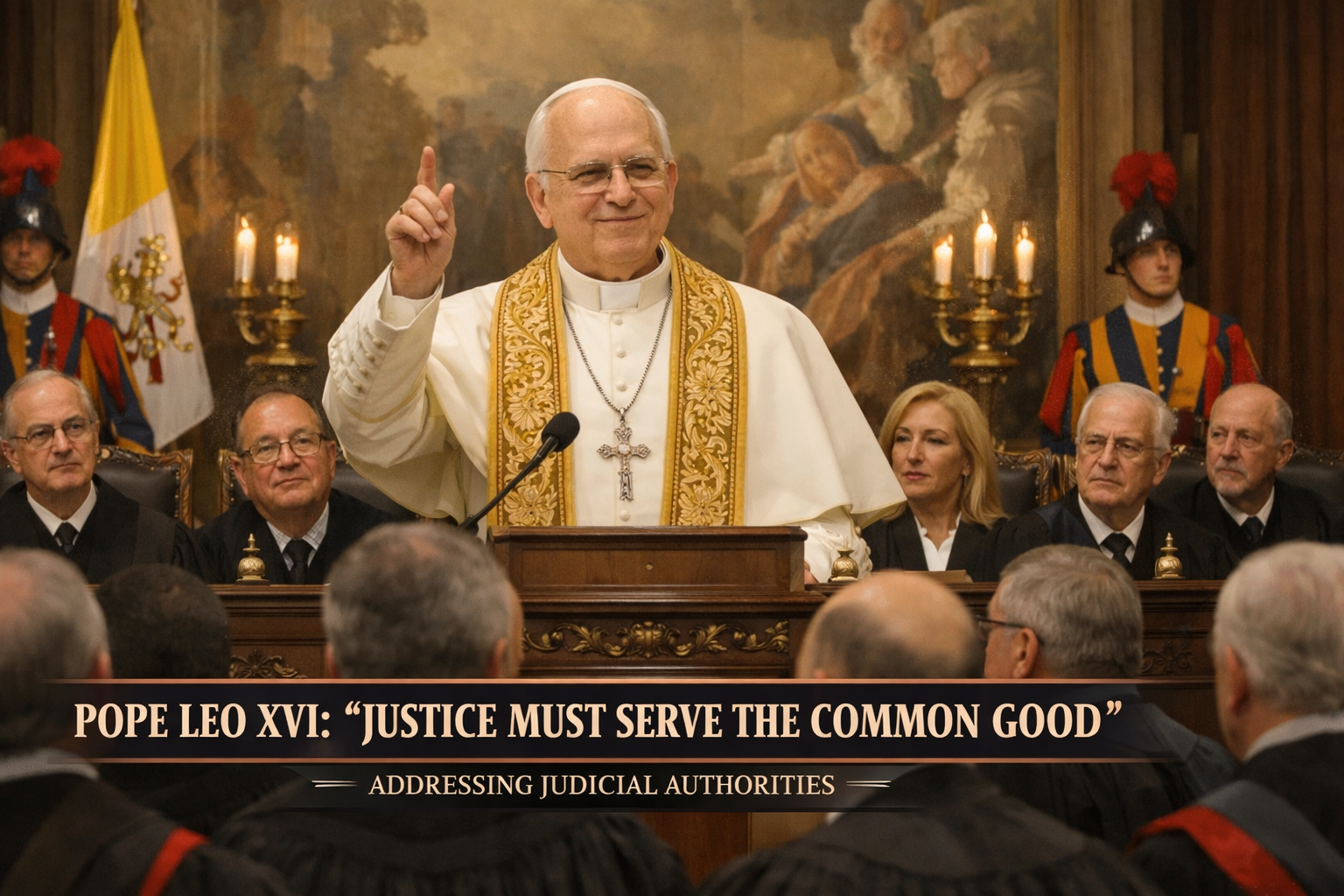
On March 14, 2026, Pope Leo XVI met with judges, lawyers, and members of various judicial bodies and emphasized that true justice cannot be separated from the promotion of the “common good,” a central principle of Catholic social doctrine. Addressing those responsible for interpreting and applying the law, he urged them not to view their work merely as the mechanical enforcement of statutes but to approach their responsibilities through the lens of society’s collective well-being. According to this perspective, the personal rights of individuals—particularly those of minorities—fall underneath what is defined as the greater good of the majority, a concept commonly referred to as the “common good.”
The Pope expressed the following in his address to those present:
• “To each of you I extend my cordial greetings, accompanied by my gratitude for the service you render in the delicate and valuable task of administering justice.” [1]
• “Your work, discreet and silent, contributes in a significant way to the correct functioning of the institutional framework of the State and, more deeply, to the credibility of the legal order that underpins it. Authentic justice, however, cannot be understood solely in the technical terms of positive law.” [1]
• “Justice, thus conceived, is the cardinal virtue that calls us to respect the rights of each and to establish in human relationships the harmony that promotes equity with regard to persons and to the common good.” [1]
The Vatican’s concept of the “common good” is rooted in its social teaching, which emphasizes that civil government should promote what benefits the community as a whole—even if doing so places limits on certain individual freedoms. By contrast, the United States Constitution—particularly the Bill of Rights—reflects the Protestant principle that individual liberties are fundamental and must be protected from government overreach. Rights such as freedom of religion, free speech, and liberty of conscience are treated as God-given protections that the state cannot violate. While the philosophy of the “common good” can be used to justify the union between church and state in order to enforce religious teachings, the American constitutional system was designed to prevent the government from favoring or enforcing religion, thereby safeguarding individual freedom and liberty of conscience.
It is through the concept of the common good that Sunday laws will be implemented in society. This idea has been promoted for years, and its justification is simple: without a uniform day that allows for the closure of shops, factories, and offices, workers are subjected to endless hours, families never have time to be together, and communities lack opportunities to rest or worship in church. And by legally guaranteeing a common day off through a Sunday law, the aim is to provide people with a real rest for their physical and mental health, thereby strengthening society.
However, the claim that Sunday laws protect the common good is an absolute myth. True protection for workers and families would simply allow each individual the freedom to follow their own convictions regarding the day of rest or worship without the government imposing Sunday observance on everyone. When the state elevates Sunday through legislation, it effectively favors the religious practices of certain Catholic and Protestant traditions while placing others at a disadvantage. Such preferential treatment contradicts the fundamental principle of religious liberty enshrined in the United States Constitution, which forbids the establishment of religion and protects liberty of conscience.
From a biblical perspective, the seventh day, or Saturday—not Sunday—is God’s true day for rest and worship. Scripture clearly states, “The seventh day is the sabbath of the Lord thy God” (Exodus 20:10), referring to the day God blessed and sanctified at creation after resting from His work (Genesis 2:2–3). This commandment was later written by God’s own finger on the tables of stone as part of the Ten Commandments, establishing the seventh day as the divinely appointed day of rest and worship.
Throughout the Bible there is no passage that changes the sanctity of the Sabbath from the seventh day to the first day of the week. Sunday observance developed later through human tradition and ecclesiastical authority rather than through a command of God in Scripture. Therefore, from the standpoint of the Bible, the true Sabbath remains the seventh day, a memorial of creation and a sign of loyalty to God rather than an institution established or enforced by human legislation.
“And the third angel followed them, saying with a loud voice, If any man worship the beast and his image, and receive his mark in his forehead, or in his hand, The same shall drink of the wine of the wrath of God, which is poured out without mixture into the cup of his indignation; and he shall be tormented with fire and brimstone in the presence of the holy angels, and in the presence of the Lamb.” Revelation 14:9-10.
Sources
[1] https://press.vatican.va/content/salastampa/en/bollettino/pubblico/2026/03/14/260314b.html
 0
0 0
0 0
0
Leave a Reply