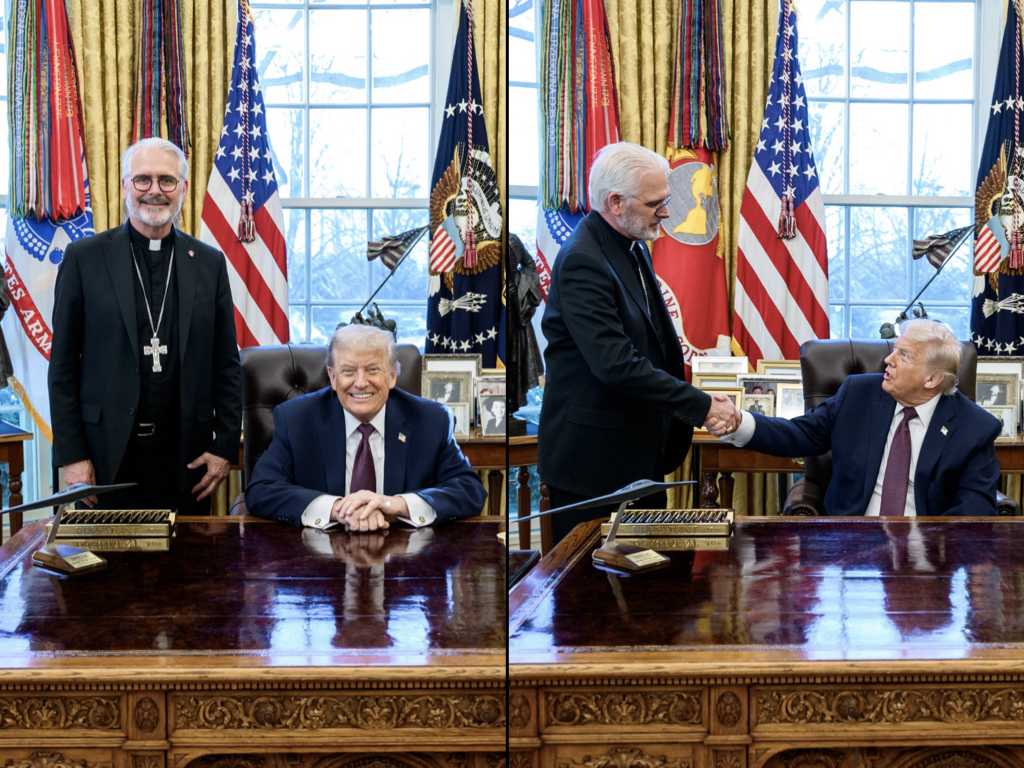
On January 12, 2026, Archbishop Paul S. Coakley, president of the United States Conference of Catholic Bishops (USCCB), met privately with President Donald J. Trump at the White House. The meeting was closed to the press, and no official details were released regarding the substance of the discussion. The USCCB—the national governing body of Catholic bishops in the United States that provides guidance to American Catholics and engages policymakers on public issues—later acknowledged the meeting in a brief statement, releasing the following:
Photos from yesterday’s introductory meeting with USCCB President Archbishop Paul S. Coakley and President Trump https://t.co/AqIKaElO4l pic.twitter.com/DC68JknAt3
— U.S. Conference of Catholic Bishops (@USCCB) January 13, 2026
• “Archbishop Coakley, had the opportunity for introductory meetings with President Trump, Vice President Vance, and other Administration officials, in which they discussed areas of mutual concern, as well as areas for further dialogue. Archbishop Coakley is grateful for the engagement and looks forward to ongoing discussions.” [1]
When Archbishop Paul Coakley met with Donald Trump, Vice President Vance, and other White House officials to talk about shared concerns and future cooperation, it may have seemed like a normal government matter. However, history shows that moments like this deserve careful attention. More than 1,600 years ago, Constantine the Great faced a divided and crisis-plagued Roman Empire. Instead of keeping politics out of religion, he aligned himself with the church and used it to help restore order and national unity to the empire. That decision gave the government moral legitimacy and the church political power, but it also eliminated the line between church and state, paving the way for the establishment of Sunday laws.
The current political situation feels all too familiar. When political leaders seek the support of powerful religious institutions, and when church leaders gain access to and influence within the government, both sides appear to benefit, but it is the public that ultimately pays the price when freedom and conscience are compromised. History teaches us that what begins as “dialogue” and a search for “common ground” with Rome gradually transforms into political favoritism and religious influence on public policy. That is why this meeting between the United States Conference of Catholic Bishops and the White House serve as an important reminder of why the separation of church and state has always been a fundamental safeguard of religious liberty.
“When the leading churches of the United States, uniting upon such points of doctrine as are held by them in common, shall influence the State to enforce their decrees and to sustain their institutions, then Protestant America will have formed an image of the Roman hierarchy, and the infliction of civil penalties upon dissenters will inevitably result.” (Great Controversy, p. 445).
Sources
[1] https://x.com/usccb/status/2011172537443459411
 0
0 0
0 0
0
Leave a Reply