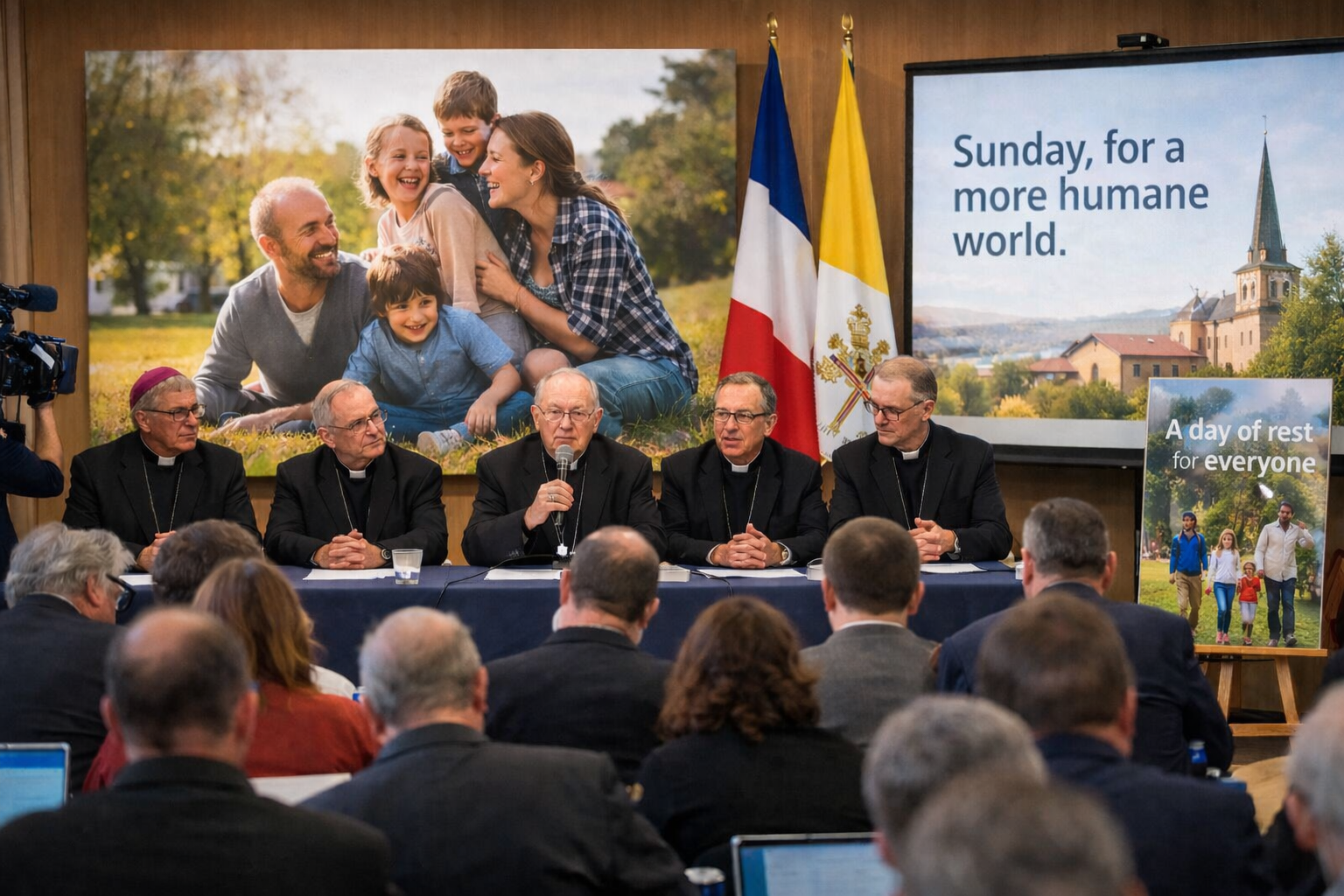
The Conference of Catholic Bishops is the national authority within a country and functions as the policy and teaching entity for the Roman Catholic Church. This body does advocate for public policies on national issues; they meet with lawmakers and publish their policy priorities, which are shared with local and national leaders. Recently, the Conference of Catholic Bishops in France published a statement on the “Christian meaning of Sunday,” which was posted on its official church website.
The article stated the following:
• “Sunday for Christians is the “Lord’s Day,” the day of Christ’s resurrection, the first day of the week … Therefore, the meaning of Sunday, for a Christian, through the celebration of the Eucharist to which he is invited, preceded in the early centuries the establishment of Sunday as a weekly day of rest.” [1]
• “The blessed tradition of Sunday as a day of rest has enriched the celebration of the Lord’s Day. Taking time off from work to refresh oneself spiritually, strengthening family and fraternal bonds, and taking time for contemplation is already a taste of the joy of the resurrection.” [1]
• “Therefore, the meaning of Sunday, for a Christian, through the celebration of the Eucharist to which he is invited, preceded in the early centuries the establishment of Sunday as a weekly day of rest.” [1]
• “Man is not reducible to his economic dimension. The questioning of Sunday, which would tend to make it a day like any other, risks obscuring the meaning of human life as revealed to us by Christ.” [1]
• “Certainly, modern life requires adjustments to ensure that social life can continue on Sundays. These adjustments should only be considered as exceptional measures that concern only certain specific areas: health, safety, transport, leisure, professionals, etc.” [1]
• “By preserving for Sunday the meaning of the celebration of the Resurrection, the Church affirms its desire to enable Christians to experience it under favorable conditions. It also wishes to serve society as a whole so that it may find a path that makes human life ever more humane. [1]
When the Roman Catholic Church says that Sunday rest serves society and makes life more humane, the real goal is to make Sunday the universal day of rest for all people. The Catholic Bishops are advocating for Sunday as the Christian Sabbath to be recognized and observed by society as a whole. By presenting Sunday rest as beneficial for workers, families, and social stability, the argument becomes more appealing to governments and the public, making it easier to promote legislation to stop activities and commerce on that day.
This emphasis reinforces the prophetic warning found in Daniel 7:25 and reflects the Catholic Church’s long-standing position that it has the authority to designate Sunday as the day of rest and worship in place of the biblical seventh-day Sabbath. By promoting Sunday rest in society and encouraging people and governments to structure their lives and laws around church attendance on that day, it seeks to establish Sunday as the universal day of rest and worship for all people, elevating a tradition of the church above the commandment of God.
This is exactly the kind of development Bible prophecy warned about in the books of Daniel and Revelation. The Great Controversy also predicted that a movement would arise to promote Sunday through the untion of both church and state, presenting it as something good for society while setting aside the biblical seventh-day Sabbath. As these signs become more visible around us, the real question is: when will God’s people wake up to what is happening, believe the warnings given in the Bible and the Spirit of Prophecy, and boldly share the message of Revelation 14 with a world that is quickly moving toward the fulfillment of these prophecies?
“In a special sense Seventh-day Adventists have been set in the world as watchmen and light bearers. To them has been entrusted the last warning for a perishing world. On them is shining wonderful light from the word of God. They have been given a work of the most solemn import—the proclamation of the first, second, and third angels’ messages. There is no other work of so great importance. They are to allow nothing else to absorb their attention.” (Testimonies, Vol. 9, p. 19).
Sources
 0
0 0
0 0
0
Leave a Reply