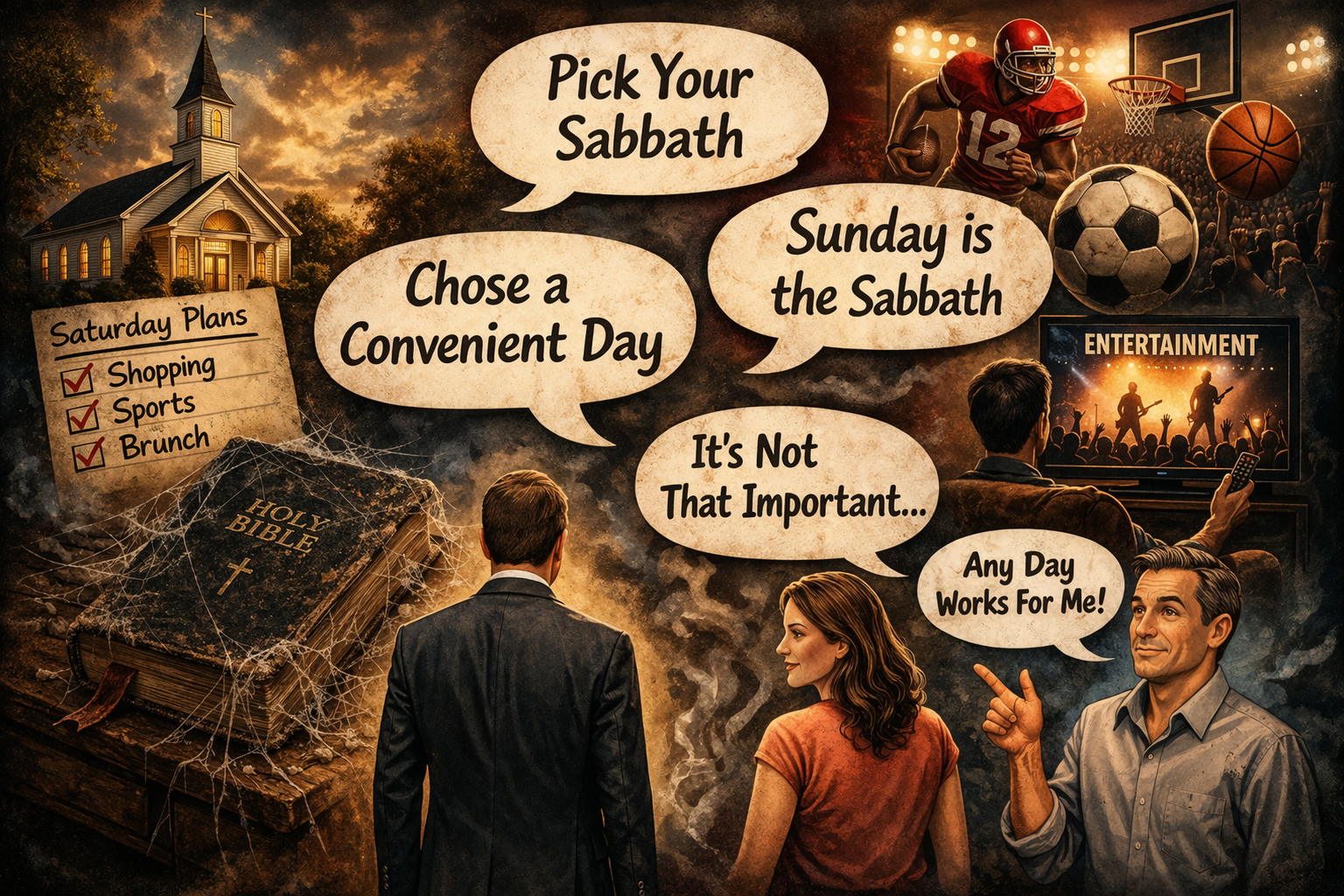
Calvin Chimes is the official student newspaper of Calvin University, a private Christian institution known for its Reformed evangelical roots. On March 23, 2026, the newspaper published a deeply troubling article claiming that people “need a Sabbath,” while at the same time stripping away any true biblical meaning of what the Sabbath actually is
The article argued that this so-called “Sabbath” can be observed on any day, at any time, for any length, and without any connection to a fixed weekly calendar. In other words, the Sabbath is no longer a sacred, God-appointed day—it is whatever you want it to be. This radical redefinition reduces the Sabbath to a matter of personal convenience, shaped entirely by individual preference rather than by God’s commandments.
The Calvin Chimes expressed the following:
• “Feeling overrun by life may feel like a barrier to Sabbath, but it is actually an indicator you need a Sabbath.” [1]
• “I initially had a narrow view of Sabbath that limited my ability to fully commit, so allow me to debunk some myths about Sabbath.” [1]
• For some people, Sunday will not work. I take my Sabbath on Sundays, but Pastor Mary Hulst takes her Sabbath on Mondays because that is what works best for her schedule.” [1]
• “I could Sabbath on Tuesdays since I don’t have class, I just prefer Sunday. Sabbath does not have to happen on a Sunday, it just needs to happen.” [1]
• “Sabbath does not have to be 24-hours or align with a day of the week. I Sabbath from the time I go to bed Saturday to the time I eat dinner Sunday. This allows me the flexibility to do a couple hours of work if I desperately need to before classes on Monday.” [1]
• “Maybe you want to Sabbath from dinner on Tuesday through lunch on Wednesday. I encourage getting as close to a full day as possible, but it is not required, and your Sabbath by no means has to align with the calendar.” [1]
Apparently, according to many evangelicals, the Sabbath no longer needs to be tied to a specific day, a set period of time, or even the seven-day weekly cycle established in Scripture. What is being promoted is the idea that our beliefs can be shaped by personal preference rather than the Word of God. The danger in these kinds of teachings is that when people reshape truth to fit their lifestyle, they are no longer following God—they are following themselves. True worship is not determined by what is convenient or practical for us but by what God has clearly established in His word.
“But in vain they do worship me, teaching for doctrines the commandments of men.” Matthew 15:9.
“God is a Spirit: and they that worship him must worship him in spirit and in truth.” John 4:24.
Jesus made it unmistakably clear that the Sabbath is not a human invention but a divine institution with a specific day tied to a weekly calendar cycle. In the Gospel of Mark 2:27–28, He declared that “the Sabbath was made for man,” establishing its universal application to all nations and people, and then proclaimed Himself “Lord also of the Sabbath.” By doing this, Christ did not redefine or replace the Sabbath—He identified Himself as the rightful authority over the very day already established at the seven-day creation week (Genesis 2:1-3) and affirmed by God in His moral law (Exodus 20:8-11).
He was pointing His hearers back to the known and original Sabbath day, or Saturday, that had long been in existence. He did not introduce a new day or ask you to keep your own day or didn’t even sanction Sunday. In other words, Jesus tied His Lordship to a specific day—the one already recognized as the Sabbath, the seventh day. If Jesus is Lord of the Sabbath, then that day rightfully belongs to Him. It is not ours to redefine or change according to human preference, because His Lordship establishes both its authority and its identity. To separate Christ from the day He Himself claimed is to undermine His authority and reject the very claim He made.
If our teachings contradict Scripture, then we are not honoring God—we are replacing Him or, in the case of the Antichrist power of the last day, usurping His authority (Daniel 7:25). The Bible warns against adding to or taking away from His Word (Revelation 22:18-19), because doing so deceives and misleads others. A faith built on human opinion may feel comfortable for a little while, but it has no power to save anyone. Honoring and worshipping God means submitting to His Word as the final authority, even when it confronts us, corrects us, or calls us to change. Anything less is not faithfulness—it is a lie.
Sources
[1] https://calvinchimes.org/2026/03/23/reflecting-on-a-year-of-sabbath/
 0
0 0
0 0
0
Leave a Reply