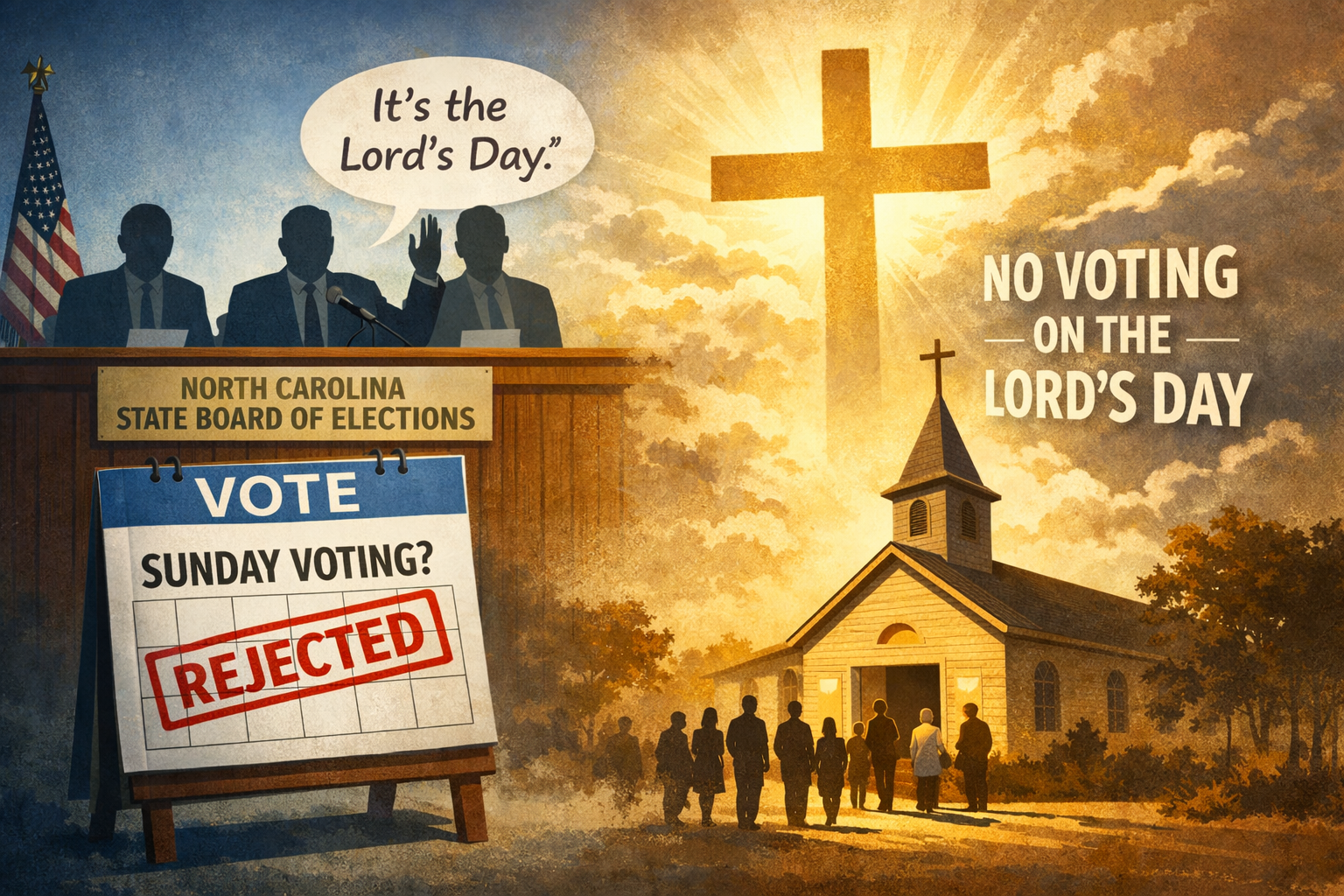
Religious beliefs are beginning to influence voting policies, and this influence is showing signs of spreading to other areas of public life, particularly attempts to restrict activities on Sundays. On January 14, 2026, the Border Belt Independent newspaper reported that the North Carolina State Board of Elections blocked Sunday voting in Columbus County on religious grounds. While officials publicly stated that their decision was based on providing a day of rest for election workers, the chairman’s own words revealed the true motive: “I don’t think we should be voting on Sundays … because that’s the Lord’s Day.”
The Border Belt Independent reported the following:
• “Columbus County residents won’t have the option to vote on Sunday ahead of the March 3 primary election.” [1]
• “The North Carolina State Board of Elections on Tuesday rejected a plan for the county to offer early voting on Sunday, February 15. The 3-2 vote was split along party lines, with the Republican majority opposing the plan.” [1]
• “Republican board chairman Francis X. De Luca told reporters at the meeting that poll workers should be allowed to rest on Sundays. He also said that Sunday voting approved by the state board couldn’t be retracted in the future.” [1]
• “I don’t think we should be voting on Sunday,” De Luca said. “I know lots of people who do nothing on Sunday because that’s the Lord’s day.” [1]
This news item matters because it shows how Sunday is increasingly being treated as a sacred day whose perceived religious character is allowed to influence public behavior. In other words, a personal religious conviction about Sunday observance was used to limit access to a civic right—voting. Once state officials accept religious reasoning as a valid basis for restricting voting on Sunday, a precedent is established. If Sunday can be treated as “off-limits” for voting because it is considered the Lord’s Day, it becomes far easier to argue that other activities on Sunday should also be restricted for the same reason.
As religious language becomes more normalized in public decision-making, efforts to shut down activity on Sunday will also increase. North Carolina’s decision on voting shows that Sunday closing laws are not theoretical but are real. It is happening in real time, affecting real rights. Civil ordinances about Sunday activity are being justified on the basis of religion. What is happening in North Carolina is not an isolated incident. It is an early warning of how religious convictions about Sunday are moving from the pulpit into the polling place—and, eventually, into every corner of public life.
“The pressure of the Sunday law has come and is coming. It has been ordered that all stores shall be closed on Sunday, and this is being rigidly enforced. The government is trying to have God acknowledged in the constitution. Our people are making just as vigorous a stand as possible that it shall not be. They have been securing names to a petition to this effect. We can see that that which we have been talking about for the last thirty-five years—this law causing the Sunday to be exalted and making human inventions take the place of God’s holy day—is now being fulfilled. There is much excitement now in regard to these matters” (Letter 28, 1897).
Sources
[1] https://borderbelt.org/nc-elections-board-rejects-sunday-voting-for-columbus-county/
 0
0 0
0 0
0
Leave a Reply