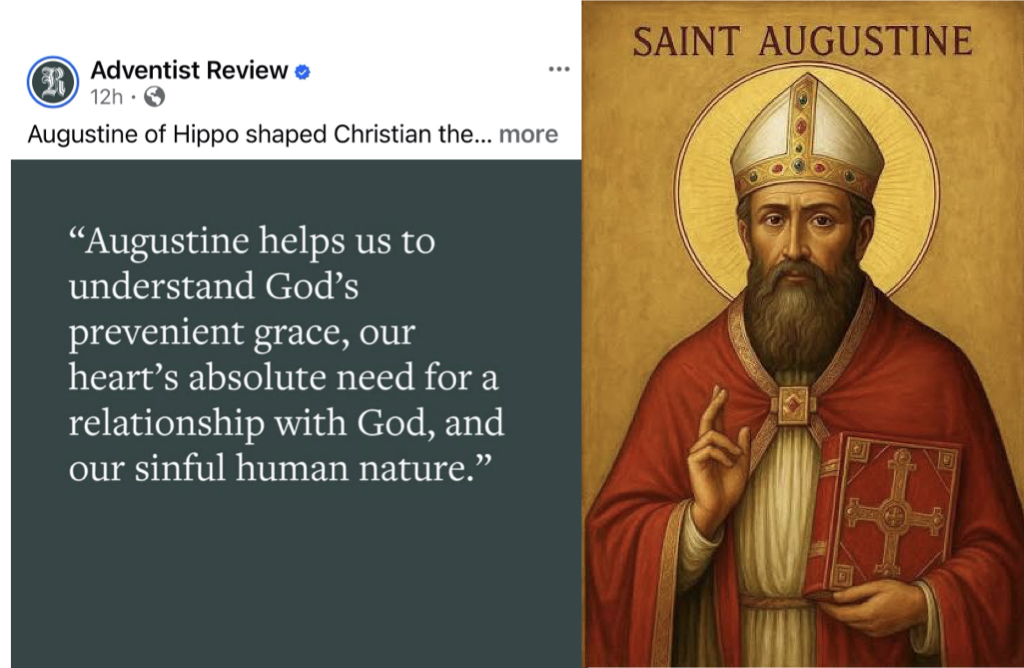
The flagship publication of the Seventh-day Adventist Church occupies a unique position because it is not merely another religious magazine. The Adventist Review is the longest-running continuous publication intended to reflect and defend the prophetic message entrusted to the Adventist movement. For this reason, when such a publication praises the contributions of Saint Augustine of Hippo as someone who promoted important biblical truth, it raises serious theological and prophetic concerns. [1]
The Advent movement did not arise to promote the church fathers of the Roman Catholic Church. It arose to restore the very truths that Rome had obscured during centuries of spiritual compromise. While Augustine is widely celebrated throughout Christianity as one of its greatest theologians, his influence also contributed to some of the most significant departures from biblical truth during the early centuries of the church.
One of Augustine’s most far-reaching contributions was his promotion of allegorical interpretation, particularly in his treatment of prophecy. Instead of reading the prophecies of Daniel and Revelation as unfolding historical events, Augustine promoted a spiritualized approach that effectively neutralized the prophetic messages of Daniel and Revelation. This view later became dominant in the medieval church and helped obscure the rise and identity of the woman that rides the beast, Babylon, and the man of sin as foretold in Scripture. [2]
Augustine also strongly defended the idea that the state could be used to enforce religious unity. Interpreting Christ’s words “compel them to come in,” he argued that civil authority could legitimately coerce the conscience and impose religious conformity for the good of the church. [3] That idea became the theological foundation for the Roman Inquisition, leading to centuries of persecution and the union of church and state power. Using force to convert unbelievers also led to the Crusades and to many more abuses in which faith was no longer voluntary but could be forced upon societies.
In contrast, Adventists have always emphasized religious liberty and the separation of church and state as vital principles of the gospel. This is why praising Augustine primarily as a promoter of truth is something that should not be embraced within the Adventist community.
Augustine also solidified the doctrine of the immortal soul into Western Christianity by interpreting Greek philosophy with the Holy Scripture. In his book, The Immortal Soul, he strongly defended what he called the natural immortality of the soul, which became one of the foundations of the Roman Catholic and much of Protestant theology regarding the soul and the afterlife. [4] Augustine’s influence helped shape the very apostasy that the Advent movement was raised up to warn against. Our prophetic message includes exposing the historical development of religious systems that departed from the simplicity of apostolic Christianity.
When the church’s own flagship publication appears to celebrate figures whose theology helped contribute to the rise of serious theological error, it compromises and distorts the distinctiveness of the message God entrusted to this movement. It sends mixed messages to the world and misrepresents who we are. The hour in which we live calls not for ecumenical or theological appeasement but for prophetic clarity. Our mission is not to validate Roman Catholic Church fathers but to faithfully proclaim the truths of Scripture—even when those truths challenge long-established religious systems.
In a time when the world is moving toward greater religious unity and renewed alliances between church and state, God’s faithful people must guard its prophetic voice with great care. The mission of the Advent people has always been to lift up the Word of God above human tradition and to warn the world of the final issues soon to confront our world. Any message that softens our prophetic identity ultimately weakens the very witness we were raised up to give.
“But God will have a people upon the earth to maintain the Bible, and the Bible only, as the standard of all doctrines, and the basis of all reforms. The opinions of learned men, the deductions of science, the creeds or decisions of ecclesiastical councils, as numerous and discordant as are the churches which they represent, the voice of the majority,—not one or all of these should be regarded as evidence for or against any point ofreligious faith. Before accepting any doctrine or precept, we should demand a plain ‘Thus saith the Lord’ in its support” (Great Controversy, p, 595).
Sources
[2] https://www.spiritandtruth.org/teaching/documents/articles/148/148.htm
[4] https://www.goodreads.com/book/show/9888895-the-immortality-of-the-soul
 0
0 0
0 0
0
St. Augustine of Hippo (AD.354-430)was one of early Roman Catholic church founders who helped to shape the doctrines of the church such as the ” immortality of the soul”he was also a philosopher and theologian at the same time. Augustine was from north africa (Annaba Algeria). His writings helped to shape the development of western philosophy and western christianity. During the council of Nicea in AD.325, he helped to shape the trinity doctrine, which is closely identified with him. He also helped to shape the doctrine of ”the origin of sin” and many other doctrines. This is the man who helped to shape theological error which the Adventists are identifying with? It’s also important worthy to note the during the upcoming papal visit in Africa by Pope Leo XIV, in the month of April, he plans to make an official visit in Algeria, the home country of Augustine of Hippo, he also expressed his interest by visiting the home country of one of the early church founders of the church.
What about Augustine’s more fundamental errors that are now popular/widely accepted within Adventism since the early 1980’s? –
1) original sin as inherited guilt vs inherited weakness
2) God’s grace as irresistible and predestined for the elect vs God’s grace can be resisted and there is no special predestination
3) Christ had an unfallen nature vs Christ had fallen nature – “the seed of David”
Don’t these matter any more as long as you believe and keep the Sabbath? They certainly mattered to our pioneers.
Augustine is praised by his acolytes, who revere him as their spiritual “father” – those who praise him preach another gospel altogether.
{When the church’s own flagship publication appears to celebrate figures whose theology helped contribute to the rise of serious theological error, it compromises and distorts the distinctiveness of the message God entrusted to this movement. It sends mixed messages to the world and misrepresents who we are.}
AMEN
There are Adventists today who are only Adventist in name the doctrines they picked up via their training in many cases has come directly from the Papacy,
So now they uplift popery, they will not give the Trumpet a certain sound, They have no interest in doing the commission of The 3 Angels Messages, they are fully compromised.
James White wouldn’t be allowed to editor of the magazine he started.
All the early Adventist pioneers were against creeds. What happened? We have creeds and twist the Scriptures to say God doesn’t have a Son, just a metaphor. Christ says he will spew this Laodicea out and it doesn’t return to His mouth. Our foundation has been changed.
It is dependent on each Seventh-Day Adventist believer to stand for truth though the heavens fall. We must be strong in Christ. We must refuse to go along with members who weekly refuse to be counted. We must turn completely from the world and its beliefs and turn wholly to our Savior.