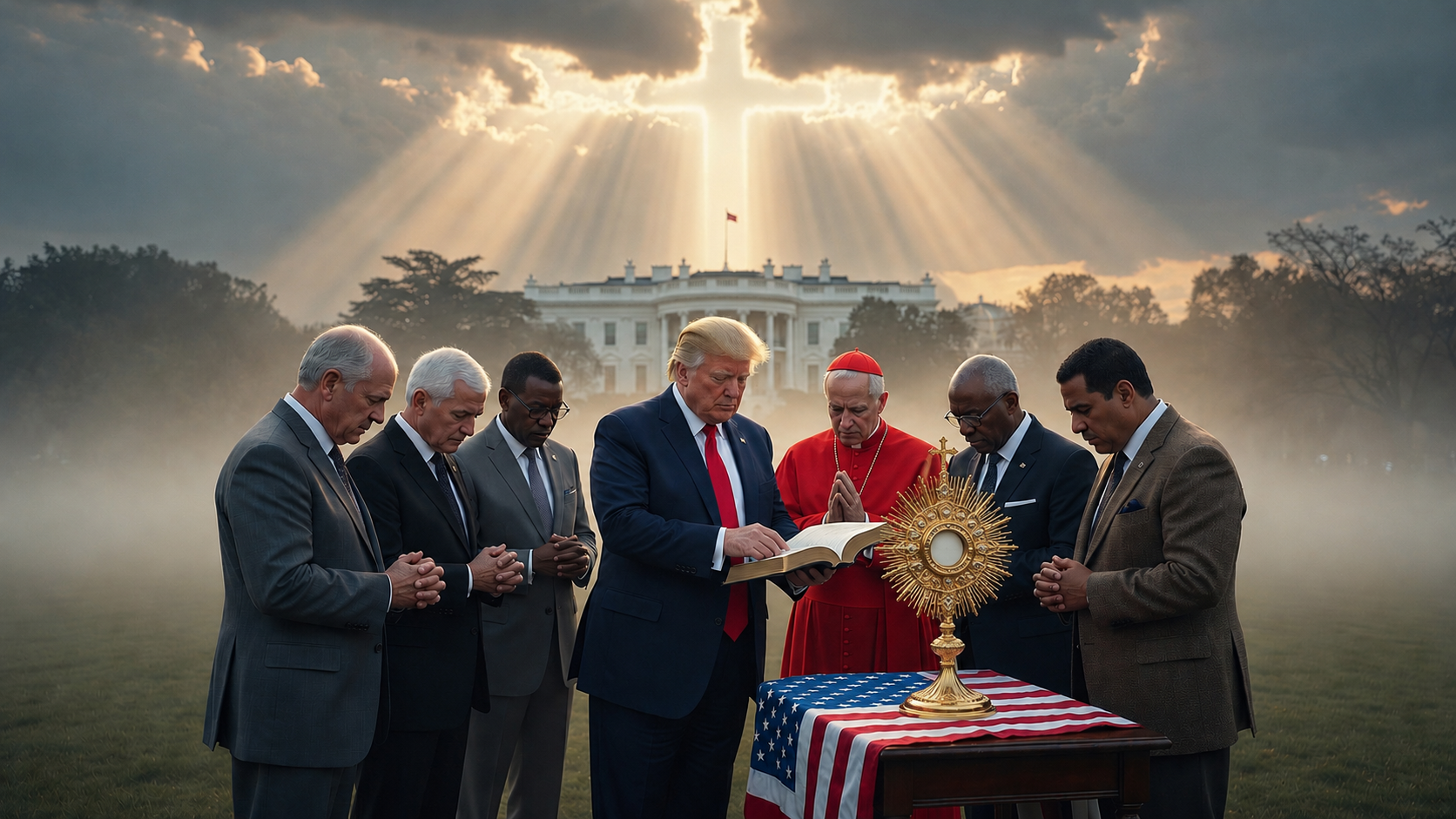
A news article from June 27, 2026, reported on how the Trump administration’s second term has made Christianity a central part of its political agenda. This includes efforts to promote religion in public life, address what it describes as anti-Christian bias in government, and advance policies supported by many religious conservatives.
It also describes a growing union of religion and politics, where many within the MAGA movement and the Republican Party want America to be seen more openly as a Christian nation shaped by biblical values. It warns that American history is being redefined and that the nation’s identity, laws, and institutions are increasingly being shaped by a Christian nationalist vision rather than preserving the constitutional principle of separation between church and state.
CNN published the following about the Trump administration’s vision for America:
• “A major theme of Trump 2.0 is that Americans need more religion—and specifically Christianity—in their lives.” [1]
• “Added to that the biblical language in Hegseth’s war press conferences, the calls by Trump officials to bring religion more into public life, and the use of the Department of Justice to defend against what they see as anti-Christian bias.” [1]
• “The intermixing of religion and politics is really at an unprecedented level in recent American history … while previous modern Republican presidents have paid some lip service to the religious right, Trump has done more to act on their behalf in their policies.” [1]
• “Many people within the MAGA movement, within the GOP, envision a world that the US should be identified more as a Christian nation with conservative Christian goals.” [1]
• “That’s in line with the more controversial idea of Christian nationalism, an ideology rooted in the belief that the United States was founded as a Christian nation and that its laws and institutions should reflect Christian values.” [1]
The growing efforts to redefine America’s founding and the push for closer church-state cooperation are a serious concern because the Bible prophecy warns that when religious leaders gain civil power, it often leads to the loss of religious freedom. A case in point would be President Trump’s Religious Liberty Commission, which has argued that America should move past this separation. They want to build “bridges” between church and state. [2]
Many people support these efforts because they want to restore moral values and honor America’s Christian roots. However, our Founding Fathers wanted the United States to be a special nation where both civil and religious liberty could thrive. The constitutional separation of church and state was never intended to exclude Christianity from public life. On the contrary, it was designed to protect every person’s God-given right to worship according to their own conscience, without the government imposing or favoring any particular group or doctrine.
The final crisis of earth’s history will center on worship and religious liberty. Revelation 13 describes a power that uses civil authority to force religious observance, pressuring people to follow a system of worship that goes against God’s commandments. This is what is described as the “image to the beast”—a union where Protestant churches influence the government to pass religious laws. The danger does not lie simply in the presence of more religion in society. The danger arises when churches turn to the state to achieve religious objectives through force, rather than through free choice.
Sunday legislation will ultimately become the key test in this final conflict. Today, many support Sunday rest for various reasons—family time, worker protection, or worship. Prophecy indicates, however, that pressure will grow for governments to make Sunday observance a matter of law. This would put God’s true seventh-day Sabbath, Saturday, in direct conflict with human laws and tradition. History shows that once a government begins imposing religious tests, freedom of conscience is compromised, and those who think differently face penalties and persecution.
As America celebrates Independence Day, the best way to honor our history and founding is to celebrate the very principle that made us unique: the constitutional separation of church and state. The Founders created a government that neither establishes church doctrines nor interferes with anyone’s free exercise of religion. This allows churches to grow without depending on government power and protects religious minorities.
Sources
 0
0 0
0 0
0
“When religion combines with politics, the Inquisition is born.”— Albert Camus
“14 And no marvel; for Satan himself is transformed into an angel of light.
15 Therefore it is no great thing if his ministers also be transformed as the ministers of righteousness; whose end shall be according to their works. ”
2 Corinthians 11:14-15 KJV
This very tactic is being used: the celebration of Americas 250 Anniversary, of Americas Independence and the birth of a Nation which was founded on Christlike Principles that promote Freedoms and Liberties from religious and political tyrannny and oppression. It’s being used to promote the opposite, pushing for one religion.
This Nation:
• 2 Horns like a Lamb = 2 Christlike Principles: Republicanism & Protestantism.
• Speaks like a dragon = eventually uses satanic enforcement of laws for the observance of a counterfeit day of worship sunday.
Revelation 13:11
“God never forces the will or the conscience; but Satan’s constant resort—to gain control of those whom he cannot otherwise seduce—is compulsion by cruelty. Through fear or force he endeavors to rule the conscience and to secure homage to himself. To accomplish this, he works through both religious and secular authorities, moving them to the enforcement of human laws in defiance of the law of God.” Great Controversy, pagr 591.2