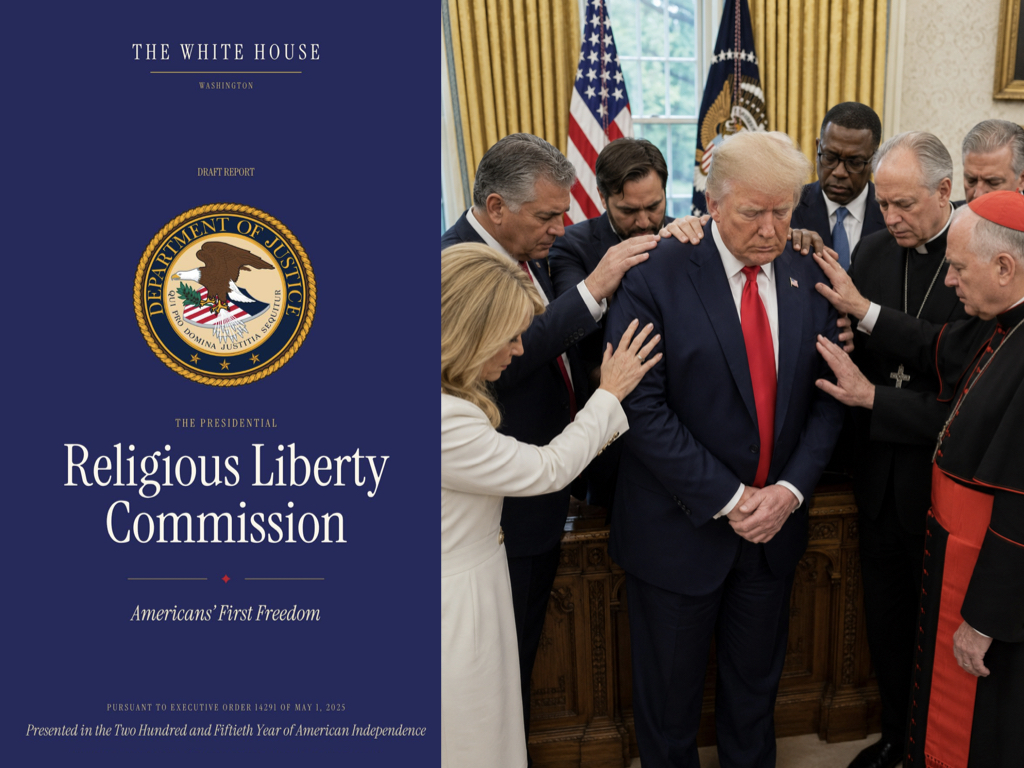
On June 26, 2026, the White House Religious Liberty Commission released its final report, offering recommendations to the Trump administration that supposedly seek to strengthen religious freedom in the United States. President Donald Trump received the report in the Oval Office as members of the commission urged him to provide guidance to federal agencies regarding the issues addressed in the document. [1]
Not surprisingly, the report recommends building bridges between church and state, funding churches with government money, promoting religious instruction in public schools, permitting religious displays on state and government property, opposing efforts to limit cooperation between church and state, calls for the elimination of the Johnson Amendment, which restricts partisan political activity by tax-exempt churches, promotes the “common good,” and cites Abraham Lincoln’s call for Sabbath observance. These recommendations bring us closer to the very scenes portrayed in Revelation 13.
The 224-page document, titled “Draft Report,” published by the Religious Liberty Commission, included the following statements:
• “For much of our nation’s history, religious expression was not viewed as a complication within military life but as a core component of it. From the earliest days of the Continental Army, commanders incorporated faith into the structure of service. George Washington required attendance at ‘divine service.’ Abraham Lincoln called for ‘the orderly observance of the Sabbath.’ During World War II, General Patton ordered 250,000 ‘weather prayer’ cards to be distributed before the Battle of the Bulge, and President Franklin Roosevelt led the nation in prayer as Allied forces landed on the beaches of Normandy.” (Paragaph 3, page 105). [2]
• “Education of their children, including the right to choose a religious education; permitting time for voluntary prayer and religious instruction at public schools; Government displays with religious imagery; and the right of all Americans to freely exercise their faith without fear or Government censorship or retaliation.” (Section 2B, page 8). [2]
• “Americans must know their rights and stand with courage when those rights are challenged. To preserve this freedom, we must build bridges, not walls, between the ‘City of God and the City of Man’ (note: Catholic Augustinian teaching). If we do so, we will pass on a free and prosperous nation to the next generation.”(Paragraphs 1 and 2, page 45). [2]
• “Expand partnerships with faith-based institutions. The Administration should expand partnerships with faith-based institutions by utilizing faith-welcoming language in notices of funding opportunities, training faith groups on the grant application process, and directing grant reviewers to provide equal treatment to faith-based and secular groups” (Paragraph 3, page 63). [2]
• “Guarantee faith-based institutions an equal opportunity to participate on an equal basis in funding opportunities without requiring them to renounce their religious identity; issue guidance that religious discrimination in federal funding programs is unconstitutional” (No. 2, page 14). [2]
• “Support Fruit Partnerships for the Common Good—The Department of Homeland Security should raise awareness of and increase the accessibility of security enhancement grants for houses of worship and non-profit organizations at high risk of attack” (Paragraph 4, p. 203). [2]
• “Repeal the Johnson Amendment, which purports to give the government authority to regulate religious leaders’ sermons and spiritual guidance to their communities” (No. 9, page 23). [2]
• “From the very beginning of the American story, pastors have spoken freely about matters of faith, morals, and public life, providing spiritual enrichment to their congregations and seeking to further the common good in American culture. For generations, this tradition has been a defining feature of our national life” (Paragraph 4, page 123). [2]
It should be noted that this “Draft Report” is intended to serve as a guide for federal agencies, including the Department of Justice. These are some of the recommendations made by the commission—a body comprising federal and state political representatives, legal activists, and prominent Catholic and evangelical religious leaders—which is tasked with defining national policy on religious freedom. Composed of political and religious leaders, this White House Religious Freedom Commission works directly to advise the White House Office of Faith-Based Initiatives and the Department of Justice on U.S. policy matters.
The danger lies not in religious individuals serving in government or in the defense of religious freedom; the heart of the matter is the extent of influence churches and religious institutions should have in shaping our national laws. The problem arises when religious freedom is redefined—shifting from the protection of freedom of conscience to government-backed initiatives that promote religious doctrines in public life.
The First Amendment protects both sides of the issue: the government must not prohibit the free exercise of religion, but it must also not establish religion, meaning it cannot impose the doctrines of the churches. When churches work together inside a federal government, the line between protecting conscience and promoting a religious agenda becomes dangerously obscured.
Whenever church leaders seek governmental power to promote religious practices or encourage religious observance, the door is open for force and coercion. In that context, recommendations that encourage the formal mixing of political power with religious leadership must be rejected. History and prophecy both warn that when church and state unite, liberty of conscience is always placed in danger.
Sources
[1] https://www.youtube.com/live/GARzrQnt4pQ?is=fYqSNRRY0oZDcsBX
[2] https://www.justice.gov/religious-liberty-commission/media/1449896/dl?inline
 0
0 0
0 0
0
The work that has long been neglected must be done. We must repent of our indifference to this work and pray for spiritual enlightenment so that we can clearly see and understand the needs of this work. We have been entrusted with edifying, saving truth. The fate of many people who have not yet received the light depends on our efforts. It is for them that we must proclaim the Three Angels’ Messages, a vitally needed truth. We must seek souls, working with all our diligence to convey to people that which will open the way to eternal life.
The Lord desires that His people will rise up and accomplish the task assigned to them. The responsibility for this does not rest solely with the minister. Every believer must take part in the work of salvation… The Lord is calling today those who have the knowledge of the truth for this time to arise from sleep and become true missionaries in His service. Time is short. God’s work must be done without delay. (Letter 4, February 15, 1911).
Look at all the Pope Leo’s in history and you will find the common thread: a power structure built around church and state United.