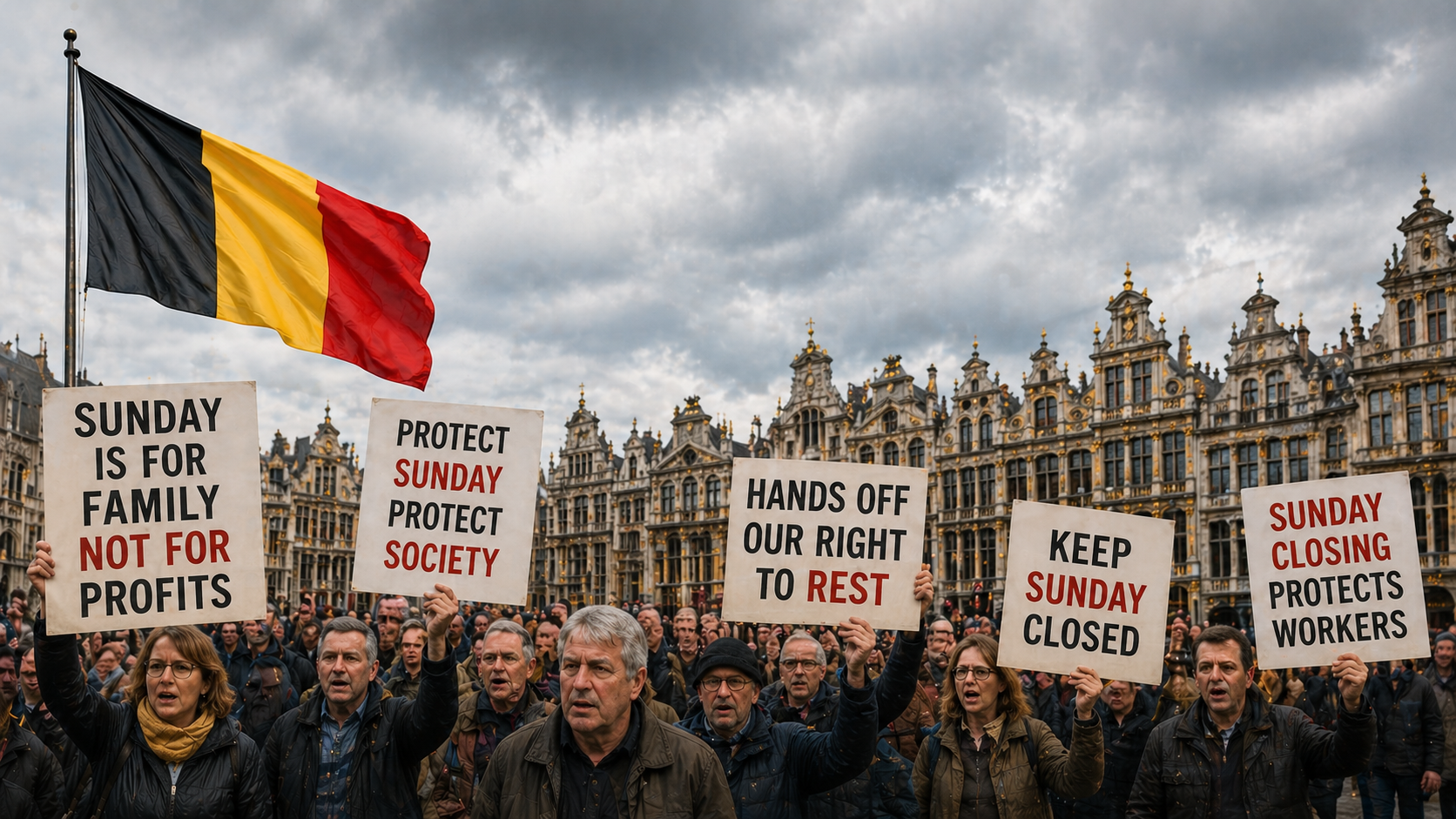
Belgium’s debate over Sunday reopening is being presented as a great injustice that will compromise civilization and radically transform society for the worse. The message conveyed by the local press is that the government’s plan to remove Sunday work restrictions threatens to erode a long-standing social order built around rest, family, worship, and worker rights.
On April 25, 2026, the German-language Belgian news outlet BRF published the following regarding the protests in Belgium over plans to expand Sunday business openings:
• “Shops open seven days a week until 9 p.m. – the unions are furious,” reads the lead story in L’Avenir. The federal government yesterday approved a relaxation of the shop closing law. According to the new regulations, shops will now be allowed to remain open until 9 p.m. Furthermore, the legally mandated day of rest will be abolished. The unions believe this goes too far and are now even considering legal action.” [1]
• “Now, the ‘holy Sunday’ is being sacrificed on the altar of flexibility. It wasn’t ‘holy’ for purely religious reasons anymore; it was almost a civilizational compromise. Sunday was the day we could spend time together, a collective break with family, friends, or neighbors. And that’s exactly what they want to dismantle now. In the name of modernization. This is much more than just a ‘technical’ correction; in practice, it amounts to a profound upheaval.” [1]
The very public debate unfolding in Belgium demonstrates that Sunday continues to occupy a prominent role in discussions involving economics, labor rights, family values, and Christian identity. The fierce reaction from labor unions and various media outlets shows that Sunday is still widely viewed as a day that deserves legal protection.
Public controversies like these are preparing the public to become more receptive to Sunday protections and less resistant to future Sunday legislation. Efforts to preserve Sunday’s special status harmonize with the prophetic expectation that Sunday will ultimately become the central issue where church, state, economics, and liberty of conscience unite in the final conflict over worship and obedience.
Sources
[1] https://brf.be/meinung/presseschau/2070575/
 0
0 0
0 0
0
Tout laisse croire désormais que le Christ est sur le point de revenir ! L’heure est à la vigilence .🙏