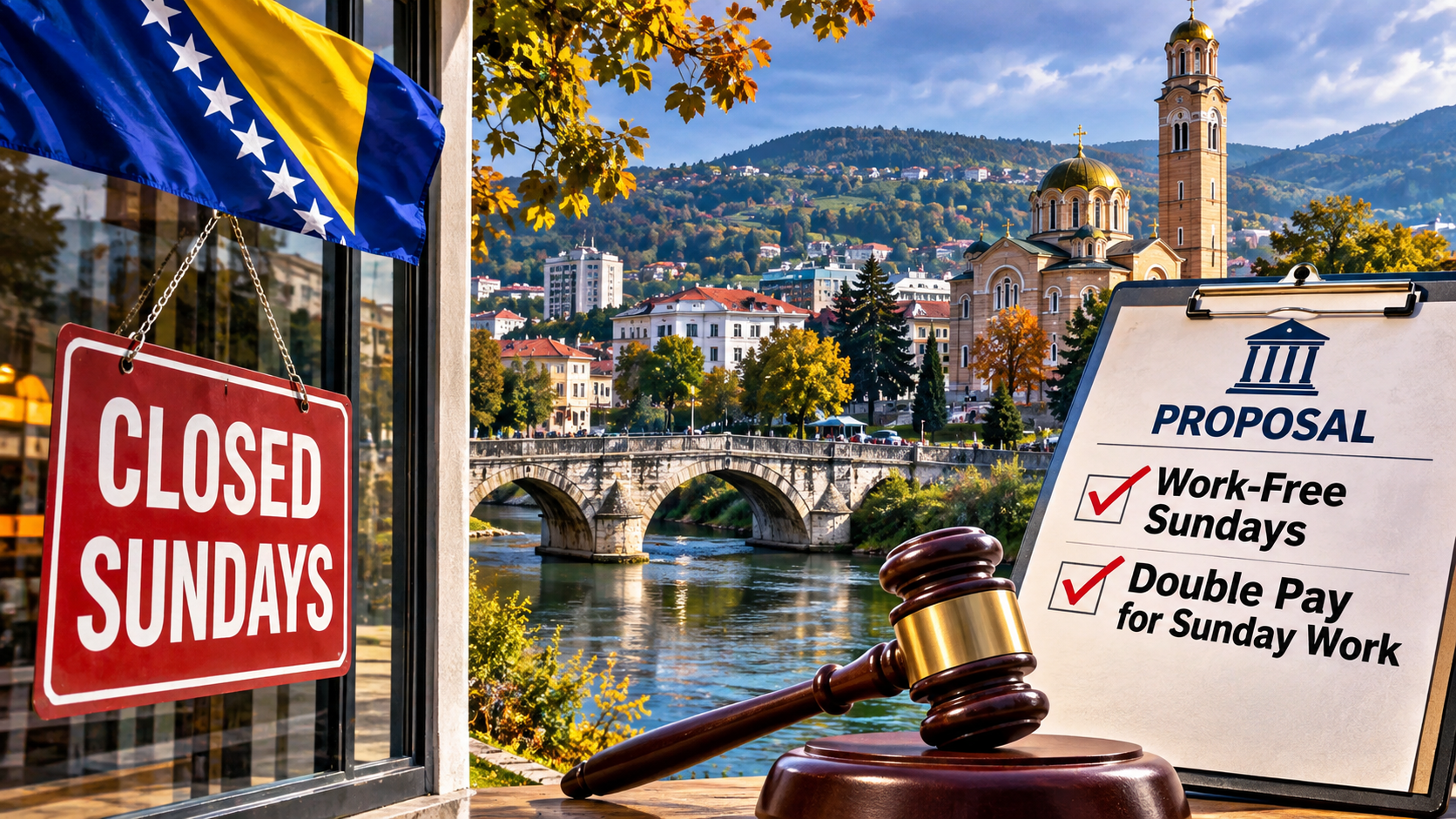
Banja Luka is the second-largest city in Bosnia and Herzegovina and a major economic and cultural center. On November 18, 2026, the Sarajevo Times reported that Banja Luka’s City Assembly would consider a proposal to establish a non-working Sunday for most retail and service businesses. Supporters of the Sunday-closing measure emphasize workers’ rights and family time, seeking to establish Sunday as the day “dedicated” to these priorities. The proposed law would establish Sunday as a legally protected day of rest for society, with the stated aim of providing citizens with a “better quality of life.” The measure also calls for businesses that must operate on Sundays to pay their employees “double their daily wage.”
The Sarajevo Times published the following:
• “A proposal to introduce a non-working Sunday in the city of Banja Luka will once again be presented to the members of the Banja Luka City Assembly.” [1]
• “Proponents emphasize the need to protect workers’ rights and establish a day dedicated to family.” [1]
• “According to the latest draft decision, Sunday would be a non-working day in Banja Luka for most retail and service businesses.” [1]
• Mirna Savic Banjac, City Manager: “We believe this is a measure that will lead to a better quality of life for both workers and individuals; it is simply a matter of habit, and we will not abandon this policy.” [1]
• Ljubo Ninkovic, President of the Banja Luka City Assembly: “Do I feel for the people who have to work on Sundays? Yes, I do. However, the law also stipulates that those who work on Sundays and public holidays are entitled to double their daily wage.” [1]
• “The initiative for non-working Sundays was launched by the Confederation of Trade Unions of Republika Srpska several years ago. Last year, they requested that this issue be regulated by law and that work performed on Sundays be compensated at a significantly higher rate.” [1]
What we are witnessing in Banja Luka is a twofold strategy to discourage all commercial activity on Sunday. First, the proposed measure would legally mandate the closure of most retail and service businesses. Second, businesses that must remain open would face an additional financial burden by being required to pay employees twice their normal daily wage.
This kind of strong-arm economic pressure is designed to discourage Sunday work and make Sunday business operations increasingly costly. Under the banner of protecting workers’ rights, promoting family time, and improving the quality of life, civil authorities are being asked to use legislative and financial pressure to establish Sunday as the common day of rest and worship for all of society.
These coercive tactics create favorable conditions for Sunday religious observance. While the stated justification for this particular proposal is social rather than religious, the end result favors the interests of churches seeking to make Sunday the day free from secular employment and dedicated to worship. Instead of relying on voluntary religious conviction, churches and labor unions will resort to economic pressure and government legislative power (Revelation 13) to elevate Sunday above every other day of the week.
Sources
[1] https://sarajevotimes.com/banja-luka-once-again-facing-a-decision-on-non-working-sundays/?amp=1
 0
 0
 0
Leave a Reply