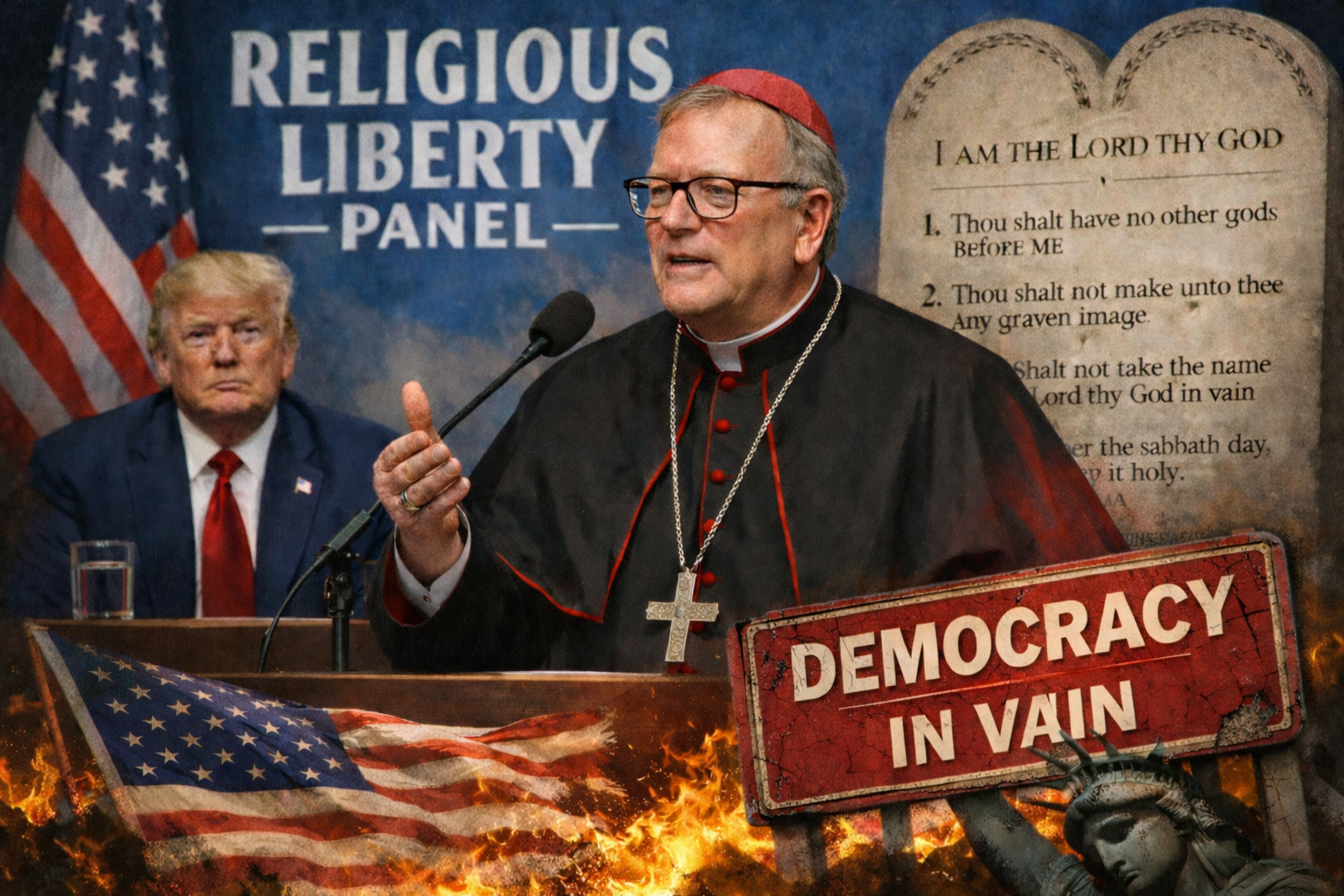
Robert Barron, a Roman Catholic bishop, serves as a member of the Presidential Commission on Religious Liberty, appointed by Donald Trump. This commission serves as a policy advisory initiative housed within the United States Department of Justice, the federal agency responsible for enforcing civil rights and religious liberty laws. By placing the commission within the DOJ, its recommendations can be more directly connected to legal enforcement—enabling the department to investigate violations, pursue litigation, and help shape national policy regarding religious freedom and legal protections for churches.
On April 13, 2026, Bishop Robert Barron participated in a Religious Liberty Commission hearing and expressed the following about the decline of religion, the Ten Commandments, and the danger this poses to civilization:
• “And so to me one of the ironies is as religions have faded more and more in our society and disaffiliation has gained, you know, speed, that’s dangerous for our democracy because people start forgetting. They don’t hear the story of the good Samaritan; they don’t hear about the Ten Commandments; they don’t hear the Beatitudes. That affects our democracy; it’s not just a religious problem, and so the disaffiliation issue is, um, bad for religion, but it’s also bad for democracy, it seems” (Video).
Roman Catholic Bishop Robert Barron’s involvement on a federal commission within the United States Department of Justice raises serious concerns. It challenges the long-standing American principle of the separation of church and state, rooted in the First Amendment. When a sitting Catholic bishop helps shape policy within a government enforcement agency, this is no longer about protecting religious freedom—it places religion in a position to influence civil law. This type of arrangement reflects the very principle warned about in Revelation 13, where religious authority becomes intertwined with the power of the state.
This is a call from a Catholic bishop to the United States Department of Justice to advance and enforce religious interests. How? Robert Barron’s assertion—that the decline of religion and the neglect of the Ten Commandments threaten democracy—advances the argument that religion is necessary for a secure and stable society. This argument has historically been used to justify religious legislation. If religion is seen as essential to national survival, then government intervention to restore it becomes necessary. That is precisely how Sunday laws have been defended in the past—not only on theological grounds but also as a social imperative.
Bishop Barron references the Ten Commandments, but—as Roman Catholics have done from the beginning—they interpret and apply them according to their own traditions. When Rome calls upon government to legislate morality, those efforts often center on Sunday observance and the enactment of Sunday laws.
According to Bible prophecy, the papacy is identified as the power that uses civil power to advance religious authority. When prominent Catholic clergy in America begin shaping U.S. legal policy, their actions should be viewed as a step toward the fulfillment of God’s word. Our nation, which arose as a lamb-like power symbolizing liberty (Revelation 13:11), will eventually speak like a dragon—using the coercive power of the state to enforce religious practices.
 0
0 0
0 0
0
Current events remind me of these statement a lot, the word “speedily” is very sobering.
“Roman Catholic principles will be taken under the care and protection of the state.
This national apostasy will speedily be followed by national ruin.” —RH June 15, 1897.
This panel is not promoting religious liberty—it is undermining it and advancing the very opposite.