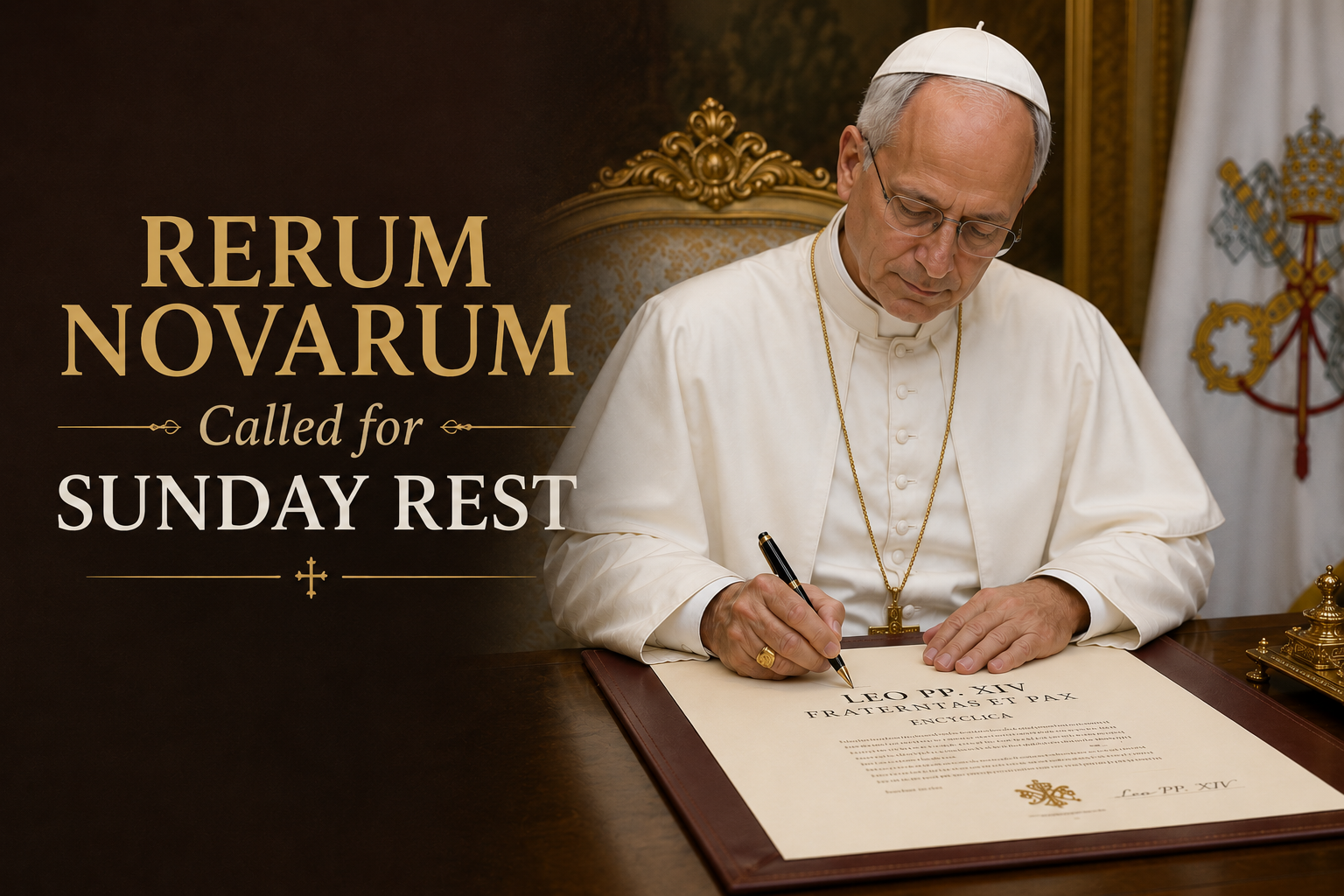
Pope Leo XIV is expected to sign his first encyclical on May 15, 2026, on the anniversary of Rerum Novarum, the landmark papal encyclical that advocated Sunday rest as a benefit for society. The new document, reportedly titled Magnifica Humanitas, is expected to address artificial intelligence, peace, and the future of global order, while drawing upon the legacy of Pope Leo XIII and reaffirming the importance of human dignity in an age of rapid technological and social transformation.
On May 6, 2026, the Catholic news site Zeale published the following regarding Pope Leo XIV’s upcoming papal encyclical:
• “The document carries the provisional working title Magnifica humanitas, or ‘Magnificent Humanity,’ and will address contemporary challenges, including the ethical implications of artificial intelligence (AI), questions of peace, and perceived crises in the international order and global law. The May 15 date would coincide with the publication of Pope Leo XIII’s 1891 encyclical Rerum Novarum, which laid the foundations of modern Catholic social teaching amid the Industrial Revolution.” [1]
Rerum Novarum was signed and published on May 15, 1891, and addressed issues involving labor, workers’ rights, and Sunday rest. In this encyclical, Pope Leo XIII emphasized that society should provide workers with time for rest and worship on Sunday. Now Pope Leo XIV, following in the footsteps of his predecessor, is expected to issue his own encyclical on the anniversary of Rerum Novarum, highlighting the continuing influence of Pope Leo XIII’s legacy.
Rerum Novarum stated the following:
• “Civil laws—laws which, so long as they are just, derive from the law of nature their binding force. The authority of the divine law adds its sanction” (Rerum Novarum, Paragraph 11). [2]
• “Civil society exists for the common good, and hence is concerned with the interests of all in general” (Rerum Novarum, Paragaph 51). [2]
• “Let the working man be urged and led to the worship of God, to the earnest practice of religion, and, among other things, to the keeping holy of Sundays” (Rerum Novarum, Paragraph 57). [2]
• “From this follows the obligation of the cessation from work and labor on Sundays and certain holy days. The rest from labor is not to be understood as mere giving way to idleness; much less must it be an occasion for spending money and for vicious indulgence, as many would have it to be; but it should be rest from labor, hallowed by religion” (Rerum Novarum, Paragraph 41). [2]
• “Rest, combined with religious observances, disposes man to forget for a while the business of his everyday life, to turn his thoughts to things heavenly, and to the worship which he so strictly owes to the eternal Godhead. It is this, above all, which is the reason arid motive of Sunday rest” (Rerum Novarum, Paragraph 41). [2]
If Pope Leo XIV intends to build upon the legacy and principles outlined in Rerum Novarum, then his forthcoming encyclical deserves very close attention. Since Pope Leo XIII’s 1891 encyclical promoted Sunday rest as beneficial for workers and society, we need to carefully watch whether Pope Leo XIV will revisit or expand upon these themes in the context of today’s global crises. As political and religious leaders increasingly speak about the need for securing Sunday for family time, worship, mental health, workers’ rights, and the “common good,” any renewed call for a universal day of rest will further normalize the idea of government-supported Sunday laws.
Sources
 0
0 0
0 0
0
In the book of Ecclesiastes 1:9 Says: There is nothing new under the sun: The thing that hath been , it is that which shall be: and that which is done, there is no new thing under the sun. The history is now repeating itself before our eyes. And now the efforts are in full gear towards making Sunday observance as mandatory by law. Let’s take a look in the year 1888, the U.S senate there was a lobby called the ” National Reform Movement” which was agitating for a National Sunday law and the Seventh day Adventists was just a budding church and that same particular year, God used two young men to present the message of Righteousness by faith they were Alonzo T.Jones and E.J .Waggoner. The 1888 message was rejected by the General Conference leaders at the time led Ole Andre Olsen; George I. Butler; and Arthur Gravenous Daniells. The messenger of the Lord ( Mrs Ellen G. White ) threw her weight in full support behind these two men, and the conference was convened at the State of Minnesota. The two young men preached the message of Righteousness and being sanctified, while the older generation led by the General Conference leaders were opposing the message claiming that it’s only the obedience to the law that could have sanctified individuals and so they believed the righteousness by works. George I.Butler wrote a book called the ”law unto the Galatians ” inorder to counter the book written by A.T .Jones and E.J . Waggoner concerning the message of Righteousness by faith”.
The Minnesota conference was held for one week and the church members ended in disagreements? Another area which was the bone of contention was about the ten horns of Daniel chapter 7,Uriah Smith argued about the Huns or the Alemmani which was supported by E.J. Waggoner; and Alonzo T. Jones. The conference was about the doctrinal differences between the young and old generation. It was about the rightoeousness and legalism. The same year , when the National Reform Movement was calling for sunday law . A.T .Jones and E.J .Waggoner were also opposing the Sunday law and they advocated for the religious liberty. A.T . Jones played a role of co-editor of American Sentinel from ( 1887-1897) and also he be became the President of National Religious Liberty Association. He was a force to be reckoned with for those who attempted to merge the religion and the government. Finally the 1888 message of Righteousness by faith was rejected and the church was back in the religious wilderness after 40 years after emerging from the Great Dissapointment in 1844, just like the ancient Israelites wasted 40 years in the wilderness. Christ would have returned back had the church accepted the message. Now that the Jesuits wanted to have a National Sunday law in America because they wanted to merge the state and religion. They used Cardinal Edward Gibbons of Baltimore. They wanted to christianize America through Sunday legistlation agenda.
In early 1888 ,senator Henry W. Blair Republican from New Hampshire and the Chairman of senate committee on education and labour ,proposed a bill to secure enjoyment of the first day of the week,commonly known as the Lord’s day as a day of rest and to promote it’s observance as the day of religious worship. Jones was elected as the Church’s representative of the church before fifteenth United States congress to testisfy against Blair’s Sunday law bill. Jones embarked on a major tour across the U.S Cities to try lecture the cities on the need and importance of having the religious liberty. He also testified in the senate committee of education and labour to testisfy against the proposal to amend the constitution to christianize the public school system. And finally through God’s grace the Blair’s Sunday law bill was defeated because God of Heaven manifested his power and controlled four winds blowing on the earth to halt , because God’s people were not ready.
In the same year 1888, Pope Leo XIII was the Pontiff at the time when the events were taking shape and after three years later he finally wrote his encyclical to the world famously known as ”RERUM NEVORUM which addressed the importance of having a sunday law as a way of giving workers a day of rest and he also addressed the issue concerning the industrial revolution, the date and month of this date this year 2026, will be of the greatest interest because the students of bible prophecy would like to know whether the issues contained in the encyclical will echo any similarities to to the one written on May ,15 ,2026.