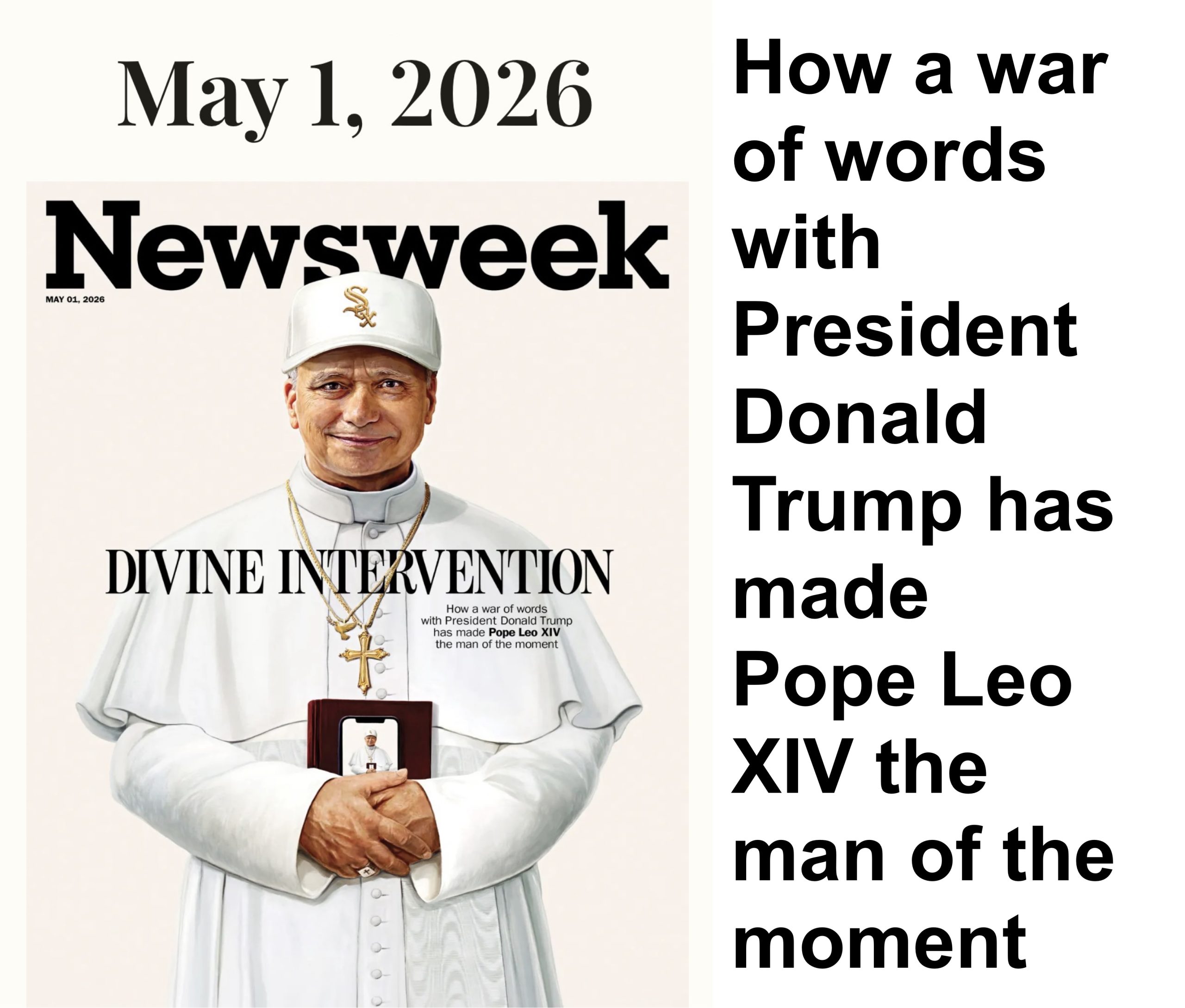
 The May 1, 2026, issue of Newsweek International has been released, reporting that Pope Leo XIV is emerging as the dominant figure on the global stage amid his public clash with President Donald Trump. Newsweek also explains how this confrontation will reshape both politics and faith worldwide and why they believe Pope Leo will ultimately come out on top. The front cover of Newsweek’s May 1, 2026 edition shows a full spread of the Pope with the words “Divine Intervention: How a war of words with President Donald Trump has made Pope Leo XIV the man of the moment.” [1]
The Newsweek article is essentially saying that unless Donald Trump seeks to mend relations with the Pope, it could spell trouble for Republicans in the coming elections, arguing that the papacy is an institution that will outlast any U.S. presidency.
Newsweek published the following:
• “On a Sunday morning in mid-April, Donald Trump picked a fight with him—and found that the quiet pope was not so quiet after all. Leo was clearer than Francis had ever been, and growing more assured by the week.” [2]
• “As Trump’s attacks escalated, so did the range of voices defending Leo, including figures who would not typically align with the Vatican on faith or geopolitics.” [2]
• “No sitting American president has publicly attacked a pope in such explicit personal terms. No American leader in the republic’s history has so directly portrayed papal authority as subordinate to presidential power. Trump’s assault on Pope Leo was something genuinely new in American politics: a Republican president openly confronting the moral authority of the Catholic Church itself.” [2]
• “What began as a clash with the Vatican was becoming something else entirely: a rupture with American Catholics. Catholics make up roughly one-fifth of the U.S. population, according to the Pew Research Center, and are among the country’s most politically consequential religious blocs, with about half identifying as Republicans or Republican-leaning.” [2]
• “For much of American history, American political life was shaped by suspicion of Catholic allegiance … that Catholics posed a threat to American sovereignty because their ultimate loyalty lay with Rome.” [2]
• “The pope he was attacking was born in Chicago, raised in the Midwest and already deeply embedded in American life. When Trump attacked him, he attacked a fellow citizen, one who was far more popular than the man making the attack.” [2]
• “Michele Dillon, dean of the College of Liberal Arts and a professor of sociology at the University of New Hampshire, has spent decades studying the tension between Catholicism and American Protestantism.” [2]
• “Mainline Protestantism used to be the default for American power,” Dillon explained. “That dominance has evaporated. Now you have these two intense fronts of Christianity at play. And what you’re seeing in the Trump administration is a coalition where evangelical fervor provides the populist energy, even as Catholic traditionalism shapes much of the policy leadership.” [2]
• “Leo has an unusual position in American public life. He doesn’t have the same political aspirations or incentives as other leaders. That gives him a unique ability to weigh in morally and prophetically in a way that seems to bother Donald Trump, because he can’t really compete with that,” she said.” [2]
• “But that moral authority does not sit outside politics—it is beginning to shape it. For Republicans, the strategic implications remain unclear. The party’s 2024 coalition relied on working-class voters, including many Hispanic Catholics in battleground states, a delicate balance of economic messaging and cultural conservatism. Catholics also make up a sizable share of voters in several competitive 2026 races, meaning even small shifts could have outsized effects.” [2]
• “As tensions escalate with an increasingly popular Pope, the party faces a choice: continue the feud or attempt to contain the political damage among Catholic voters ahead of November.” [2]
• “The pope himself remains undiminished. What the Trump administration had not anticipated was that it was picking a fight with an institution that had just found, at its helm, another American who could not be intimidated.” [2]
• “The church will outlast this presidency,” Dillon said. “It has a long history of diplomacy, working behind the scenes with the U.S. and maintaining relationships with countries around the world. It’s truly a global institution.” [2]
Historically, the Papacy has often presented itself as an authority that does not submit to political leaders but rather expects kings, emperors, and presidents to show it respect. Rooted in centuries-old doctrine, it has claimed both spiritual and temporal power—teaching that the Pope, as the Vicar of Christ, holds supreme authority that transcends earthly rulers.
The papacy has taught that submission to the Roman Pontiff is absolutely necessary for salvation—a claim most famously expressed by Pope Boniface VIII in the 1302 decree Unam Sanctam. As a result, popes at times asserted their influence by crowning emperors, symbolizing that political power needed to be validated and legitimized by the Church. The Papacy also believed it possessed the authority to depose emperors or—in the case of Donald Trump—that by incurring the Pope’s displeasure, Republicans would lose the Catholic vote they needed to remain in power.
In this light, Newsweek’s May 1, 2026 cover story presents Pope Leo XIV, the Chicago-born pontiff, as “Divine Intervention” and the clear victor in his escalating war of words with President Trump over issues like the Iran conflict, immigration, and moral authority. The magazine warns that unless Trump mends relations and symbolically bows to the papacy’s enduring moral weight, Republicans risk a major rupture with Catholic voters, who comprise about one-fifth of the U.S. population and were key to Trump’s 2024 election victory, especially in the Catholic battleground states.
Newsweek makes the point that Donald Trump’s feud with the Pope is alienating the Catholic Vatican bloc, as no prior U.S. president has so directly challenged a Pope’s authority, while the Church—an institution that outlasts any administration—retains global influence and can shape politics through its global influence. Continuing the clash could fracture the Republican base ahead of 2026 midterms, revealing how rulers and kings in the past who defied the papacy often faced long-term political consequences.
Under the coming reign of the Antichrist, no power—whether earthly rulers or institutions—will be permitted to overshadow the authority, power, and prestige of the Papacy. That authority will bring the entire world into submission—pagans, Protestants, Muslims, Jews, secular nonbelievers, and even kings, presidents, and other earthly rulers.
“And the woman (church) which thou sawest is that great city (Rome), which reigneth over the kings of the earth.” Revelation 17:18.
“The Roman Church is far-reaching in her plans and modes of operation. She is employing every device to extend her influence and increase her power in preparation for a fierce and determined conflict to regain control of the world, to re-establish persecution, and to undo all that Protestantism has done. Catholicism is gaining ground upon every side. See the increasing number of her churches and chapels in Protestant countries. Look at the popularity of her colleges and seminaries in America, so widely patronized by Protestants” (Great Controversy, p. 565).
“The Protestant world will learn what the purposes of Rome really are, only when it is too late to escape the snare. She is silently growing into power. Her doctrines are exerting their influence in legislative halls, in the churches, and in the hearts of men. She is piling up her lofty and massive structures in the secret recesses of which her former persecutions will be repeated. Stealthily and unsuspectedly she is strengthening her forces to further her own ends when the time shall come for her to strike. All that she desires is vantage ground, and this is already being given her. We shall soon see and shall feel what the purpose of the Roman element is. Whoever shall believe and obey the word of God will thereby incur reproach and persecution” (Great Controversy, p. 581).
Sources
[1] https://www.newsweek.com/2026/05/01/issue.html
[2] https://www.newsweek.com/how-war-of-words-donald-trump-making-pope-leo-xiv-11860046
 0
0 0
0 0
0
Leave a Reply