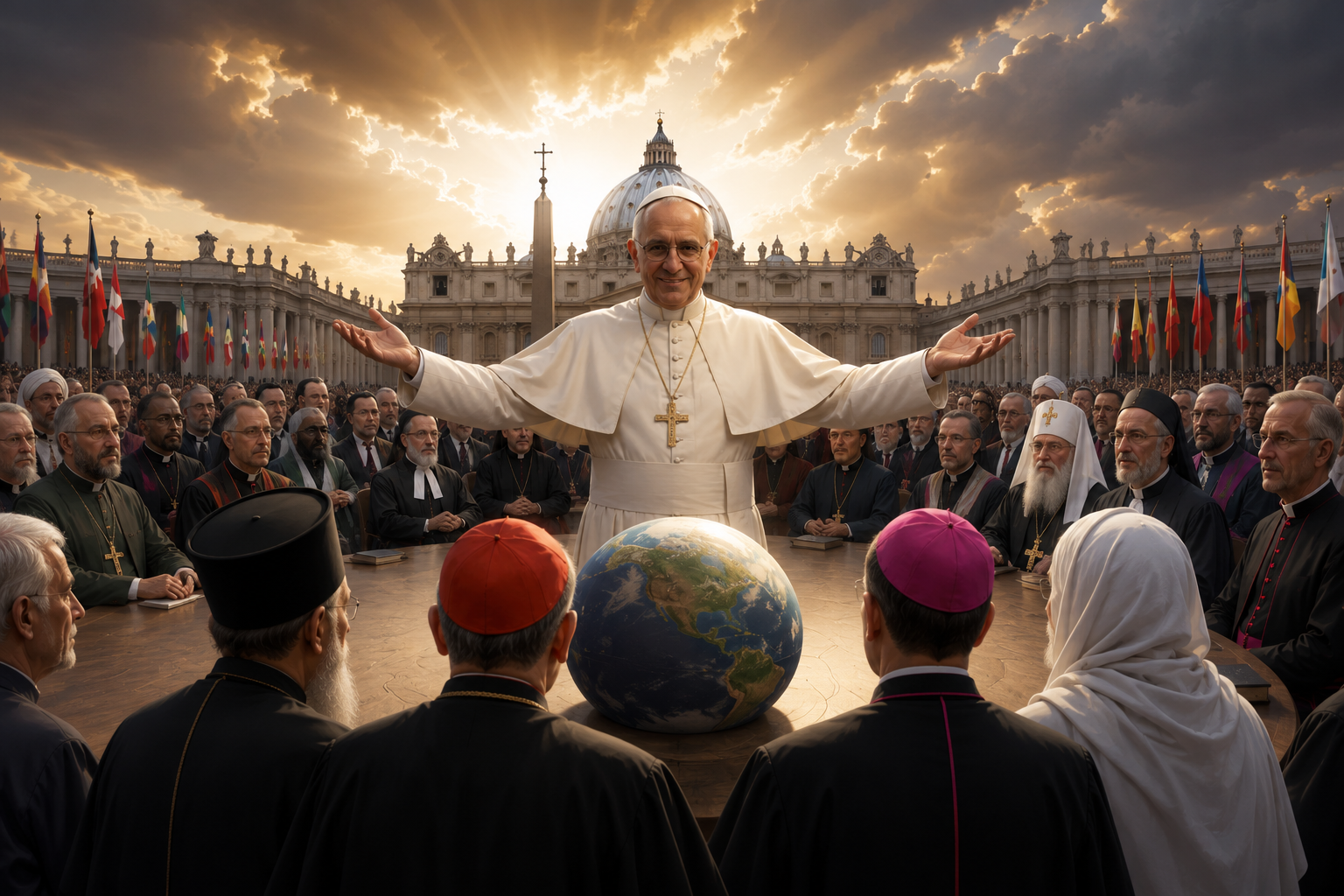
On June 30, 2026, Pope Leo XIV addressed representatives of an ecumenical delegation at the Vatican during the celebration of the Feast of Saints Peter and Paul. In his speech, Pope Leo urged all Christian denominations worldwide to walk together, rediscover a common witness, and unite into a single faith. He claims that this unity is essential for peace and for the very survival of the world. Furthermore, the Pope challenged the churches, arguing that their credibility depends on their joining the ecumenical movement. In other words, those who reject Rome’s call for visible unity are portrayed as obstacles to peace, cooperation, and the common good.
Pope Leo expressed the following during his meeting with the ecumenical delegation:
• “I am very pleased to meet you, following our celebration yesterday of the Solemnity of Saints Peter and Paul, the patron saints of this Church in Rome.” [1]
• “May the journey towards the celebration of the second millennium of the Redemption, in 2033, be undertaken together by all the Christian denominations of the world, rediscovering the gift and the call to be witnesses to the Risen One.” [1]
• “In an age marked by wars and growing polarization, as well as cultural and social divisions, Christians — reconciled amongst themselves and united in their profession of the one faith — are called to be a credible sign of peace, making a decisive contribution to the efforts of all men and women of good will to build peace.” [1]
• “Moreover, in the current situation, it is not only the credibility of the Christian message that is at stake, but the very future of humanity. The need for greater cooperation amongst Christians in the face of today’s challenges — which include peace, the proper use of new technologies and care for creation — stems from the Gospel of Jesus Christ itself.” [1]
This is how Rome seeks to pressure the hand of the churches—by presenting unity as the answer to the world’s crises. But the danger is that once churches accept this reasoning, the plan is for them to begin setting aside their distinctive biblical convictions in order to speak with a single, common voice. In this way, each church’s unique calling is replaced by Rome’s vision of peace and unity. Instead of standing firm on the truths of God’s Word, churches are pressured to unite around a shared creed, mission, and social agenda.
For Bible-believing Christians, this is a serious matter. We were never called to join into a single religious body with Rome, but rather to proclaim the Three Angels’ Messages of Revelation 14. God has raised up a people to call the world back to the commandments of God, the true Bible Sabbath, and to come out from Babylon. Rome’s ecumenical message seeks to gather the churches into one visible body, but Bible prophecy warns that the final religious confederacy will unite the world under a false system of worship. When churches sacrifice present truth for the sake of unity, they lose their prophetic identity and become instruments in advancing Rome’s agenda.
The Pope’s invitation may sound peaceful and harmless, but the prophetic issue is much deeper. The question is whether unity will be based on the Word of God or on human tradition. True biblical unity can never be achieved by ignoring error, downplaying the truth, or promoting apostasy. Any effort to unite the churches while ignoring the great doctrinal divide between Protestants and Roman Catholics is not a return to apostolic Christianity but a return to Rome.
Sources
 0
0 0
0 0
0
More than a century ago, Ellen White described the very movement that would precede the final crisis:
“The wide diversity of belief in the Protestant churches is regarded by many as decisive proof that no effort to secure a forced uniformity can ever be made. But there has been for years, in churches of the Protestant faith, a strong and growing sentiment in favor of a union based upon common points of doctrine. To secure such a union, the discussion of subjects upon which all were not agreed—however important they might be from a Bible standpoint—must necessarily be waived.” The Great Controversy, p. 444.
She then gave one of the clearest prophetic warnings regarding the outcome of this movement:
“When the leading churches of the United States, uniting upon such points of doctrine as are held by them in common, shall influence the state to enforce their decrees and to sustain their institutions, then Protestant America will have formed an image of the Roman hierarchy, and the infliction of civil penalties upon dissenters will inevitably result.” The Great Controversy, p. 445.
The New world religion is underway just as the bible predicted almost 2,000 years ago, the book of Revelation was written about A.D 95,by John the revelator. If we read in the chapters 12 and 17, they clearly show the characteristics of pure woman and harlot woman. A woman in the bible prophecy represents the Church while the harlot woman represents the apostate church. In this case the woman of Revelation chapter 17 ,represents the impure church. This woman was seen holding a golden cup filled with the blood of the saints, and this woman was sitting on the seven hills.
The church that is being brought the view here is none other but the Roman Catholic Church, the Papal Rome is the only church in the world that is both represented in both political and religious order. The Vatican has across the world diplomatic relations with almost 183 nations and sends apostolic nuncio (ambassadors) to the respective countries , so it is a church with a global touch, John the revelator, was shown that this church had been drunk with blood of the saints, we know from history that the Church of Rome is the greatest persecutor the world has ever seen. From the history the records clearly shows that true christians were persecuted and killed for refusing to follow the doctrines and teachings of the Roman church,the Spanish inquisition where 1,000,000 christians lost their lives from the Catholic torturers, St. Bartholomew massacre in France where protestant reformers were killed through burning at the stake .And during the dark ages period from A.D 538-1798, where 100 million christians lost their lives to the Roman Catholic persecutors. It is recorded that Pope Innocent III killed 1,000,000 christians in one day than any Roman emperor that existed.
The Church of Rome has shed more innocent blood than than other institution that has ever existed in the history of mankind, and it’s going to repeat the same again? Just like the way Jews were killed during the Nazi holocaust during third Reich in Hitler’s reign, the same is going to happen in these last days against God’s faithful commandment keeping people. The Roman Church today, has gained most of it’s power it lost during the dark ages, and is now at the forefront making all the efforts bringing closer the churches including all the apostate christians and Muslims together in one ecumenical movement being led by Rome. It’s evident very clear that all the roads are leading to Rome and the headquarters of this New world religion is located at U.A.E where the Abrahamic religions originated from Christianity, Islam, Judaism all trace their roots to Abraham. The ecumenical bandwagon is being led by Pope of Rome as the head and all the religious leaders behind him. In short the prophecy of Revelation 17, clearly speaks of superstate church prophecy which will be led by the World Council of Churches which will lead the world in the false sun god worship. The sungod worship is the worship that is going to be enforced in these last days, and the whole religious world will be in rebellion against the God of heaven. This worship will be in contrast to the three angels messages of Revelation 14:6-12 which directs the people to worship the true God and keep his commandments and keeping the true sabbath observance.
Vatican city is the city in the world that is situated in Rome surrounded with the seven hills. In the Catholic encyclopaedia page 529, it says, the Church of Rome, the Vatican is the only city state church with the seven hills surrounding it , just like John the revelator predicted about 2,000 years ago.
Pope and his Jesuits are prepairing the world for the crisis ahead, in the coming storm? Are you ready to surrender your life to Christ and keep his commandments including his seventh day sabbath, or follow the Pope and his Jesuits by observing the first day of the week Sunday and later get lost and die and lose eternal life? This is the question everybody in this world should ask?
I did a search for, ‘One Voice 27. Ecumenical.’
and it lead me to this article.
This article was written in July and few months later in September, One Voice 27 comes along. A coincidence?
So the “One Voice” for this movement is that which Pope Leo XIV addressed and not that of the 3 Angels Messages it seems.?..
I question that of One Voice 27 as I’m not quite sure what it means.