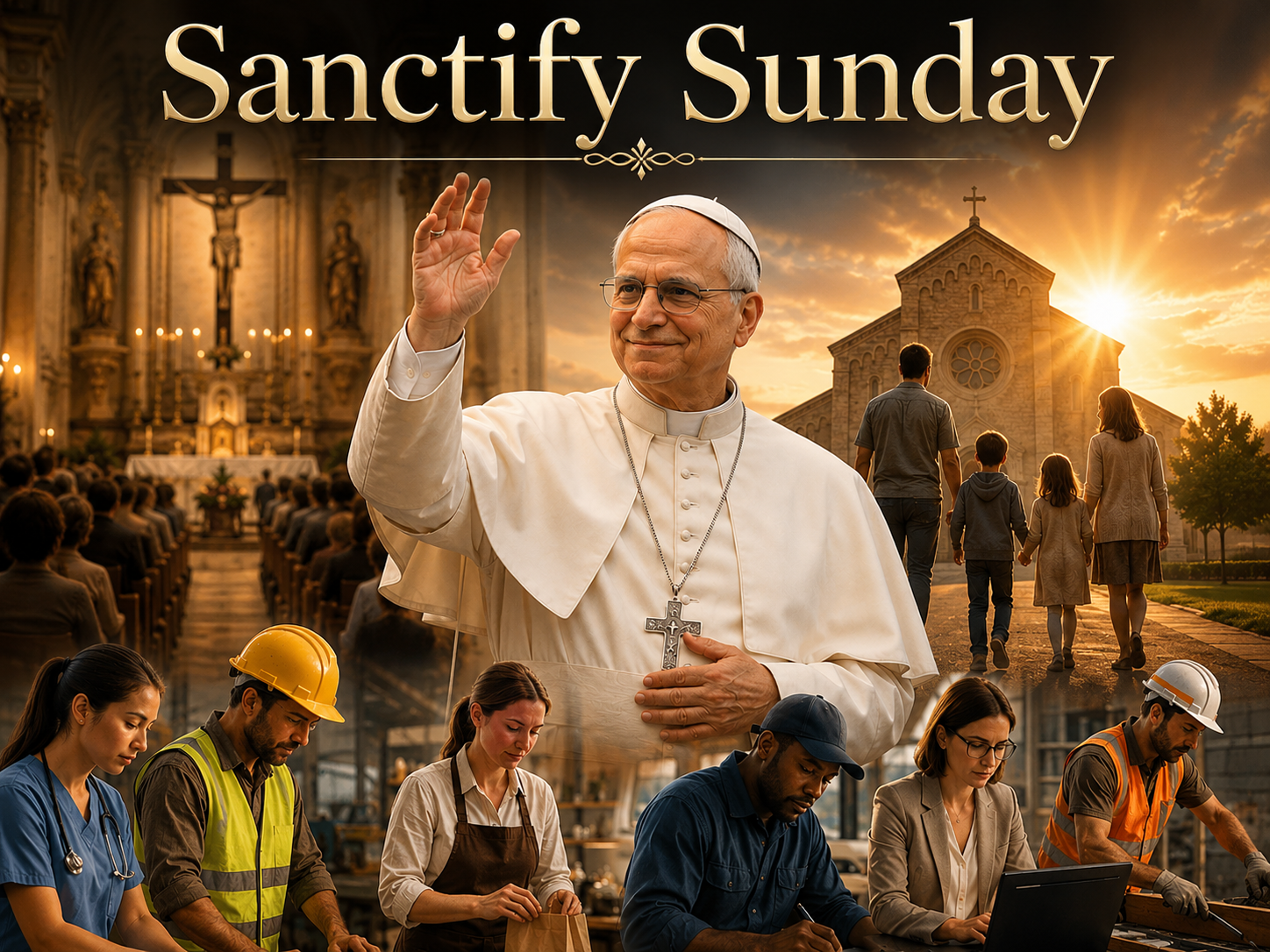
A significant new development has emerged as Pope Leo XIV encourages people to attend church on Sunday by presenting Sunday as sacred time and connecting it with Christ’s authority and His Second Coming. The Pope also calls for the sanctification of Sunday and urges society to provide working conditions that will allow people to participate in Sunday Mass. This papal appeal is particularly significant because it increasingly connects Sunday observance with faithfulness and loyalty to Christ and the Church:
The Vatican Press Office published the following remarks by Pope Leo XIV on August 12, 2026:
• “The Council Fathers considered ‘the foundation and kernel of the whole liturgical year to be Sunday, the original feast day. In various modern languages, its name indicates that it is the ‘dies Domini—the Lord’s day.’ Even in those languages where the reference to the ‘day of the sun’ (Sunday, Sonntag) has prevailed, the link with Christ can be discerned: Christ is the true ‘sun of righteousness’ who enlightens every person!” [1]
• “Saint John Paul II, in the Apostolic Letter Dies Domini (31 May 1998), teaches that Sunday is the day of the Lord, the day of the Church, the day of man and, finally, the day of days. Since Sunday is the weekly Easter, recalling and making present the day upon which Christ rose from the dead, it is also the day which reveals the meaning of time.” [1]
• “Christ’s Second Coming—Sunday foreshadows the last day, the day of the Parousia, when we shall all rise again.” [1]
• “To sanctify Sunday, it is fundamental to celebrate the Eucharist. Listening to the Word and partaking of the Body of Christ entail, according to the Council Fathers, the coming together in unum, that is, the joyful gathering of the faithful. In this assembly, the Christian community makes visible its communion with the Lord and bears witness to its belonging to Christ and its fidelity to the Church.” [1]
•, “In this regard, I urge everyone to seek the best possible conditions so that even those who are unable to take time off work on Sundays may take part in Holy Mass.” [1]
Ellen G. White describes the progression of how Sunday will eventually unite religious and political powers.
“Yet this very class put forth the claim that the fast-spreading corruption is largely attributable to the desecration of the so-called “Christian Sabbath,” and that the enforcement of Sunday observance would greatly improve the morals of society” (Great Controversy, p. 587).
“When the leading churches of the United States, uniting upon such points of doctrine as are held by them in common, shall influence the State to enforce their decrees and to sustain their institutions, then Protestant America will have formed an image of the Roman hierarchy, and the infliction of civil penalties upon dissenters will inevitably result” (Great Controversy, p. 445).
Today, Sunday is being exalted as the Lord’s Day and presented as sacred time. Sunday worship is being portrayed as essential to Christian life, Sunday rest is being promoted as beneficial for workers and families, and calls are increasingly being made to protect the day. The next step will ultimately be the civil enforcement of Sunday observance, bringing it into direct conflict with the seventh-day Sabbath.
While Rome is calling the world to sanctify Sunday, the Three Angels’ Messages are calling the world back to the Creator and His commandments, including the call to “worship him that made heaven, and earth, and the sea, and the fountains of waters” (Revelation 14:7)—a direct quote from the fourth commandment and a call to honor the true seventh-day Sabbath established by God at Creation.
Sources
[1] https://press.vatican.va/content/salastampa/en/bollettino/pubblico/2026/08/12/260812a.html
 0
0 0
0 0
0
It is written:
“12 And the LORD spake unto Moses, saying,
13 Speak thou also unto the children of Israel, saying, Verily my sabbaths ye shall keep: for it is a sign between me and you throughout your generations; that ye may know that I am the LORD that doth sanctify you.
14 Ye shall keep the sabbath therefore; for it is holy unto you: every one that defileth it shall surely be put to death: for whosoever doeth any work therein, that soul shall be cut off from among his people.
15 Six days may work be done; but in the seventh is the sabbath of rest, holy to the LORD: whosoever doeth any work in the sabbath day, he shall surely be put to death.
16 Wherefore the children of Israel shall keep the sabbath, to observe the sabbath throughout their generations, for a perpetual covenant.
17 It is a sign between me and the children of Israel for ever: for in six days the LORD made heaven and earth, and on the seventh day he rested, and was refreshed. ”
Exodus 31:12-17 KJV
“Moreover also I gave them my sabbaths, to be a sign between me and them, that they might know that I am the LORD that sanctify them. ”
Ezekiel 20:12 KJV7
“8 Remember the sabbath day, to keep it holy.
9 Six days shalt thou labour, and do all thy work:
10 But the seventh day is the sabbath of the LORD thy God: in it thou shalt not do any work, thou, nor thy son, nor thy daughter, thy manservant, nor thy maidservant, nor thy cattle, nor thy stranger that is within thy gates:
11 For in six days the LORD made heaven and earth, the sea, and all that in them is, and rested the seventh day: wherefore the LORD blessed the sabbath day, and hallowed it. ”
Exodus 20:8-11 KJV
Today, Rome is being viewed by the world as the moral compass in the religious matters and the social order. Sunday as we know is the child of the Papacy. Pope Leo XIV, is making an appeal for the whole world to sanctify Sunday as the day of rest.
This is not the first time the Papacy is making such an appeal. Back in 1998, his predecessor Pope John Paul II , also wrote in his encyclical letter called “Dies domini” which urged the christian world to sanctify Sunday as the day of rest and worship. John Paul successor Pope Benedict XIV, also made the same appeal to honour Sunday during his papal reign of eight years until his resignation in 2013. Pope Francis renewed this appeal in his famous encyclical letter called Laudato Si which he wrote on November ,2015, which put so much emphasis on the need to observe Sunday.
Now, we have Pope Leo XIV,now he’s making the same appeal to the world, calling for Sunday to be kept holy, and that every believer must partake in the eucharist. Well, this call as we know is in direct contrast to the three angels messages of (Revelation 14:6-12 ). The three angels messages is the message of these last days , calling every one to worship God and keep his commandments including the seventh day sabbath. This is world wide apostacy, being led by man of sin, who exalteth himself above everything that is called God and to be worshipped. Remember, Satan’s aim he wanted to be worshipped as god,and because he never got the position in heaven ,he established a false church here in earth inorder to seek worship, remember the seven churches of asia minor , he established his church in pergamum on the hill, he established a title called antipas or Papa (Father) who later came to be known as the ” Bishop of Rome”. Those who worship Sunday are worshiping the devil indirectly, through the representation method through his agent Bishop of Rome.