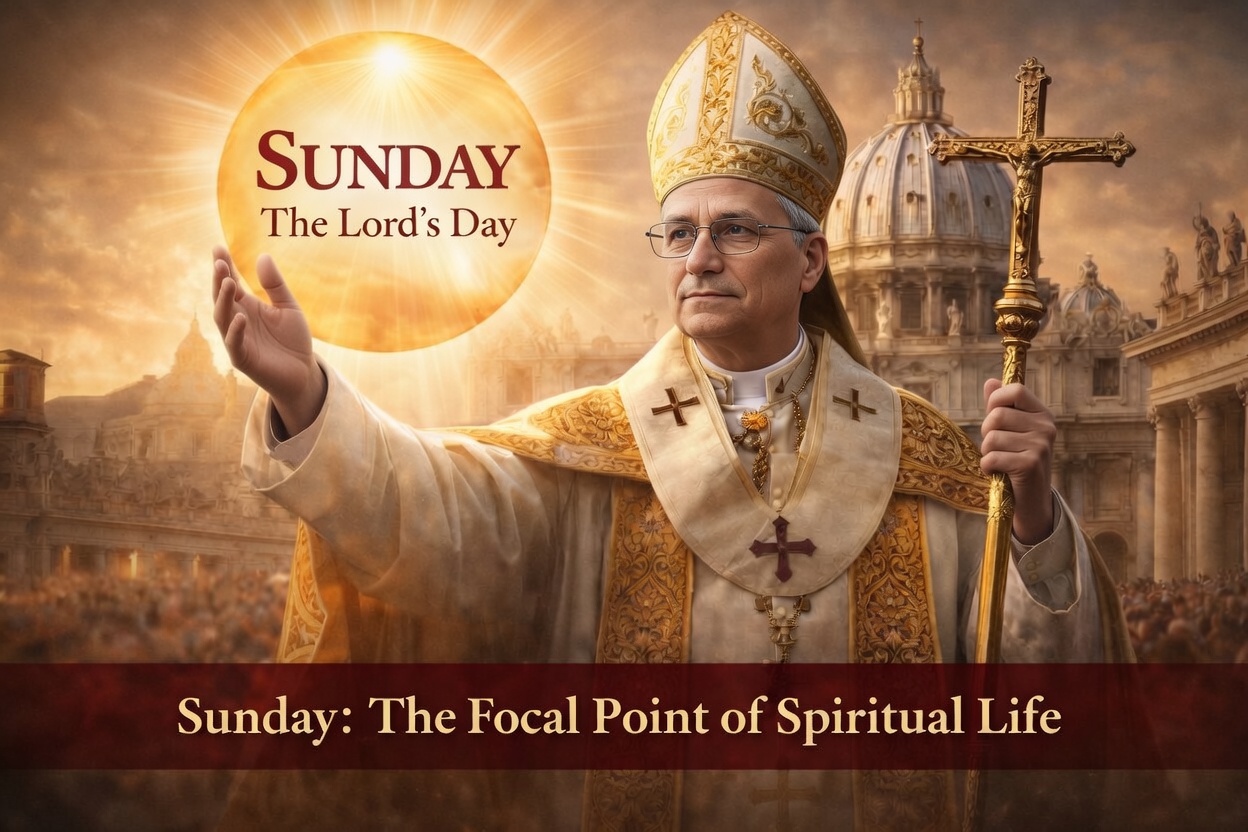
On Sunday, April 12, 2026, Pope Leo XIV addressed the faithful gathered in St. Peter’s Square, declaring Sunday to be the indispensable day of worship for Christians. In doing so, he reaffirmed one of the core pillars of Catholic theology: that Sunday stands as the focal point of spiritual life for all believers.
The Holy See Press Office published the following statement made by Pope Leo:
• “Dear brothers and sisters, happy Sunday and happy Easter once again!” [1]
• “The Sunday Eucharist is indispensable to the Christian life. Tomorrow I will depart for my apostolic journey to Africa. Some of the martyrs of the early African Church, particularly the Martyrs of Abitene, have left us a beautiful testimony in this regard. When offered the chance to save their lives by renouncing the celebration of the Eucharist, they replied that they could not live without celebrating the Lord’s Day. It is there that our faith grows and is strengthened. It is there that our efforts, though limited, are united by God’s grace to the actions of the members of a single body — the Body of Christ — for the accomplishment of a single great plan of salvation that embraces all humanity.” [1]
• “It is through the Eucharist that our hands become the hands of the Risen One, giving witness to his presence, mercy and peace. The signs of work, sacrifice, illness and the passing of the years are often etched into our hands, just as they are in the tenderness of a caress, a handshake, or a gesture of charity.” [1]
When the Pope speaks of the “Sunday Eucharist” as indispensable, he is directly linking the Christian life to participation in the Sunday Eucharistic mass. By claiming that early Christian martyrs could not live without celebrating the Lord’s Day and that they chose death rather than renounce Sunday worship, the Pope is using this argument to reinforce the false notion that, in some way, the Christian faith is inseparable from Sunday observance.
The Pope’s claim places human tradition above the Word of God. The Scriptures—and not the teachings of the Church—define true worship; likewise, the Bible consistently identifies the seventh day—and not Sunday—as the Lord’s holy day (Exodus 20:8–11; Mark 2:27–28). The Martyrs of Abitene, cited by Pope Leo, may have died sincerely embracing the tradition of Sunday; however, sincerity does not establish truth. Faithfulness is defined by obedience to the Word of God and not by embracing traditions that emerged 300 years after the apostolic era.
In the year 365 A.D., the Catholic Church, through the Council of Laodicea, declared what is commonly cited as Canon 29, which directly addressed the observance of the Sabbath. This canon instructed that Christians were not to “Judaize” by resting on the seventh day—the Sabbath—but rather, on the contrary, were to work on that day and honor Sunday as the Lord’s Day. This decree formally declared the observance of the seventh day as anathema (cursed) and elevated Sunday as the preferred day of worship.
Shortly thereafter, throughout Christian history, the Roman Catholic Church persecuted groups of Christians who observed the seventh-day Sabbath—Saturday—as a biblical commandment, viewing their refusal to fully embrace Sunday as the primary day of rest and worship as defiance of Rome’s authority. Those who chose to remain loyal to Scripture rather than ecclesiastical tradition were often marginalized, branded as heretics, and subjected to various forms of punishment.
Such persecution is the result whenever the church unites with the state to advance its teachings. Such a union leads to the suppression and eventual persecution of all dissenting voices. History shows that Rome has repeatedly suppressed biblical teachings while promoting a different day of rest—Sunday—elevating human tradition above the clear command of Scripture. When religious authority is backed by civil power, matters of faith become subject to coercion, placing those who remain faithful to biblical truth out of favor with the prevailing popular beliefs.
Sources
[1] https://www.vatican.va/content/leo-xiv/en/angelus/2026/documents/20260412-regina-caeli.html
 0
0 0
0 0
0
The term ”Eucharist” is being used by the Roman Catholic Church when partaking the bread and wine which symbolizes the body of Christ. It’s point worthy to note that the transubstiation is the doctrine taught in the Catholic church which the believers are deceived that the priest is capable of transforming to change the body of Christ into bread and wine. But the scriptures teaches otherwise,in the I Corinthians 5:7 Paul says; for we have a passover lamb that has been sacrificed. Therefore let’s keep the festival not with old bread leavened with malice and wickedness, but with unleavened bread with sincererity and truth. The term Eucharist was used by Justin Martyr in A.D 155, that’s when the Eucharist began to be celebrated. On the day of the sun, all those who live in the cities or in the fields gather in the same place. When the prayer is finished bread , wine water, are brought. We all meet on the first day the day of the (SUN) on the day which God transformed the darkness and matter to create the world and because Jesus Christ the saviour rose from the dead on that day.
So, the Eucharist and Sunday worship are the most ordinances in the Roman Church. So, when the Sunday law wil be implemented it will be compulsory for every Christian to attend the mass and partake the Eucharist. The cathechism of the Catholic Church speaking of the early christians quotes Acts 2:42. They devoted themselves to the Apostles teaching and fellowship to the breaking of bread and prayers day by day attending the temple together and breaking bread in theirhomes they partook of food with glad and generous hearts. The early christian martyrs could not have observed the first day of the week, this is because they had learned the obligation of the fourth commandment in regard about the sabbath. That’s why Rome thoroght the centuries has continued to hate any sect of christians that observes the seventh day sabbath.
Historical records show that the Roman Catholic Church did persecute sabbath keepers, particularly during the dark ages. Rome saw sabbath observance as heresy and challenge to it’s authority. The Waldenses a christian sect that arose in the 12 th century were known to observe the sabbath and were susequently persecuted by the Roman Catholic Church. Other groups that faced persecution were Cathari and Petrobrussians. The Church of Rome viewed these groups as threat to it’s power and authority and they sought to eliminate them through persecution and violence. Other groups who faced persecution were Albingenses, and many others. Overall, the historical records shows Roman Catholic Church persecute sabbath keepers , and that this persecution was significant of church’s efforts to maintain power and it’s great authority.