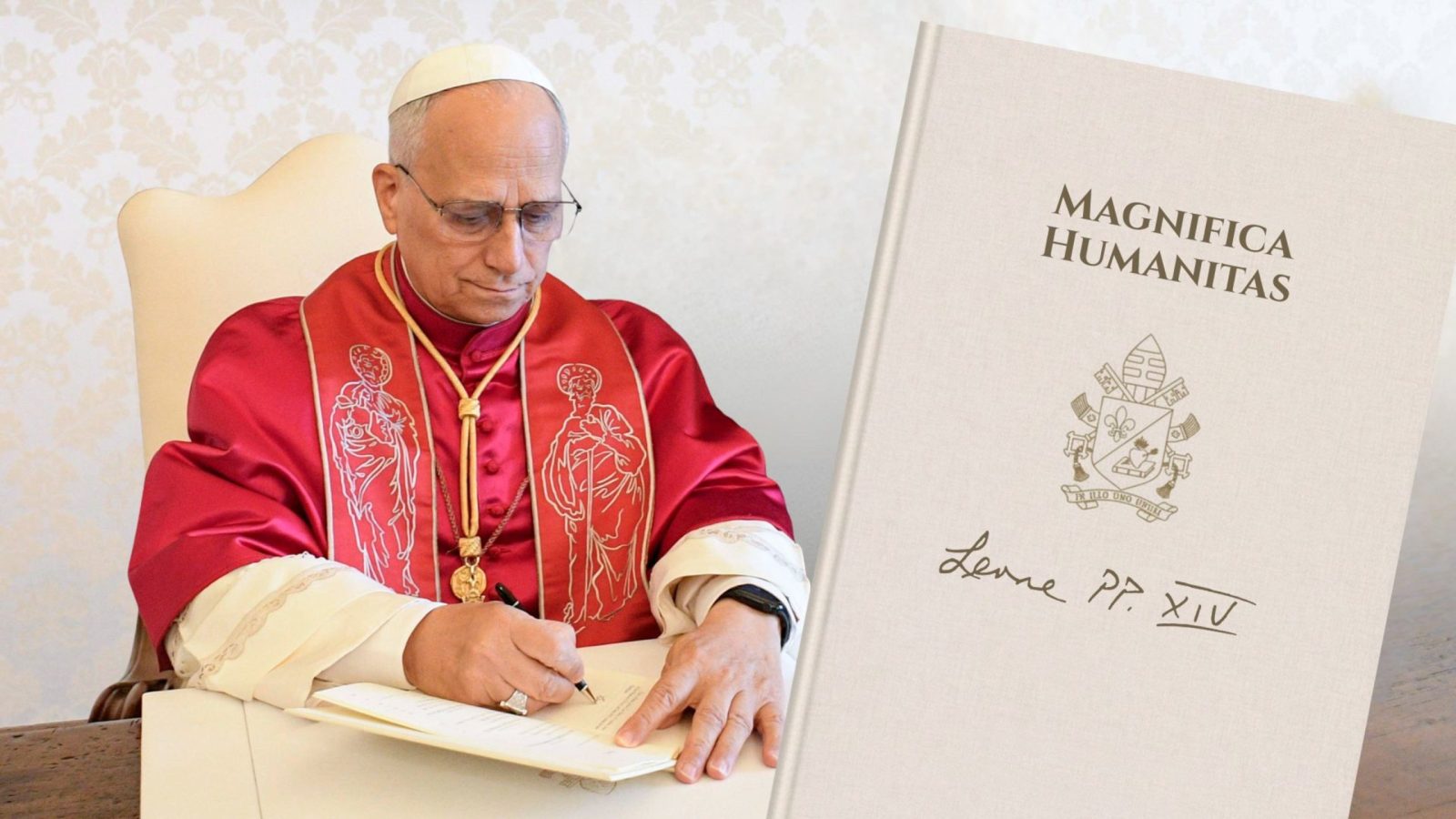
On May 25, 2026, the Vatican released Magnifica Humanitas, a landmark encyclical by Pope Leo XIV addressing issues such as government, the common good, labor, fraternity, and even rest. Although the encyclical does not specifically mention Sunday, it does not have to. The document references Rerum Novarum 13 times and Pope Leo XIII 12 times in the actual text, showing that it is a continuation of his work. In other words, Leo XIV is building upon the foundation laid by his predecessor, who did in fact call upon governments to ensure Sunday as the day of rest.
The only difference this time is that in Magnifica Humanitas, Leo XIV re-elevates the call for governments to pass labor laws that ensure a proper balance between work and rest. In addition, the new encyclical highlights the role of the church in guiding, directing, and even instructing the state to promote the “common good”—Catholic social teaching. It also calls upon civil authorities to regulate and assume more control over free speech in digital media.
The Pope expressed the following in his new encyclical:
• Magnifica Humanitas #3 – “Today, the Social Doctrine of the Church is a legacy of wisdom, where we find principles for thought, criteria for discernment and judgment, and concrete guidelines for action.” [1]
• Magnifica Humanitas #169 – “Labor policies need to promote continuity and the quality of employment, countering insecurity as a normal condition of life and encouraging realistic paths for entry into the workforce and for professional growth. Second, measures are needed to ensure a healthy way of living, for without a proper balance between work, leisure and rest, families are weakened and young people struggle to develop a sense of responsibility.” [1]
• Magnifica Humanitas #63 – “It is the State’s responsibility to ensure cohesion, unity and the proper organization of civil society, so that the common good can be pursued with everyone’s contribution … When politics abandons a long-term perspective and reduces itself to short-term calculations or sterile polarizations, then the language of the common good loses credibility, and, at the same time, social inequalities and divisions grow.” [1]
• Magnifica Humanitas #32 – “In the tragic context of the Second World War … the Pope proposed a dialogue with society based on an appeal to natural law understood as a set of objective principles that precede the interests of individuals and States, and which must regulate both the internal life of nations and their mutual relations.” [1]
• Magnifica Humanitas #95 – “Here, we must recognize another crucial aspect, which I have noted earlier. In many cases within the digital context, control over platforms, infrastructure, data and computing power does not rest with States, but with major economic and technological actors. These entities effectively set the conditions for access, determine the rules of visibility and shape the very possibilities for participation. When such power is concentrated in the hands of a few, it tends to become opaque and evade public oversight, increasing the risk of distorted forms of development that give rise to new dependencies, exclusions, manipulations and inequalities.” [1]
• Magnifica Humanitas #72 – “States and transnational institutions are called to ensure fair rules … When it comes to decisions regarding economic flows and digital platforms, as well as the governance of data and algorithms, we cannot allow a handful of actors to dictate these processes on their own; instead, we must build forms of cooperation that respect the various levels of the global community and make them jointly responsible for the common good.” [1]
Pope Leo XIV’s Magnifica Humanitas is prophetically significant because it continues the Papacy’s long-standing effort to shape civil society through religiously influenced social policy. While the encyclical never explicitly mentions Sunday observance, it repeatedly builds upon Rerum Novarum and the legacy of Pope Leo XIII, who openly advocated for government protection of Sunday rest. Throughout history, Rome has consistently pushed for rest legislation as necessary for family, worker protection, social harmony, and the “common good.”
This very same theme now resurfaces in modern language, adapted to the social and economic concerns of the present day. The call to legislate rest for workers’ rights has now been articulated in a new Papal encyclical that will, in all likelihood, resonate throughout the world—much as Pope Francis’s encyclical on climate change also exerted great influence on a global level. The issue is not simply about rest, because rest is a biblical principle ordained by God, but rather who has the authority to define which day is sacred and whether governments should enforce religious observance through civil law.
Equally significant is the encyclical’s repeated appeal for the state to regulate society according to Catholic social teaching. The final crisis described in Revelation will involve an attempt to elevate human religious authority above the commandments of God and upon society. When church leaders call upon governments to pursue the “common good” through coordinated social policy, history has repeatedly shown that individual liberty of conscience is often sacrificed to the will of the majority.
The sections in Magnifica Humanitas dealing with digital media and platform control are also prophetically relevant. Pope Leo XIV warns about tech companies having too much freedom to operate their digital platforms without government oversight and calls for stronger controls and regulation. Increased calls for this type of centralized control over speech and digital participation raise concerns about restricting dissenting voices—especially religious minorities whose beliefs may be viewed as unpopular or contrary to those in positions of power. The Papacy’s growing influence over policies involving labor, economics, social order, digital media, and governance reflects the prophetic scenario described in Scripture in which church and state unite in the final scenes of earth’s history to impose coercive and false worship.
Sources
[1] https://www.vatican.va/content/leo-xiv/en/encyclicals/documents/20260515-magnifica-humanitas.html
 0
0 0
0 0
0
Approximately 9 months before Magnifica Humanitas was released, Chapters Thirteen and Fourteen of my new unpublished book, Last Call, there was enough evidence to identify Magnifica Humanitas as Rerum Novarum 2.0. Last Call, in Chapter Thirteen, provides a history leading up to Rerum Novarum, including key players of the Nineteenth Century Industrial Revolution. Then, in Chapter Fourteen, Last Call, provides the Twenty-first Century AI Revolution, including key players — Senator Josh Hawley, Sean O’Brien, Jonathan Berry, “Cowboy Catholic” Kevin Roberts, and others (throughout the book), which, today, May 25, 2026, produced Rerum Novarum 2.0, Magnifica Humanitas. Nothing new! Of course not!! “No new thing under the sun…God requireth that which is past.” In other words, History repeats itself!